The Cash Leg · Essay 03 of 08 · Euro area · 7 September 2026
The Centralising Operator
How the Eurosystem decided to run the job itself
London is still holding auditions. Switzerland already has a book. Frankfurt is doing something else: it is opening a service, this month, and putting the Eurosystem in the operator’s chair. The fee at the door is the tell.
On 21 September 2026 the European Central Bank switches on Project Pontes. The first thing a new participant will notice is the invoice. Not a transaction fee, not a monthly subscription, just a single onboarding charge: €15,000 for a market DLT platform operator, €2,500 for a market participant, and nothing else. No fixed monthly charges. No settlement fees. The enhanced product planned for 2028 is expected to look like a normal utility, with periodic and transaction prices. The opening phase does not.12
The ECB has said the pricing is designed to support early adoption. Read that sentence as policy, not as boilerplate. A central bank cutting the cost of entry to near zero for the first years of a settlement service is demand-pull. It wants the market inside the building, and it does not want price to be the reason anyone stays out.
That is the opposite posture to Threadneedle Street. Where London spent 2026 running a non-binding audition with no promises attached, Frankfurt is opening the doors cheaply and asking the market to walk in. The date is not incidental either. 21 September sits in the same month as the second phase of Korea’s Project Hangang which is the live deposit-token flows across nine banks, including programmed public payments. Three institutions, three continents, one month, three theories of who should run the cash leg.3
The constitution and the first statute
The Eurosystem’s work runs on two tracks, and the names are not decoration. Pontes is Latin for bridges. Appia is the road. Pontes, approved by the Governing Council in 2025, is the near-term service: a way to get tokenised settlement into production on infrastructure the Eurosystem already governs. Appia is the long document as in a blueprint for an integrated European tokenised ecosystem, covering interoperability, standards, monetary-policy operations, collateral and law, aimed at 2028.4
The cleanest way to read the pair is constitutional. Appia is the text that will eventually set the enduring rules. Pontes is the first statute passed under a constitution that does not yet formally exist: live, binding, built so the later document has something real to describe. The Eurosystem did not wait for the constitution before legislating. It legislated in production and will let the constitution catch up. That sequencing is aggressive for an institution often accused of caution. It is also the opposite of the Bank of England, whose Synchronisation Lab remains explicitly non-binding and whose live target is still 2028.
At launch Pontes offers two settlement paths. One is a cash token: a tokenised representation of central-bank money on a Eurosystem DLT. The other is a trigger: an instruction on a market DLT starts a conventional payment through T2, the existing real-time gross settlement system. In this first phase, legal finality on the trigger path stays in T2. Tokenised balances are not meant to sit overnight on the Eurosystem ledger. Either route, the money that extinguishes the trade is central-bank money, and not a commercial-bank token or a stablecoin.5
Hold those two paths. Everything else about TARGET plumbing can wait. The argument of this essay lives in the ownership of the doors, not in the message formats.
Outsourcing discovery versus installing the operator
Here is the contrast this series has been building since the first essay, and it should be stated without softness. The Bank of England is outsourcing the discovery of who the synchronisation operator should be. The Eurosystem is installing itself as the operator.
London put eighteen outside firms into a simulated RT2 and asked them to compete for a role the Bank has not promised. If there is a winner, it will be a private company or a consortium, certified by the Bank, not owned by it. Frankfurt has made the other choice. Pontes is not a bake-off for the right to sit between market ledgers and central-bank money. The Eurosystem is that layer from day one. It operates the cash-token ledger. It processes the T2 triggers. National central banks certify their own communities. There is no operator vacancy of the London kind, because the seat is already taken.
| What goes live first | A lab, 2026 | Production wCBDC, Dec 2023 | A service, 21 Sep 2026 |
|---|---|---|---|
| Who runs the link | Not decided | SNB money + SIX / BX pipes | The Eurosystem |
| Private contest? | Yes - 18 firms | No - incumbent FMI | No - first four DLT venues plug in |
| Named 2028 object | Live capability | Still a pilot, on purpose | Appia blueprint + 24/7 Pontes |
This is not a difference of emphasis. Two large central banks looked at the same problem (how tokenised assets settle against the safest money) and wrote opposite governance answers. One outsources the choke-point to whoever proves capable. The other keeps it inside the institution bound to the treaties and to price stability. Whatever else separates the projects technically sits downstream of that fork.
The evidence before the building
None of this started from a slide. Between May and November 2024 the Eurosystem ran exploratory work with 64 participants from nine countries (banks, CSDs, DLT operators, four central banks) across more than fifty trials and experiments. There were more than 200 real transactions. €1.59 billion settled in central-bank money. Cipollone has used that file as the warrant for everything after: access to central-bank money was not an optional extra for tokenised finance. It was a condition for the thing to develop safely at scale.6
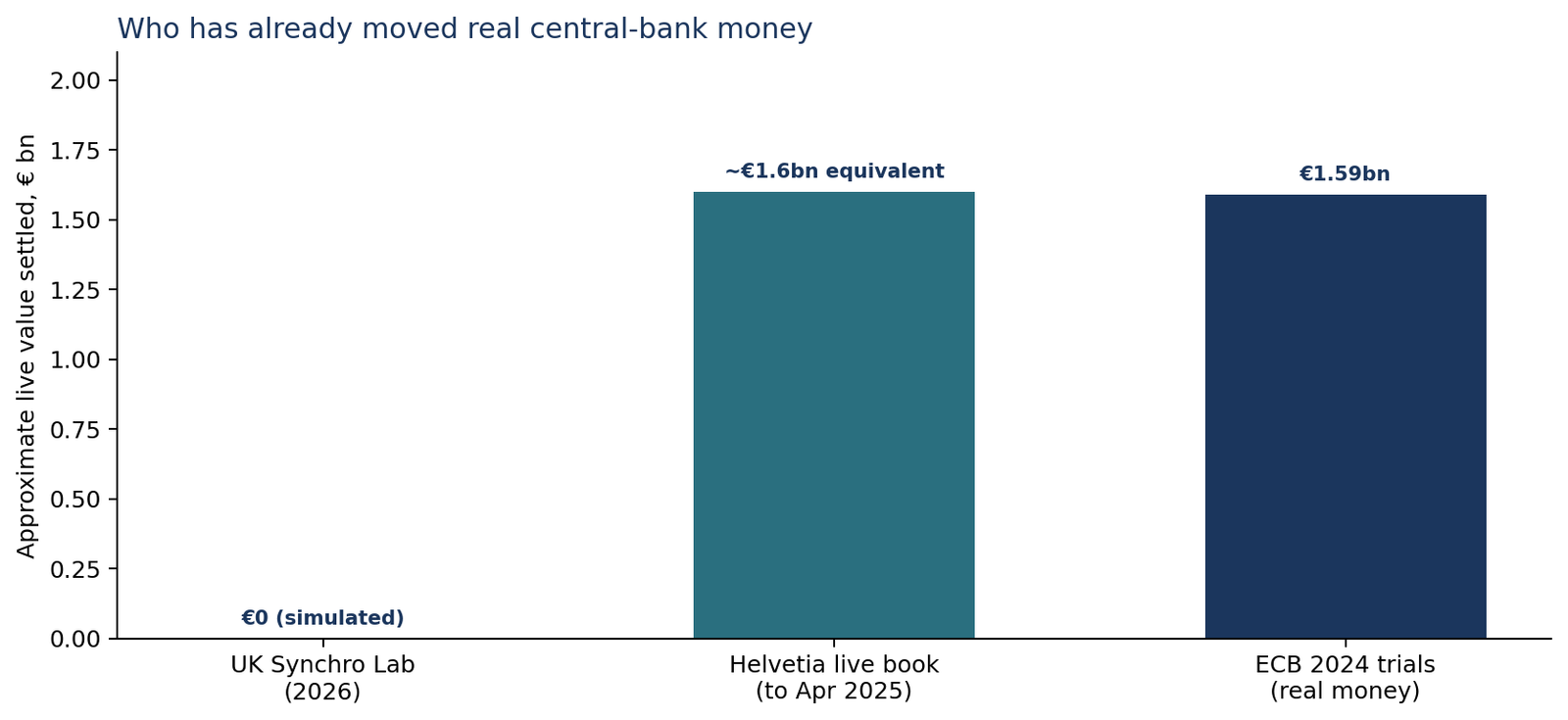
That undercuts a lazy reading of ECB confidence as mere habit. The Eurosystem tested the claim in public, with real settlement, before it built the standing service around it which it is closer to Helvetia’s Phases I and II than to a leap of faith.
Cipollone’s three risks, and the one that is industrial policy
The public case for why the ECB chose this path is now a set of three named risks. Cipollone laid them out in Brussels in the spring and sharpened them at the Bundesbank’s payments symposium on 26 August 2026.7
The first is platform fragmentation. Multiple DLT networks already run in parallel across Europe without a way to move assets between them. Liquidity splits; the cost of connecting to each venue rises. The supporting number is not a tokenisation statistic. It is a capital-markets one. Europe has 31 central securities depositories, 14 central counterparties and 323 trading venues. Even inside groups that own more than one CSD, more than 95 percent of transactions by volume and by value still settle inside a single depository. National fragmentation is the starting condition. Cipollone’s fear is that incompatible DLT platforms will reprint it. The opportunity he describes in the same speeches is the inverse: build an integrated tokenised market from a clean sheet rather than digitise 31 national silos. That is why Pontes is tied, in ECB language, to the savings-and-investments union. The cash leg is being asked to do capital-markets work.
The second is the loss of the monetary anchor. Without a path into central-bank money, tokenised markets settle in private assets (stablecoins, commercial-bank tokens) that carry credit and liquidity risk the central bank’s own liability does not, and that cannot expand elastically off a central-bank balance sheet. This is the justification for Pontes existing at all. Central-bank money, in this telling, is not a feature layered onto tokenised finance. It is a precondition.
The third is external dependence, and it should be named without dressing. Cipollone has described the risk as Europe becoming reliant on infrastructures, technologies, governance or settlement assets controlled outside Europe. That sentence is industrial policy. It says European capital markets should not end up running on rails built, owned or ultimately governable by American cloud, American-issued dollar stablecoins, or non-European consortia. The ECB has tied the point to “strategic autonomy” and to the savings-and-investments union as in Brussels vocabulary, not Threadneedle vocabulary. Where the Bank of England’s horizontal bet is agnostic about who wins the operator role so long as the winner plugs into RT2, the ECB has decided in advance that the answer cannot be a non-European entity, and has built an operator so the question never has to be tested in a bake-off.
Isabel Schnabel made the competitive object explicit at Jackson Hole on 28 August, in a speech titled “Central banks on-chain.” Central banks, she said, must put public money on the same rails as the tokenised assets forming around it, or watch the settlement layer default to privately issued dollar tokens nobody in Frankfurt controls. Stablecoins, in her phrasing, are complements, not substitutes, for the ultimate settlement asset. Read next to Cipollone’s third risk, the picture is consistent: external dependence is not a mood. It is a named competitor.8
The gap between live and useful
It would be easy to treat 21 September as the day tokenised finance in Europe becomes operational. The honest version has to resist that. What switches on is a pilot with real money and a short leash. The distance from “live” to “useful for always-on global token markets” is measured in years, not weeks.
At launch Pontes follows the T2 calendar: weekdays, TARGET opening days, a usable window on the order of a conventional European business day with just one parliamentary briefing that puts it at 09:00 to 16:00. Tokenised central-bank money is not held overnight on the Eurosystem DLT. A trade struck at three in the morning on a Sunday has no Pontes path. The 2027 “initial enhancements” stretch availability toward 22.5 hours on business days and move settlement finality onto the Eurosystem DLT. Only the enhanced product, targeted for mid-2028, is described as 24/7, multi-currency, more programmable, built to hold balances through the night. That milestone is a target, in the same hedged register the SNB uses for Helvetia and the Bank of England uses for 2028.9
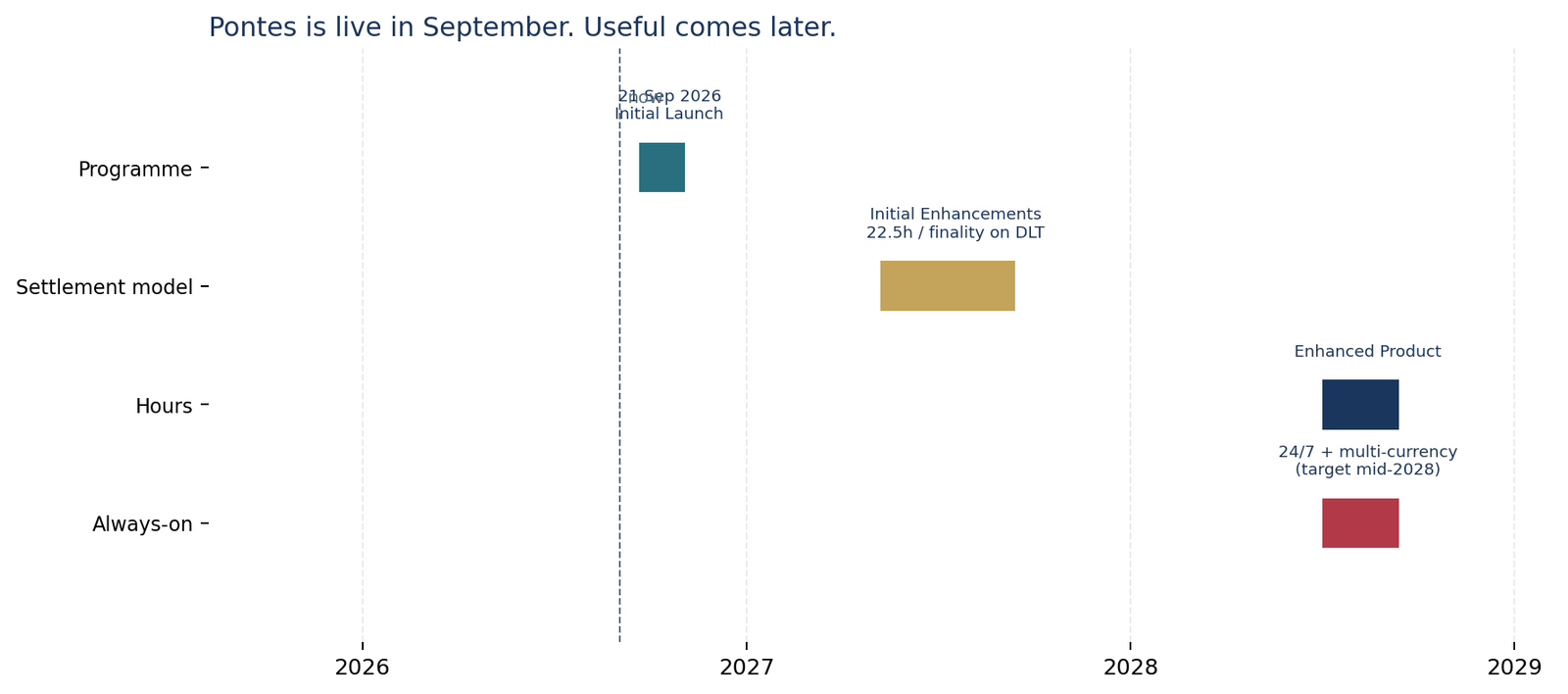
| Initial Launch (pilot) | 21 Sep 2026 | Weekday hours; T2-anchored trigger finality; no overnight DLT balances; one-off fees only |
|---|---|---|
| Initial Enhancements | 2027 | 22.5 hours, five days; finality on the Eurosystem DLT |
| Enhanced Product | Target mid-2028 | 24/7; multi-currency; more programmability; normal utility pricing |
| Appia blueprint | 2028 | The constitution the statute has been living ahead of |
Every project in this series carries some version of that gap. It belongs in the headline here because the ECB’s own communications lean on September. The more accurate line is that European settlement of tokenised trades in central-bank money begins a multi-year build this month. It does not arrive finished.
Feel the hours as a trade, not as a slide. A tokenised euro instrument bought in Singapore after Frankfurt has closed still has a conventional cash path, or none. For roughly two years after the ribbon, Pontes does not close that gap natively. That is inherited from T2, not from DLT, which has no natural reason to sleep. The 2027 enhancement reuses TARGET’s existing ancillary-system procedure to stretch the day to 22.5 hours without rewriting the core. It is an honest engineering choice. It is also a confession that the first live service is a bridge bolted onto last decade’s calendar.
Two doors, one owner
Return, briefly, to the two paths. They map onto the pair Switzerland put into production: a native cash token on a DLT, or a synchronised trigger back to the old RTGS. The technical rhyme is close. The governance is not.
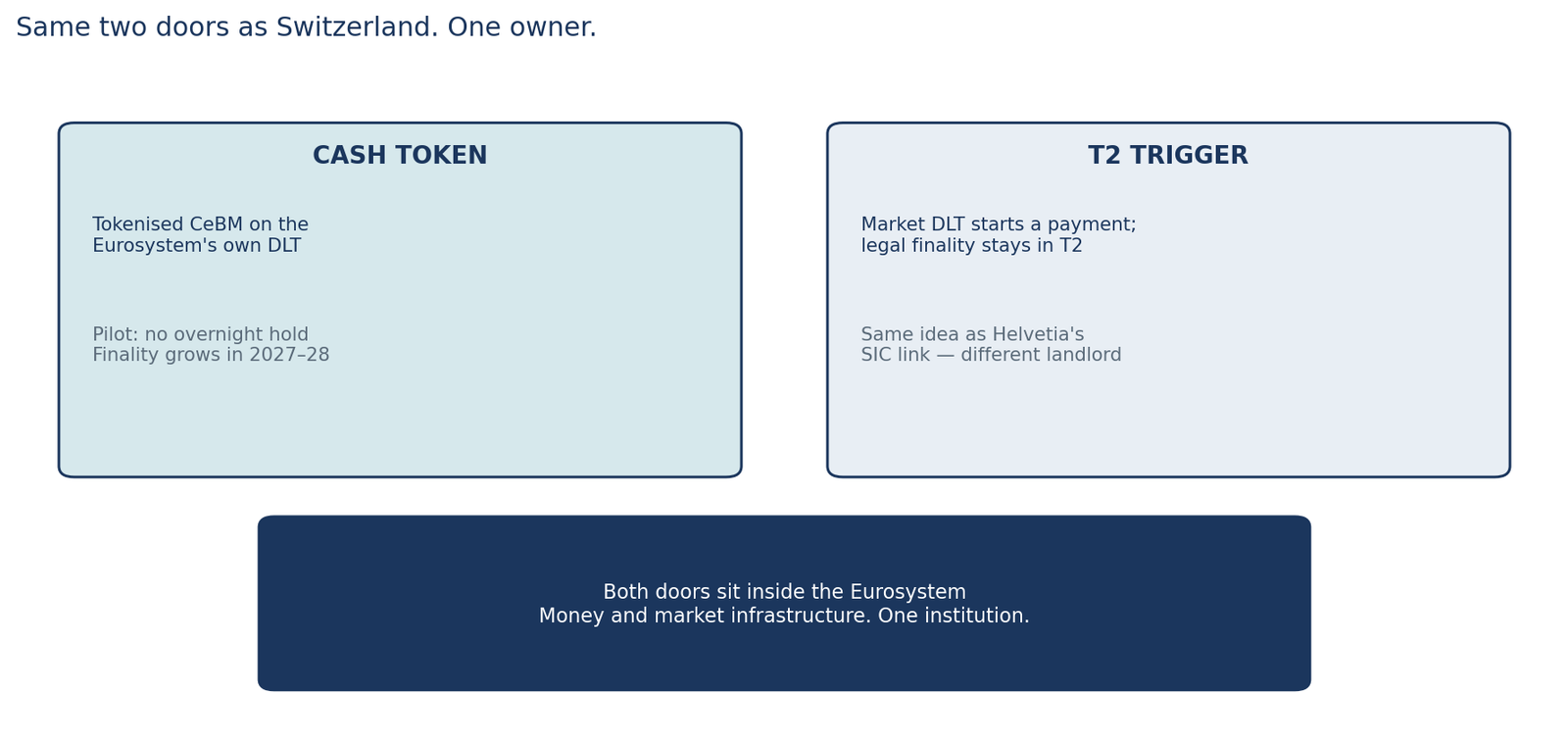
In Switzerland the DLT side of the pair, SDX, is run by SIX, a private FMI. The SNB provides the money and does not operate the venue. BX Digital, on the other door, is also private. In the Eurosystem version both doors sit inside the same public institution. The Eurosystem is the money and the market infrastructure. That consolidation is what Cipollone’s three risks are designed to stop anyone else from imposing on Europe. It is also what the ECB has chosen to do itself.
The first four market DLT operators named ahead of launch make the shape concrete: Axiology, a DLT Pilot Regime platform; Clearstream, Deutsche Börse’s CSD; Cashlink, a German registrar; SWIAT, a multi-bank network. They are venues plugging into a Eurosystem service, not candidates for the operator role. National central banks still certify their communities. Appia’s contact group already has 61 members. The club is large. The chair is not empty.10
Whether that is prudent centralisation or a chokepoint concentrated in one mandate depends on how much you trust the Eurosystem to hold its shape under political pressure for a decade. This series is not equipped to settle that. It is equipped to name it before moving on.
The next essay turns east, to a central bank that did not sidestep wholesale plumbing so much as put a second storey on it: deposit tokens issued by commercial banks, a wholesale rail at the Bank of Korea, and a state that is prepared to program public money as it moves.
NEXT IN THE CASH LEG
04 The Two-Tier State Stack — Korea. Hangang Phase 2 is due the same month as Pontes. Nine banks, deposit tokens, programmed public flows. Not a finished retail digital won in every pocket.
Then: 05 United States · 06 BIS / Agorá · 07 IMF · 08 Vendors.
Sources and notes
1. ECB, Pontes Initial Launch Pricing Guide, 19 August 2026: one-off connection fees of EUR 15,000 for market DLT operators and EUR 2,500 for market participants; no monthly or settlement fees in the Initial Launch Phase. Enhanced Product (2028) envisaged to add periodic and transaction fees.
2. Ledger Insights / Clearstream, August 2026: Pontes initial launch targeted 21 September 2026. Cipollone, Bundesbank symposium, 26 August 2026, confirmed September go-live.
3. Bank of Korea / Hangang Phase 2 materials: live deposit-token testing from September 2026 with nine banks and programmed public flows. Not a finished retail CBDC already in general circulation.
4. ECB Governing Council dual-track decision, 2025. Pontes = near-term TARGET-family service. Appia = blueprint for an integrated European tokenised ecosystem, targeted 2028. Names: pontes, Latin for bridges; Appia, the Roman road.
5. ECB Pontes user requirements and business description: dual model - tokenised central-bank money on a Eurosystem DLT, or a trigger into T2 RTGS. At initial launch, legal settlement finality for the trigger path remains anchored in T2. Pilot documentation: tokenised CeBM is not held overnight on the Eurosystem DLT.
6. ECB exploratory work, May–November 2024: 64 participants from nine countries; more than 50 trials and experiments; over 200 real transactions; €1.59 billion settled in central-bank money. Findings informed the Pontes/Appia dual track.
7. Cipollone, “From vision to delivery: building Europe’s tokenised financial market,” 26 August 2026, and earlier 2026 remarks. Three risks: platform fragmentation; loss of the monetary anchor; external dependence. Europe’s stock: 31 CSDs, 14 CCPs, 323 trading venues. More than 95 percent of securities transactions by volume and value settled inside a single CSD in 2023.
8. Isabel Schnabel, “Central banks on-chain,” Jackson Hole Economic Policy Symposium, 28 August 2026. Central banks should bring reserves onto the same rails as tokenised assets; stablecoins are complements, not substitutes, for the ultimate settlement asset.
9. ECB Pontes training / operating-day materials, July 2026, and European Parliament briefing 2026: pilot on T2 opening weekdays; one briefing gives a 09:00–16:00 usable window. Initial Enhancements (2027): 22.5 hours, five days, and settlement finality on the Eurosystem DLT. Enhanced Product: 24/7, multi-currency, greater programmability - target mid-2028.
10. Ledger Insights, 20 August 2026: first named market DLT operators - Axiology, Clearstream, Cashlink, SWIAT. Appia Contact Group: 61 members, replacing earlier market contact groups. National central banks certify their own communities before production.