The Cash Leg · Essay 07 of 11 · United States · 16 September 2026
The Private Rail
How Washington kept the dollar’s tokenised future inside the banking club
Beijing nationalised the primitive. Washington licensed the wrapper and wrote the public token out of the statute book.
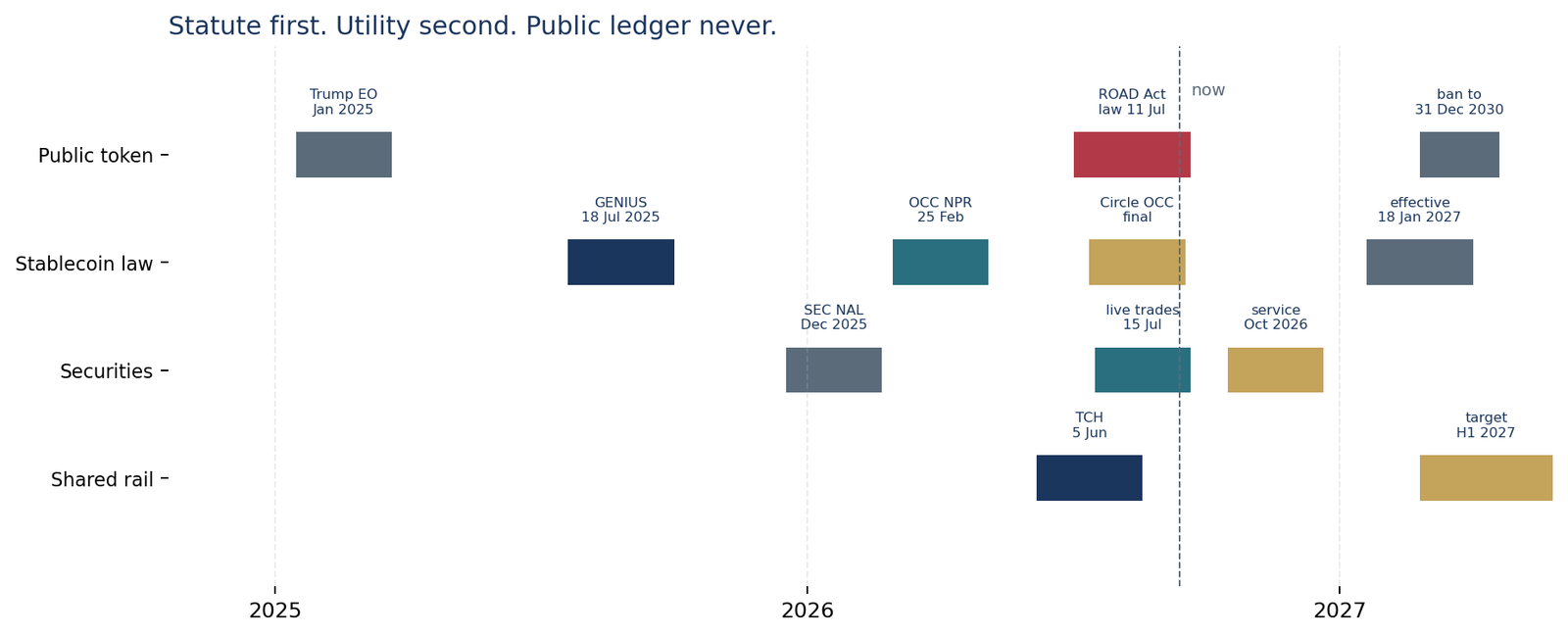
Two American statutes, passed about a year apart, did more to shape the tokenised dollar than any sandbox in this series. The GENIUS Act, signed on 18 July 2025 as Public Law 119-27, built a federal perimeter for payment stablecoins and, in the same breath, carved tokenised bank deposits out of that perimeter. The 21st Century ROAD to Housing Act, which became law on 11 July 2026 after an 85-5 Senate vote and a 358-32 House vote, bars the Federal Reserve from issuing a retail central bank digital currency, directly or through an intermediary, until 31 December 2030. Read apart they look like a crypto bill and a housing bill. Read together they are the design document. Congress never had to agree an architecture. The architecture fell out of what each statute refused to allow.1,2
A public token sitting in the middle of the system (the way RT2 sits in London, or a Eurosystem cash token sits in Frankfurt) is off the table by statute through the end of the decade. A stablecoin, the private instrument Congress did choose to license, is legally barred from being treated as an ordinary bank deposit and legally barred from paying yield to its holder. What remains is the American system as it actually exists this autumn: stablecoins in a defined non-bank ring; deposit tokens inside the regulated banks; nothing public between them. No Pontes. No Helvetia. No Synchronisation Lab. The reserve-currency jurisdiction tokenised itself without writing a line of central-bank tokenisation law, because the energy went into deciding who was allowed to compete for the job, and the banks that already owned the pipes kept them.
That is not a vacuum. It is a wager: that dollar dominance is strong enough to climb onto a ledger through private issuers and private utilities, without the central bank ever having to operate the connective tissue. Whether the wager is wise is a later question. That it is a wager, and not an absence, is the claim this essay exists to make.
Three rails, running in parallel
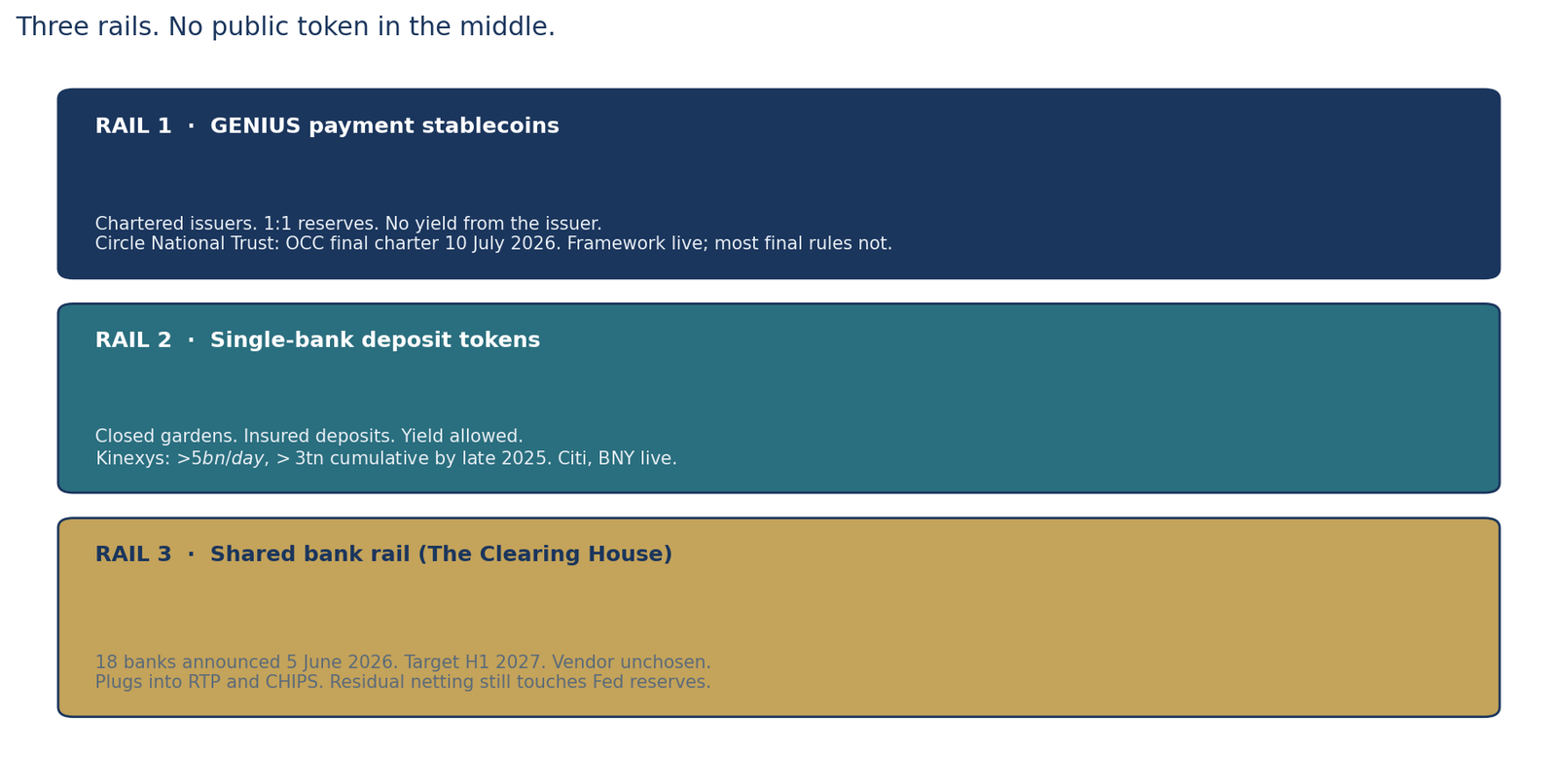
The shape Congress drew is easiest to see if the three rails sit side by side. Each was built to satisfy a different constraint. None of them talks to the others by default.
The first rail is the GENIUS-regulated payment stablecoin. The Act defines the instrument tightly: a digital asset designed for payment or settlement, redeemable at a fixed value, backed one-for-one by a short list such as cash, insured bank deposits, short-dated Treasuries, Treasury-collateralised repo, and shares in government money-market funds. Issuers must be chartered: a bank subsidiary under the bank’s primary federal supervisor, a non-bank approved by the OCC, or, below a $10 billion issuance threshold, a state regime certified as substantially equivalent. Circle applied for an OCC national trust charter on 30 June 2025, received conditional approval that December, and final approval on 10 July 2026 for First National Digital Currency Bank, N.A., operating as Circle National Trust. The largest incumbent issuer did not wait for final rules. It bought a seat inside the federal pathway while the rules were still a proposal.1,4
The sentence that does the structural work is section 4(a)(11), now 12 U.S.C. § 5903(a)(11). A permitted issuer may not pay the holder any interest or yield, in cash, tokens or other consideration, solely for holding the token. On its face that looks like consumer protection. The Council of Economic Advisers tested that claim on 8 April 2026 and could not make the arithmetic work. At the CEA’s baseline, eliminating yield increases bank lending by $2.1 billion (0.02 percent of outstanding loans) against an $800 million net welfare cost to consumers. Even stacking the assumptions the CEA itself called implausible (explosive stablecoin growth, reserves locked entirely in cash, a major Fed framework shift) additional lending tops out at $531 billion, a 4.4 percent rise. What the ban actually does, on the White House’s own numbers, is protect the second rail. Banks may pay yield on a deposit token. A GENIUS issuer may not. That is a moat with a statutory surveyor.3
The ban has a known leak. The statute stops the issuer. It does not, in so many words, stop an exchange from sharing reserve income with a customer who parks USDC on the platform. Coinbase’s USDC rewards, funded by a Circle revenue-share, are the live example. The American Bankers Association has spent the year calling that an exchange loophole. The CEA paper is silent on it. The loophole matters because it is where the first rail starts to look like the second without wearing a bank charter.
The second rail is the single-bank deposit token: a closed garden in the full sense. A bank’s tokenised representation of a customer deposit moves among that bank’s own institutional clients and nowhere else. JPMorgan’s Kinexys, formerly JPM Coin, is the most mature example anywhere this series has sat with. Company figures through December 2025 put average daily notional above $5 billion and cumulative volume above $3 trillion since the 2020 launch. Later industry notes have printed higher daily numbers; this essay keeps the last company-attributed benchmark. JPMD, the dollar deposit token, reached institutional general availability on Coinbase’s Base network in November 2025 after a June pilot with Mastercard, Coinbase and B2C2. Citi Token Services already runs live cross-border instant payments across the United States, the United Kingdom, Singapore and Hong Kong. BNY opened an institutional tokenised-deposit service in January 2026.5
Because these are deposits rather than stablecoins, the FDIC’s April 2026 proposed rule treats them as ordinary deposits under the Federal Deposit Insurance Act when they preserve the bank-customer relationship. They carry standard insurance. They can legally pay interest. A corporate treasurer holding JPMD and a corporate treasurer holding USDC are not holding the same instrument, even if both strings of code move on a public layer-two. One is a claim on a bank, inside the safety net, allowed to earn. The other is a claim on a permitted issuer, outside that net, forbidden to earn from the issuer. Congress decided they had to remain two different things. The banks then built the more attractive of the two.6
The third rail is the one that deserves the most weight, because it is the least covered and the only one that could turn a collection of gardens into something that behaves like money. On 5 June 2026 The Clearing House announced a bank-led on-chain money initiative. TCH is owned by 25 of the largest American institutions and already runs RTP and CHIPS. The published supporter list runs to the four money-centre names such as JPMorgan Chase, Bank of America, Citigroup, Wells Fargo plus BNY, BMO, Citizens, Fifth Third, HSBC, Huntington, KeyBank, PNC, Regions, Santander, TD Bank, Truist and U.S. Bank. The design goal is simple and, until now, missing: a tokenised deposit issued by one member bank should be able to move to a customer at another member bank, twenty-four hours a day. Nellie Liang put the gap in one sentence at Brookings in April: interbank settlement of tokenised deposits on private blockchains “does not exist” yet.7
The first-half 2027 launch date that travelled with every headline came from the Wall Street Journal, not from the TCH release. The release named no vendor, no product name and no hard date. Inside the banks the project is “the bridge” in some rooms and “the chain” in others. As of this writing no ledger vendor has been chosen. That is an unusual amount of blank paper for a project that wants to be live in months rather than years. It is also the point. The hard problem was never cryptography. It was getting eighteen competing treasurers to share a pipe.
What the shared rail is built to fix and what is still blank
This is not a story about American banks discovering a blockchain. Kinexys alone already moves more institutional value in a quiet week than most of the sovereign pilots in this series will move in a year. The gap is interoperability, not skill. A JPMorgan deposit token is a claim on JPMorgan. It is worth nothing to a treasurer whose supplier banks at Wells Fargo. A currency that only works between customers of one bank fails at the thing money is for. TCH exists because the major banks have jointly owned a trusted utility since 1853 and would rather extend that utility than invent a new public one.
Three questions remain unanswered in public, and they should stay unanswered in this essay rather than be filled with hope. First: what does the token settle in once it crosses a bank boundary? Mid-year reporting described a hybrid. Customer-facing tokens stay commercial-bank money on the shared ledger. Residual imbalances after netting still clear in reserves on the Fed’s own books, the way CHIPS already does. Whether that counts as “settlement in central bank money” in the sense the Bank of England or the ECB use the phrase is a definitional argument this series should not paper over. Second: who may join. HSBC and Santander are on the roster, which means a globally headquartered bank with a large American operation can get a seat. TCH has not published criteria for a bank without a major United States charter. Third: the vendor. Ethereum-derived, a permissioned enterprise chain, Canton, something proprietary as of mid-September 2026 the choice is still open, and the choice will set the programmability ceiling for every member at once.
Sitting under all three rails is a quieter fact. GENIUS is law. GENIUS is not yet fully in force. The OCC’s notice of proposed rulemaking landed on 25 February 2026, more than two hundred questions, comments closed 1 May. The FDIC, the Fed, the NCUA, FinCEN and OFAC ran parallel proposals on overlapping clocks. As of this writing none of the required final rulebooks across those five shops has been published. The Act’s own effective date is the earlier of 18 January 2027 or 120 days after final implementing rules. Banks and issuers are already pouring concrete against an expected shape. The statute they are pouring it for is, in the strict legal sense, still waiting for its last annex.4
| Rail | Legal form | Yield | Operator / issuers | Status |
|---|---|---|---|---|
| GENIUS stablecoin | Permitted payment stablecoin, not a deposit | Issuer banned from paying | OCC / state-equivalent issuers; Circle National Trust chartered | Statute live; most final rules outstanding; effective 18 Jan 2027 at latest |
| Single-bank deposit token | Insured bank deposit | Allowed | Kinexys, Citi Token Services, BNY, others | Live. Kinexys >$5bn/day, >$3tn cumulative |
| Shared TCH rail | Tokenised commercial-bank money, interbank | Allowed (as deposits) | The Clearing House, 18 named banks | Announced 5 June 2026. Target H1 2027. No vendor. |
| Public Fed token | Would be central-bank liability | n/a | Federal Reserve | Barred by statute through 31 Dec 2030 |
DTCC: the securities half of the same choice
TCH is the cash-leg half. The securities-leg half runs through the same instinct. The Depository Trust & Clearing Corporation already custodies about $114 trillion and, in 2025, its subsidiaries processed $4.7 quadrillion of securities transactions. In December 2025 DTC received an SEC no-action letter authorising a three-year tokenisation service for highly liquid instruments like Russell 1000 constituents, major index ETFs, Treasuries. On 15 July 2026 DTCC converted real DTC-custodied assets into tokens and used them in genuine production trades. The official release called it the largest such production event by breadth of use cases, asset classes and participants, and named more than thirty firms. The industry working group around the service later passed fifty names and then a hundred. A fuller launch is scheduled for October 2026.9
Frank La Salla’s phrase (bridging TradFi and DeFi) could sit equally well on the TCH press release. What matters is the identity of the bridge-builder. Twice, faced with the same choice to build a new public rail, or extend the private utility that already holds the stock and the American system chose the second option. No statute ordered it to. The statutes simply made the first option expensive, slow, or illegal.
The tell: where the New York Fed sits, and where it does not
One seating chart captures the argument more cleanly than any daily print. The Federal Reserve Bank of New York’s Innovation Center has been a continuous name on Project Agorá, the BIS-convened unified-ledger test this series has already used as Korea’s global seat. That presence has generated domestic friction. Reporting in 2025 suggested the New York Fed had slipped out after the January 2025 executive order barring federal agencies from establishing, issuing or promoting a CBDC. The BIS later treated the New York Fed as still in the room. The institutional defence is tidy and legally serious: researching tokenised wholesale reserves in a seven-bank consortium is not the same act as building a retail digital dollar. The July 2026 Agorá real-value test, for what it is worth, did not include the Fed among the live testers.10
What the New York Fed has not done is take a chair at The Clearing House’s table: not as operator, not as participant, not even as a named observer of the domestic network that will actually carry dollar deposits onto a shared ledger at home. Every other major jurisdiction in this series has its central bank somewhere inside the domestic operator conversation: running the lab in London, installing itself as operator in Frankfurt, building the wholesale layer in Bern and Seoul. In the United States the central bank researches the international wholesale-reserve question at the BIS table, and the domestic dollar plumbing is being built by the banks that already own TCH. Given the statutory environment at the top of this essay, that split could not plausibly be anything else. The tell is not that the Fed is absent from tokenisation. It is that the Fed is present exactly where the law still permits international wholesale research, and absent exactly where domestic, retail-adjacent infrastructure is being decided.
The price of speed
None of this is a story about America falling behind, and the honest version has to price both halves of the trade.
What the private-rail model buys is speed and political feasibility that no public-operator model in this series can currently match. TCH needed no enabling statute, no CBDC authorisation, no multi-year negotiation of the kind that has occupied Congress in various costumes since at least 2022. Eighteen of the largest banks agreed to extend an institution they already own and, within months of going public, had a 2027 target hanging in the press. That is faster than Pontes, faster than Appia, faster than the Bank of England’s open-ended lab. A utility that answers to its shareholder-members does not need a legislature to move. That difference in accountability is the whole of the speed advantage.
What it costs is singleness: the property, prized throughout this series, of central-bank money being unconditionally fungible and trusted by definition rather than trusted inside a club. A TCH-cleared tokenised deposit is still a claim on a named member bank, made portable to other members through shared plumbing. It stops being singular at the club’s edge. A foreign central bank cannot treat that claim as equivalent to a claim on the Federal Reserve itself, the way it could, in principle, treat a Pontes cash token or a Helvetia wholesale franc. The distinction is not theological. The Dallas Fed put a number on the domestic half of it on 25 August 2026. Because tokenised deposits can move between institutions faster than conventional deposits, they compress the window banks have to manage sudden outflows and can make deposits more rate-sensitive (“flighty,” in the language of the paper) than the sticky balances that have historically funded long-term lending. Levy and Ramaswamy’s central sensitivities: a 10 percent rise in deposit-rate sensitivity could cut the system’s capacity to absorb interest-rate risk by about $700 billion in ten-year equivalents; a 10 percent cut in deposits’ weighted average life could cut maturity-transformation capacity by about $580 billion. Those are duration-capacity estimates, not a forecast of deposits leaving the system. They belong in this essay as the price of the feature (instant, always-on movement) that makes the product attractive, calculated by the Fed’s own regional staff, not as an alarm from outside the building.10
A second cost is quieter and more American. A club of eighteen is not the banking system. Community banks, fintechs without a TCH owner-seat, and foreign institutions without a large United States charter are, for now, on the outside of the shared rail. GENIUS gives the non-bank issuer a federal door. TCH gives the owner-banks an interbank door. The rest of the industry is still walking between them. Speed for the club is not the same thing as singleness for the currency.
The one number that puts the rest in scale
Every print in this essay needs a denominator, because without one the American achievement is easy to inflate and easy to dismiss. CHIPS averaged $2.014 trillion a day in 2025 and $2.245 trillion a day through August 2026. Fedwire Funds averaged about $4.65 trillion a day in the first quarter of 2026. Combined, the two large-value systems cleared about $6.9 trillion a day that quarter. Kinexys, the most used bank-issued tokenised-money network on the planet, processes something on the order of $5 billion a day. That is a serious number in isolation. It is well under a tenth of one percent of the conventional pipes it sits beside.8
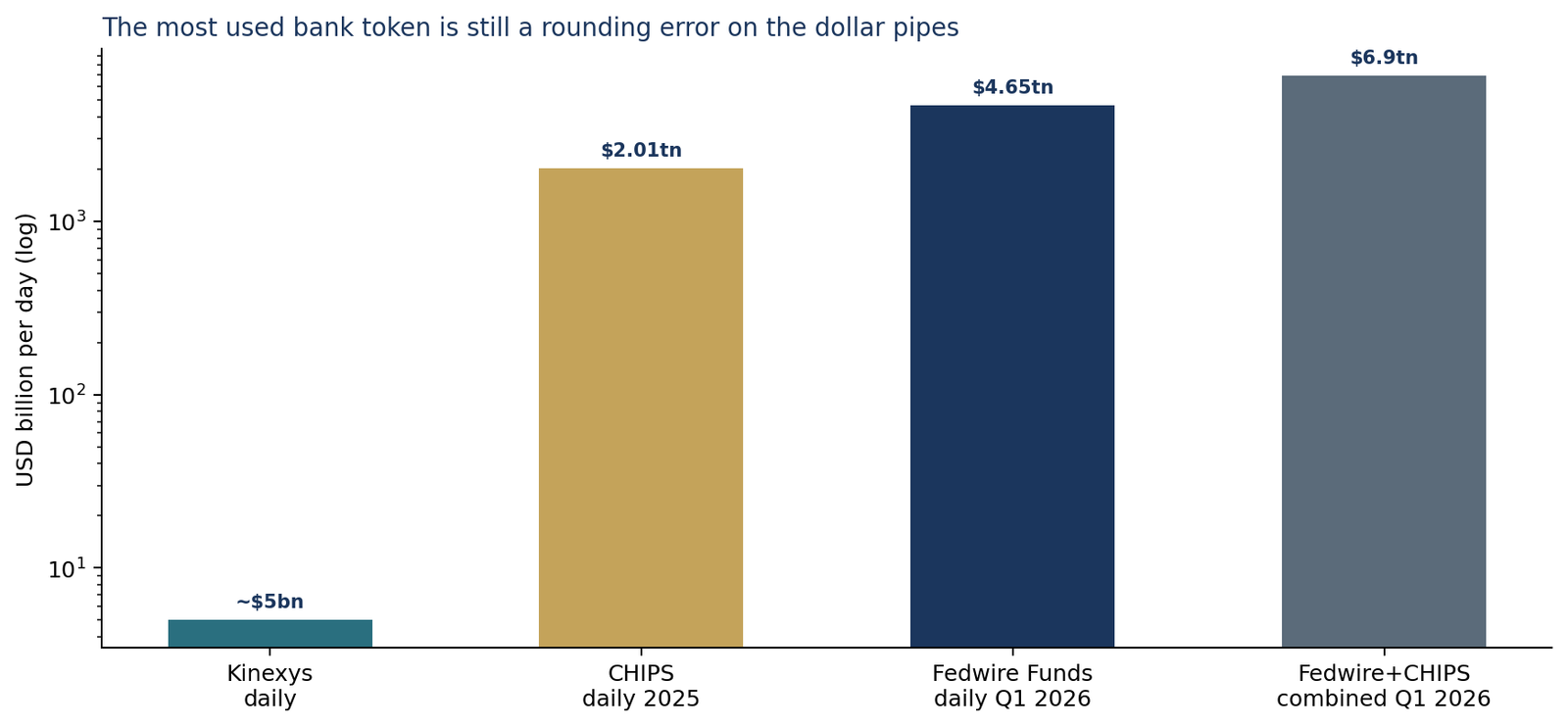
The Clearing House network exists to close a fraction of that gap without ever asking the Federal Reserve for a token. That is the wager restated as arithmetic. Bring the ease of a token to a meaningful share of the existing dollar flow, using rails that were never going to wait for Congress to authorise a digital dollar that, by statute, cannot exist before 2031.
What this is not
It would be a serious misreading to conclude that the United States has missed tokenisation. Kinexys is, by volume and institutional habit, the most used bank-issued tokenised-money network anywhere this series has measured. DTCC’s custody base dwarfs every pilot stock this series has covered, combined. Circle now holds a federal trust charter. Eighteen banks have put their names on a shared rail. What the United States has missed, specifically and only, is public tokenisation like a central-bank-operated ledger at the centre of the system, the way RT2 sits in London or the Eurosystem platform sits in Frankfurt. That is a deliberate, statutorily enforced choice, not inattention. It reflects a coherent, untested claim: that the dollar’s global position is strong enough to carry itself onto tokenised rails through private banks and private stablecoin issuers alone.
Set against the last essay the claim becomes a pair. China nationalised the primitive and criminalised the wrapper, then exported a state rail that does not touch dollar correspondent banking. The United States licensed the wrapper, forbade the public primitive through 2030, and handed the domestic job to the club that already clears most of the dollars. One model concentrates sovereignty in the issuing authority. The other concentrates it in the incumbent utilities. Neither is “doing nothing.” They are opposite answers to the same cash-leg question.
Whether the American wager holds up against jurisdictions that chose the opposite path is not a question this series can close in September 2026. The shared rail is not live. GENIUS is not fully in force. DTCC’s October service is days from its advertised start and years from replacing DTC as we know it. What can be said now is narrower and firmer. The architecture is not an accident. It is what remains when a legislature bans the public token and defines the private one so that it cannot impersonate a deposit. The banks then did what banks in this country have always done when the middle of the system is left empty. They filled it with a utility they already owned.
The hand-off
The thread back to the rest of the series runs through a single empty chair. The New York Fed sits at Agorá and does not sit at TCH. Every protagonist this series has named (London, Frankfurt, Bern, Seoul, and now Washington) will be in the next room. What they agreed to build there, and what each of them refused to rebuild with it when they went home, is the actual subject of essay 08. Agorá is the one place in this survey where the architects share a table. It is also the place that reveals the limit of that sharing. A common wholesale experiment has not produced a common domestic design. The United States is the extreme case of that limit: present for the research, absent from the domestic build, by statute rather than by taste.
Sources and notes
1. Guiding and Establishing National Innovation for U.S. Stablecoins Act (GENIUS Act), Public Law 119-27, signed 18 July 2025. Codified principally at 12 U.S.C. §§ 5901 et seq. Section 4 / 12 U.S.C. § 5903(a)(11) prohibits a permitted or foreign payment-stablecoin issuer from paying “any form of interest or yield (whether in cash, tokens, or other consideration) solely in connection with the holding, use, or retention” of the token. Effective date: the earlier of 18 months after enactment (18 January 2027) or 120 days after primary federal regulators issue final implementing rules. Payment stablecoins are defined separately from bank deposits; tokenised deposits are carved out of the stablecoin definition.
2. 21st Century ROAD to Housing Act, H.R. 6644. Senate 85-5 on 22 June 2026; House 358-32 on 23 June 2026. Became law 11 July 2026 (Bipartisan Policy Center implementation brief). Title on central bank digital currency prohibits the Board of Governors or a Federal Reserve Bank from issuing or creating a CBDC, or any digital asset substantially similar, directly or indirectly through a financial institution or other intermediary, through 31 December 2030. Carve-out for open, permissionless, private dollar-denominated instruments. Builds on the 23 January 2025 executive order directing federal agencies not to establish, issue, or promote a CBDC.
3. Council of Economic Advisers, “Effects of Stablecoin Yield Prohibition on Bank Lending,” White House release, 8 April 2026. Baseline: eliminating yield increases bank lending by $2.1 billion (0.02 percent) at a net welfare cost of $800 million. Worst-case stack: $531 billion additional lending (4.4 percent), requiring sixfold growth in stablecoins’ deposit share, all reserves locked in cash, and a Fed framework change the CEA called implausible.
4. Circle Internet Group: OCC application 30 June 2025; preliminary conditional approval December 2025; final approval 10 July 2026 to establish First National Digital Currency Bank, N.A., operating as Circle National Trust. OCC Notice of Proposed Rulemaking on GENIUS implementation, 25 February 2026 (Federal Register 2 March); comment period closed 1 May 2026. Parallel FDIC, Federal Reserve, NCUA, FinCEN and OFAC proposals through spring 2026; as of September 2026 the full set of final rules across the five agencies had not been published.
5. J.P. Morgan Kinexys: company figures through December 2025 of more than $5 billion average daily notional and more than $3 trillion cumulative since launch (earlier 2020 branding as JPM Coin). JPMD deposit token reached institutional general availability on Coinbase Base in November 2025 after a June 2025 pilot with Mastercard, Coinbase and B2C2. Later industry write-ups have cited higher daily prints; this essay uses the last company-attributed benchmark. Citi Token Services live across the United States, United Kingdom, Singapore and Hong Kong. BNY tokenised-deposit service for institutions, January 2026.
6. FDIC notice of proposed rulemaking, April 2026, treating tokenised deposits as ordinary deposits under the Federal Deposit Insurance Act when they preserve the bank-customer relationship. Brookings / Nellie Liang, April 2026: interbank settlement of tokenised deposits on private blockchains “does not exist” yet.
7. The Clearing House, “Major Financial Institutions Unveil Bank-Led On-Chain Money Initiative,” 5 June 2026. Operator is TCH, owned by 25 large institutions. Named supporters include JPMorgan Chase, Bank of America, Citigroup, Wells Fargo, BNY, BMO, Citizens, Fifth Third, HSBC, Huntington, KeyBank, PNC, Regions, Santander, TD Bank, Truist and U.S. Bank. First-half 2027 target originates in contemporaneous Wall Street Journal reporting rather than the TCH release itself, which named no vendor, no product name and no hard date. Internal nicknames reported as “the bridge” and “the chain.” TCH existing networks (RTP, CHIPS, ACH, check) already clear more than $2 trillion a day as a group.
8. CHIPS 2025 average daily value $2.014 trillion (TCH annual statistics). Year-to-date 2026 through August: $2.245 trillion average daily. Fedwire Funds Service Q1 2026 average daily value about $4.65 trillion. Combined Fedwire Funds plus CHIPS about $6.9 trillion a day in Q1 2026 (ClearingPost compilation of official prints).
9. DTCC / DTC: SEC no-action letter, December 2025, three-year authorisation covering Russell 1000 constituents, major index ETFs and Treasuries. Live production trades 15 July 2026 using DTC-custodied assets; official release: more than 30 firms, later working-group membership above 50 and then 100. Service launch scheduled October 2026. DTC custody about $114 trillion; DTCC subsidiaries processed $4.7 quadrillion of securities transactions in 2025. CEO Frank La Salla on bridging TradFi and DeFi.
10. Federal Reserve Bank of Dallas, Rosie Levy and Srini Ramaswamy, 25 August 2026. A 10 percent rise in deposit-rate sensitivity could cut banks’ capacity to hold long-term interest-rate risk by about $700 billion in ten-year equivalents; a 10 percent cut in deposits’ weighted average life could cut maturity-transformation capacity by about $580 billion. These are duration-capacity estimates, not predicted deposit flight. New York Fed Innovation Center remains listed on Project Agorá; July 2026 Agorá real-value test did not include the Fed as a live tester.