The Cash Leg · Essay 08 of 11 · Bank for International Settlements / IIF · 18 September 2026
The Shared Marketplace
How Agorá tried to keep the banks inside the token
A marketplace, by its name, is not a mint. July proved the stall can take a ticket. It did not prove the market is open.
In July 2026 twenty-eight institutions (five central banks and a score of commercial lenders spanning Asia, Europe and North America) moved real money across a shared programmable ledger. Thirty transactions. Seventeen scripted scenarios. Six currencies. Combined value about CHF 800,000, a little under a million dollars. Average time from initiation to settlement: about eighty seconds. Money that would ordinarily spend a day or more walking a correspondent chain moved atomically, across borders and currencies, in under a minute and a half.1
Then comes the sentence the BIS chose to publish next to the result, and it is the sentence this essay is built around. The prototype was not integrated with the participants’ live real-time gross settlement systems or with their own core banking infrastructure. Eighty seconds was the speed of a lab. It was not, and could not yet be, the speed of a payment fighting its way through the plumbing a bank actually runs. That gap, between what a shared platform can demonstrate in a controlled window and what it would take to replace correspondent banking at scale; is not a footnote. It is the story.1
Every earlier essay in this series asked a national question: who provides the cash leg inside one jurisdiction. Agorá is the first piece whose protagonist is a club. That change of subject is the point. A marketplace only exists if more than one sovereign is willing to put its money on the same clock without surrendering the mint.
The problem the club was assembled to touch
Wholesale cross-border payments still run, for the most part, on a nineteenth-century idea wearing twentieth-century messaging. A bank in one country holds a nostro account with a correspondent in another. The payment instruction travels. The money does not travel with it. Prefunded balances sit idle in those accounts so that a ticket can clear when the receiving market opens. Foreign-exchange legs often settle hours apart, sometimes a business day apart, which is the window Herstatt risk lives in: one currency has moved, the other has not. Reconciliation is a second industry sitting on top of the first. None of that is news to a treasurer. It is the reason the G20 has spent a decade writing communiqués about cheaper, faster, more transparent cross-border payments and why every architecture in this series keeps rediscovering the same primitive as in earmark both legs, release both or neither.9
Agorá’s wager is that the primitive can be installed without inventing a new kind of money and without asking any central bank to merge its reserve ledger into a common pool. Tokenise the deposit that already exists. Tokenise the reserve that already exists. Put coordination on a shared surface. Leave legal title where it was. If that sounds modest, it is meant to. Modest is how you get eight central banks and more than forty private firms into the same room. Ambition of the Chinese kind (nationalise the primitive, outlaw the wrapper) empties that room.
The name is the argument
Agorá is Greek for marketplace. The name is doing work, because it tells you immediately what the project is not. It is not a mint. No new form of money is created inside it. Central banks continue to issue reserves. Commercial banks continue to issue deposits. What changes is where those two pre-existing claims can meet.2
The architecture, written down in the BIS findings report of 27 May 2026, rests on a two-layer split that every participating central bank treated as non-negotiable. Tokenised commercial-bank deposits sit on a unifying ledger, visible to participating banks together. That is the coordination layer, the only genuinely new object. Tokenised central-bank reserves sit on separate jurisdictional ledgers, one per currency area, each under that central bank’s own authority and never merged into the shared surface. Workflow can be composed on the unifying ledger. It does not get to move a reserve token unless the relevant central bank’s own system executes the move. The BIS called this the project’s most consequential design choice. Read it as a political sentence dressed as an engineering one: no shared mint.
Nothing about the legal character of either token changes. A tokenised deposit remains an ordinary liability of the issuing bank. A tokenised reserve remains an ordinary claim on the issuing central bank. The project’s legal work concluded that settlement finality looked achievable across the original participating jurisdictions without requiring any of them to rewrite what their money is. That is the quiet claim on which the whole club stands. If it ever fails a court, the marketplace closes.
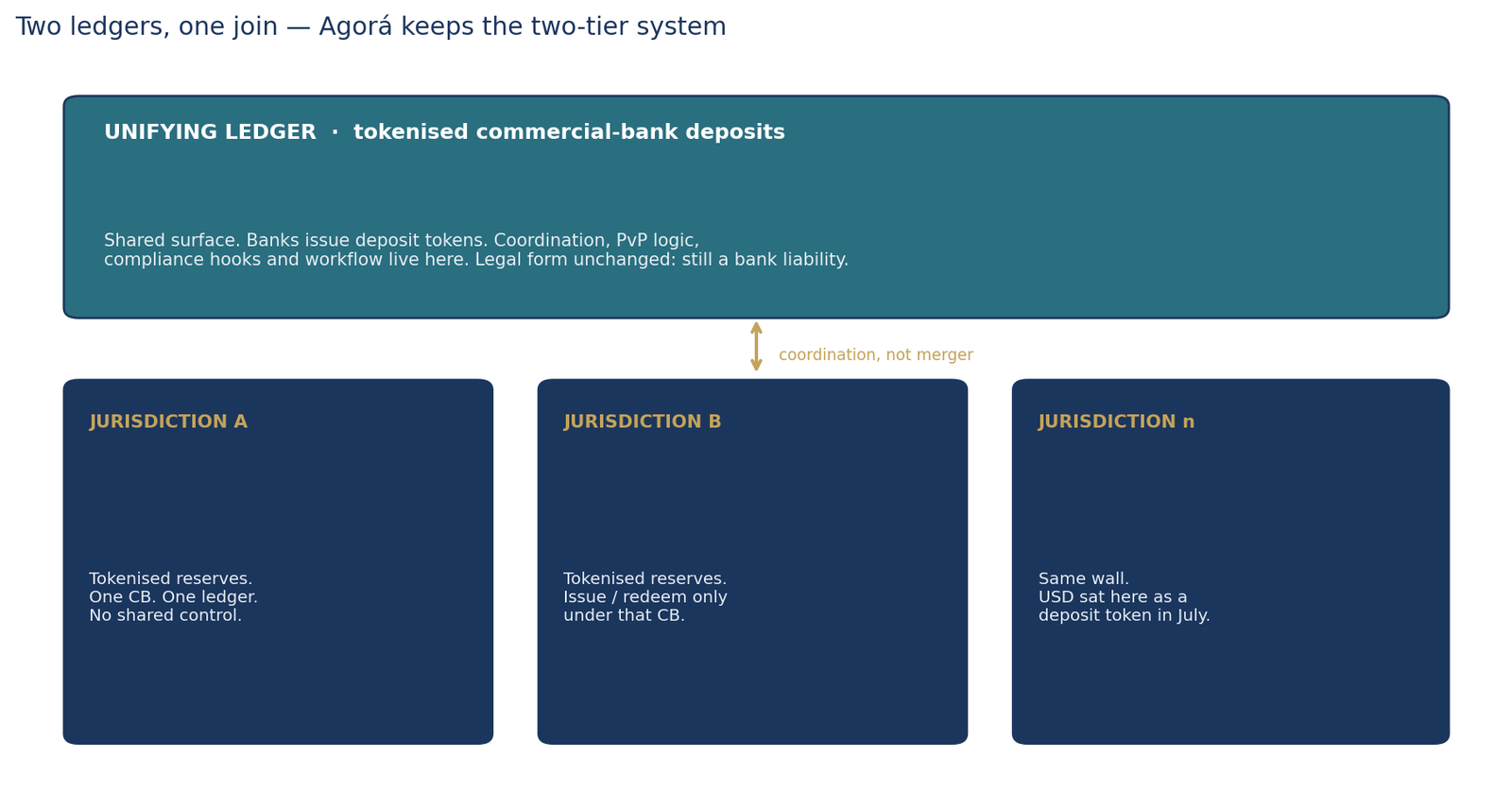
Set that picture against the rest of the series and the contrast is mechanical rather than rhetorical. China, in essay six, nationalised the primitive and criminalised almost every private wrapper. Agorá does the reverse: keep both layers owned exactly as they already were, and build the join on top. The American bet in essay seven is the same shape written in statute as in the private money on the deposit layer, a public settlement asset only where a central bank chooses to supply one, no retail CBDC required. Agorá is that bet made multilateral. London’s Synchronisation Lab tests a trigger back into a domestic RTGS, not a shared multi-currency ledger. Helvetia and Pontes are national stacks. mBridge inverts the weights: multi-CBDC, deposit tokens in a bit part, one currency doing about ninety-five percent of the volume. Agorá is the only design in this survey built, from the first page, around several central banks and several commercial banks sharing a clock without sharing a mint.
Who was actually in the room
For a project that lives on institutional trust, the guest list and the working list are not the same document. Collapsing them into “eight central banks went live” is the single easiest way to overstate July.
| Role | Institutions | Meaning |
|---|---|---|
| Project members | BoE, NY Fed, Banque de France (Eurosystem), BoJ, BoK, Banxico, SNB, Bank of Canada (May 2026) | Eight central banks, IIF, 40+ private firms |
| Testing central banks | BoE, Banque de France, BoJ, BoK, SNB | Five. No NY Fed. No Banxico. No Canada. |
| Private testers (named) | JPMorgan, Citi, UBS, Deutsche, StanChart, MUFG, Lloyds, BNY, BNP, CaixaBank, Korean five, others | Deposit tokens issued and moved |
| Operators of the run | SIX (facilitator), Kaleido (technology) | Not the owners of the money |
The private names that earn a sentence rather than a parade are the ones that already own correspondent pipes: JPMorgan, Citi, UBS, Deutsche Bank, Standard Chartered, MUFG, BNY. Lloyds ran three tickets across sterling, francs and euros. CaixaBank was the only Spanish house in the run. On the Korean side five commercials sat down together (KB Kookmin, NongHyup, Shinhan, Woori, Hana) which is a denser national showing than any other single jurisdiction managed. Messaging used the ISO 20022 types banks already speak, pacs.008, pacs.009, camt.053, chosen to show compatibility rather than a conversion. SWIFT sits inside the private cohort as a participant, not as operator. That is a political fact about who does not get to own the join, and it matters because SWIFT is, in the same summer, shipping a ledger of its own.3
What was actually tested
The seventeen scenarios were not a toy set. They covered corporate cross-border payments, interbank transfers, single- and dual-currency settlement, payment-versus-payment foreign exchange, and intragroup funding inside a banking group that lives in more than one country. Official use-case notes break out two dual-currency scenarios (CHF–GBP and GBP–USD), two PvP scenarios on the same pairs, three single-currency corporate tickets (CHF, EUR, KRW), six single-currency interbank tickets, and four single-currency intragroup tickets. Ticket sizes ran from CHF 9,000 to CHF 125,000, or local equivalents. The tokens represented real reserves and real deposits. The BIS’s own name for the exercise is real-value testing. This essay uses that name. “Go-live” is a word for a production switch that has not been scheduled.1
The most concrete national print sits in Seoul, and it is the callback essay four promised. The Bank of Korea, with NongHyup and Shinhan, moved 20 million won (about fourteen thousand dollars) as an interbank transfer on tokenised reserves: instructions in from both commercials, then the central bank issued, transferred and redeemed the reserve tokens on the platform. In a separate ticket KB Kookmin completed a yen deposit-token scenario with MUFG, the first time a Korean commercial bank had taken that foreign-currency deposit-token walk with an overseas house on this platform. Yonhap, quoting the Bank of Korea the same day, said the bank would keep sitting at the Agorá table and would review ways to integrate Project Hangang with it. That is interoperability research, not a live join. Treat Korean secondary write-ups that flatten the two into a single switched-on link with the same caution this series has applied to every other victory caption.4
Korea’s presence is still the series’ cleanest illustration of how a domestic stack becomes a ticket into the club. Hangang was built to move public money under fiscal rules. The same two-tier pattern (wholesale central-bank token plus bank deposit token) is the pattern Agorá tests across borders. Seoul did not invent the global standard. It arrived already fluent in the dialect the club had chosen to speak.
Atomic settlement is the recurring primitive
The PvP scenarios isolate what the eighty seconds is actually buying. A conventional FX trade still often settles its two legs sequentially. One currency changes hands while the other is still a promise sitting in another time zone. That window is Herstatt risk, and it is the same exposure the Bank of England’s Meridian FX work was built to close at home. Agorá tested whether the unifying ledger’s coordination logic could force both legs to execute as one event (both currencies move, or neither does) using the earmark-and-release pattern this series has now watched in London, Zurich, Frankfurt and Seoul, each time in slightly different clothes. That the same idea keeps being rediscovered, by institutions that are not copying one another’s governance, is evidence that atomic settlement is converging even where the surrounding politics are not.8
Convergence of a mechanism is not convergence of a system. A Swiss franc reserve token and a digital-yuan reserve token can both settle atomically and still refuse to sit on the same ledger. The primitive travels. The club does not.
Two scoreboards, read honestly
It would be easy, and dishonest, to let either of two available numbers win the argument. Agorá’s real-value test moved about a million dollars, in eighty-second tickets, in six currencies, with both tiers of money legally unchanged. mBridge, in essay six, has a public cumulative stock of about $55.5 billion, built over years of repeated cross-border flow, with five full members and about ninety-five percent of that volume in one currency. Global foreign-exchange turnover in the April 2025 BIS survey was $9.6 trillion in a single day. Neither project is a rounding error on that last figure. Neither should be allowed to pose as one.5
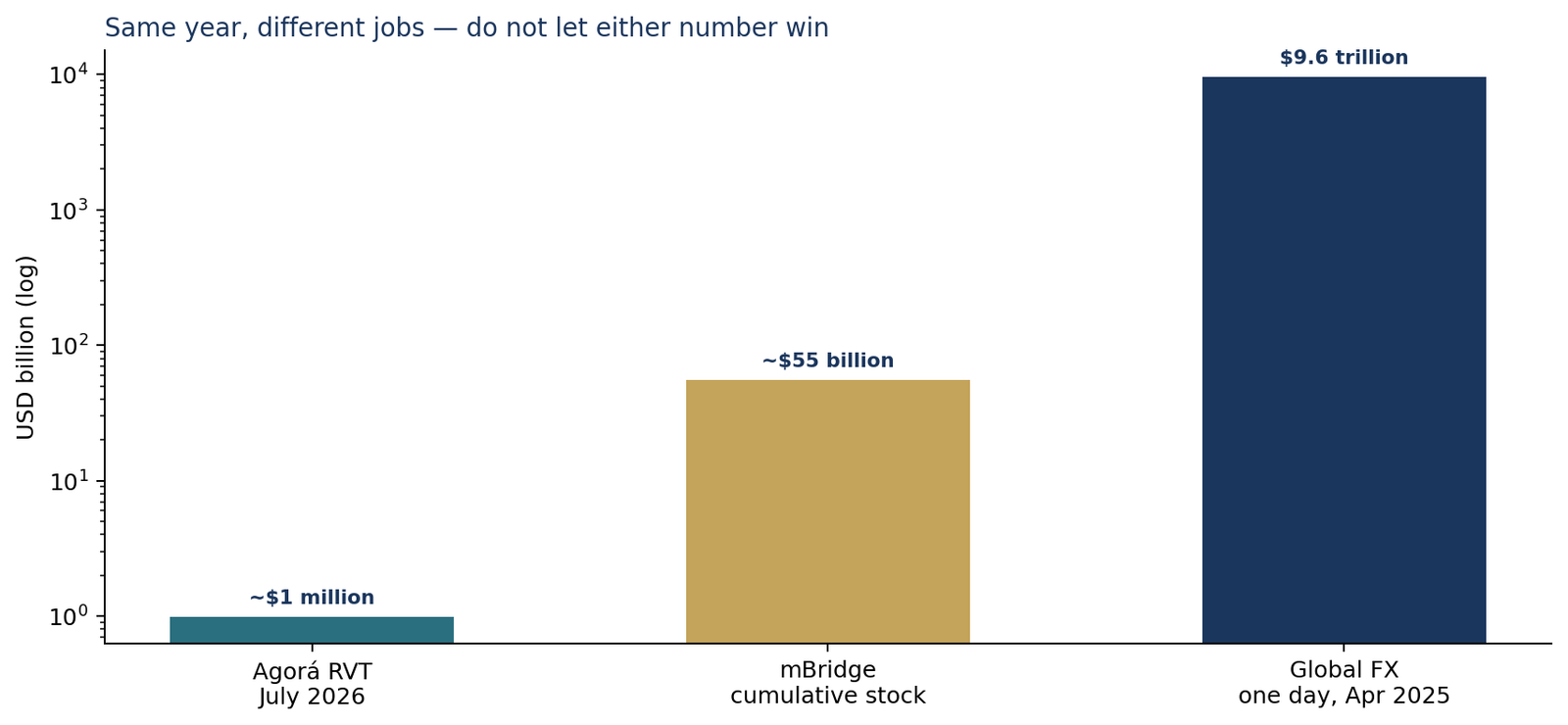
The correct reading is not that one project is ahead. They are doing different jobs. Agorá, in September 2026, is a lawyered, small-scale proof that a multi-currency, multi-central-bank, two-tier architecture can clear a real ticket. The harder questions (live RTGS integration, production liquidity, a dollar reserve token that may never arrive) sit in front of it, not behind it. mBridge is a corridor with a five-year plan and a settlement pattern that already looks like an operating rail. Both statements can be true in the same year about two projects with overlapping technical ambitions and almost no overlapping membership. A race requires a shared finish line. These two have not agreed one.
The Fed-shaped hole
The dollar was one of the six currencies inside the July run. The Federal Reserve Bank of New York has been a project member since the 2024 launch; its Innovation Center put its name on the May 2026 report. It did not sit among the five central banks that issued and redeemed reserve tokens in July. Wherever a dollar leg settled in that test, it settled as a commercial-bank deposit token, not as a tokenised Federal Reserve liability.6
That is not a clerical miss. It is the American design, made visible on a multilateral stage. Essay seven described a jurisdiction that licensed private dollar wrappers, kept a public retail token off the table, and left wholesale Fed reserves in a politically contested zone which was an executive order in January 2025 against a CBDC, a legislative track in 2026 toward a statutory ban into 2030, and a New York Fed that still sits in a project whose other members treat tokenised reserves as ordinary central-bank money under another name. Critics at Cato have called that a wholesale CBDC by another label. The Fed has not issued one on Agorá. Until it does, the world’s dominant reserve currency exists on this platform only as a bank object. The club would like a dollar reserve token. The statute in Washington is written to make that request harder, not easier.
The hole has a practical consequence the other members cannot legislate away. A PvP ticket that wants a true central-bank dollar on one side and a true central-bank euro on the other cannot, today, get both legs from the institutions that issue those currencies. It can get the euro from Banque de France. It can get the dollar from Citi or JPMorgan. That is still two-tier money. It is not two sovereign settlement assets. The difference will matter the first time a stress event makes counterparties care which name sits on the reserve token.
What success does not mean
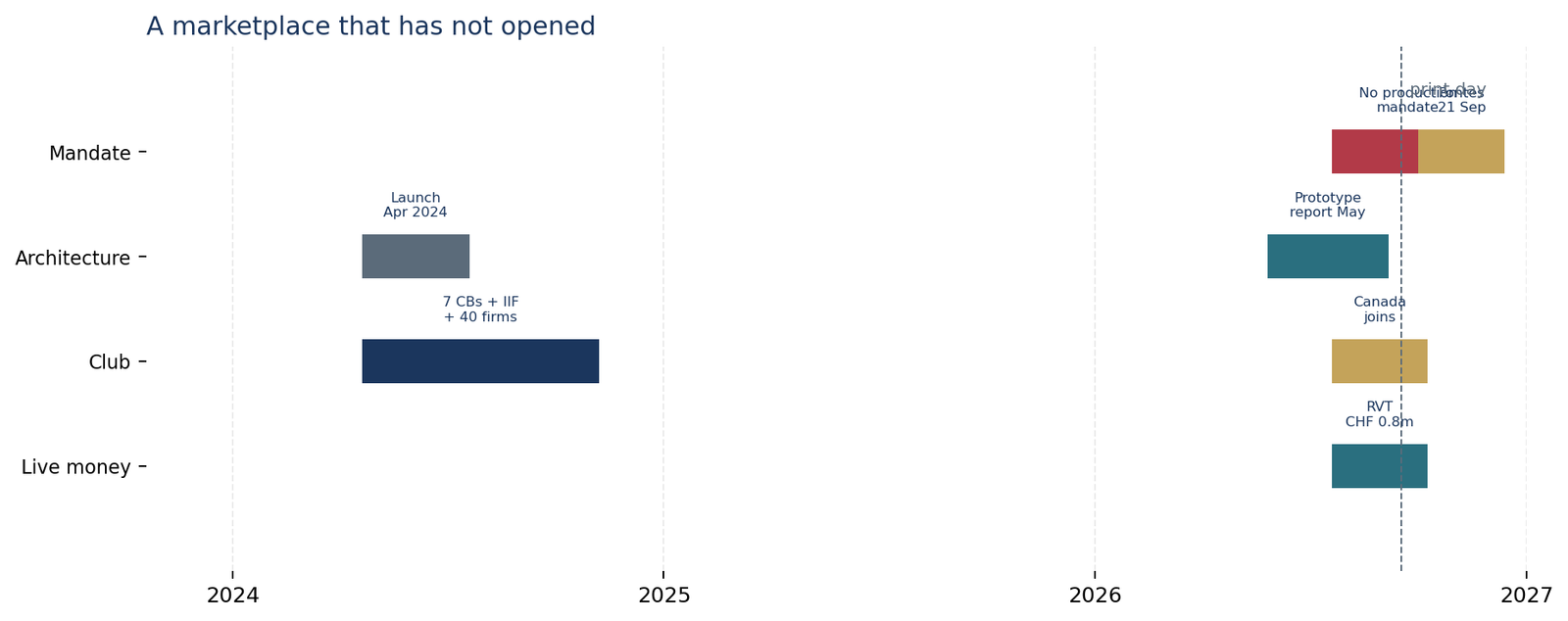
The temptation, looking at a clean July print, is to round up to “Agorá works.” The record does not support that, and the BIS has not claimed it. There is no production mandate. Official language after the test is the language of a prototype: further testing, a larger private-sector role, continued central-bank engagement. Eighty seconds with no hook into live core systems or RTGS is the ceiling of the demonstration, not the floor a production network would have to clear. A payment that never meets a bank’s actual liquidity desk, fraud screen or regulatory report is being tested under kinder conditions than the live book. Behind the headline sat about two hundred and fifty public- and private-sector staff across payments, compliance, risk and legal. That is the cost of getting dozens of institutions to agree a runbook for thirty tickets. It is not an app.10
Production, if it ever comes, would have to answer questions the RVT was allowed to park. Who holds the matching liquidity when tickets are no longer scheduled into an intraday window run by SIX. How redemption back into a national RTGS works at 02:00 on a Sunday. Which court owns a disputed atomic ticket that touched three jurisdictional ledgers. What happens to a deposit token when the issuing bank fails. None of those are technical puzzles the prototype “almost” solved. They are the job.
Competition from inside the same camp
On 9 July 2026 (the same month as the RVT) Swift said its own blockchain ledger was ready for initial use with seventeen banks across six continents. Citi, HSBC, UBS, BNY, BNP Paribas, Standard Chartered, MUFG, Lloyds, First Abu Dhabi Bank, DBS, OCBC, UOB, Wells Fargo, ANZ and others are on that list. The design is an orchestration layer for bank-issued tokenised deposits. Final settlement still completes on existing rails. On 2 September Citi processed live tickets on that ledger with FAB in the Middle East and OCBC in Southeast Asia, inside a controlled phase booked through December. DBS and UOB were expected to follow.7
This is not mBridge. It is competition from inside the Western camp, and it shares Agorá’s premise that a deposit token should remain a commercial-bank liability. It does not share Agorá’s ambition to put tokenised central-bank reserves on jurisdictional ledgers as the settlement asset of the same ticket. Swift is defending the thing it already owns: coordination between banks. Agorá is asking those same banks, and their central banks, to coordinate on a new surface that could one day make the old messaging layer less necessary. Treating the two as a single “Western platform” flatters both and describes neither.
| Agorá | Swift ledger | mBridge | |
|---|---|---|---|
| What moves | Tokenised reserves + tokenised deposits | Tokenised deposits, then legacy rails | Mostly multi-CBDC |
| Who issues the cash leg | Five CBs in RVT; deposit tokens from banks | Commercial banks only | Participating central banks |
| July-Sept 2026 print | ~CHF 800,000 RVT | 17-bank pilot; Citi live tickets in Sept | Stock ~$55bn |
| Production status | No mandate | Controlled phase to Dec 2026 | Live corridor, five-year plan |
| Dollar’s form | Bank token in the RVT | Bank token | Not the point |
The series join
Step back and the membership map across the first eight essays is no longer a scatter. The Bank of England, the Eurosystem via Banque de France, the Swiss National Bank and the Bank of Korea all sit inside Agorá’s orbit; four of those five issued reserve tokens in July. China, Hong Kong, Thailand, the UAE and Saudi Arabia sit on the other side of the page, building a parallel rail with essentially no institutional overlap. The United States sits on Agorá’s membership list through the New York Fed and simultaneously builds a domestic architecture that does not need Agorá and did not supply a reserve token to it. Malaysia and the GCC, in essay five, are writing law around asset-backed contracts that neither club has offered to host.
Two internally coherent blocs. Almost no bridge. That is the fracture essay nine has to walk into. The IMF has no ledger, no operator role and no settlement asset. What it has is a mandate to worry about fragmentation and a habit of naming central-bank money as the trusted anchor. Whether a speech can join two clubs that have chosen not to join each other is not a technical question. It is the next one.
Pontes switches on in three days. That is a Eurosystem event, not an Agorá event. Adjacent politics, different pipe. Do not write the caption that says Frankfurt has plugged Europe into the marketplace. Frankfurt has plugged Europe into itself.
Close
Project Agorá’s wager, stated as the record allows, is this. Keep the two-tier system intact (central banks issuing reserves, commercial banks issuing deposits) and put both tiers on the same programmable clock. Coordinate them. Do not merge them. Hope the resulting fragmentation stays a standards argument among friendly institutions rather than hardening into the bloc problem this essay has already had to draw. Whether that hope survives RTGS integration, production liquidity and a dollar reserve token that may never arrive cannot be answered from September 2026. What can be answered is smaller and sharper.
A marketplace requires more than one party willing to trade on the same terms. Agorá has gathered a willing crowd and cleared a million dollars under laboratory kindness. It has not opened for business. The token did keep the banks inside it. The banks have not yet had to live there.
Sources and notes
1. BIS Innovation Hub, Project Agorá project page and Real-value testing update, 30 July 2026. Twenty-eight financial institutions and central banks; about CHF 800,000 across 17 scenarios and 30 transactions; tickets CHF 9,000–125,000 or local equivalents; average initiation-to-settlement about 80 seconds. Currencies: CHF, EUR, GBP, JPY, KRW, USD. Testing central banks: BoE, Banque de France (Eurosystem), BoJ, BoK, SNB. Facilitator: SIX. Technology: Kaleido. About 250 public and private staff. Prototype not integrated with live RTGS or core banking systems; ISO 20022 (pacs.008, pacs.009, camt.053) used to talk to external systems.
2. BIS / IIF, Project Agorá: a shared programmable platform for wholesale cross-border payments, 27 May 2026 (~97 pages). Two-layer design: unifying ledger for tokenised deposits; jurisdictional ledgers for tokenised reserves. Legal analysis: settlement finality judged achievable across original participating jurisdictions without changing what money legally is. Press release same day: Bank of Canada joins; further testing and an enhanced private-sector role flagged. No production mandate.
3. IIF private-sector participant list, updated 17 August 2026. More than 40 regulated firms. Named RVT private testers on the BIS page include JPMorgan, Citi, UBS, Deutsche Bank, Standard Chartered, MUFG, Lloyds, BNY, BNP Paribas, CaixaBank, Mizuho, SMBC, NatWest, TD Bank, Eurex Clearing, PostFinance, Basler Kantonalbank, and the five Korean commercials.
4. Bank of Korea, 30 July 2026; Yonhap. Five Korean commercials in the RVT: KB Kookmin, NongHyup, Shinhan, Woori, Hana. BoK + NongHyup + Shinhan: KRW 20 million interbank on tokenised reserves. KB Kookmin + MUFG: yen deposit-token scenario. Yonhap: BoK will keep participating and review ways to integrate Hangang with Agorá - interoperability work, not a live production join.
5. Essay 06 of this series and Atlantic Council / contemporaneous 2025–26 reporting: mBridge public stock about $55.5 billion, more than 4,000 tickets, e-CNY about 95 percent. Full members: PBOC, HKMA, Bank of Thailand, CBUAE, SAMA. BIS exited October 2024. BIS Triennial Survey, April 2025: global FX turnover $9.6 trillion a day.
6. New York Fed / NYIC statements confirming continued Agorá membership through the 27 May 2026 report. January 2025 executive order opposing a US CBDC; Cato Institute, 16 June 2026, arguing tokenised Fed reserves are a wholesale CBDC by another name. US legislative track in 2026 toward a statutory ban on a Fed-issued CBDC into 2030. The July RVT list of testing central banks does not include the New York Fed.
7. Reuters and Swift, 9 July 2026: Swift blockchain ledger ready for initial use with 17 banks across six continents (Citi, HSBC, UBS, BNY, BNP Paribas, Standard Chartered, MUFG, Lloyds, FAB, DBS, OCBC, UOB, Wells Fargo, ANZ and others). Tokenised deposits move on the ledger; final settlement remains on existing rails. Citi Services, 2 September 2026: live tickets with First Abu Dhabi Bank and OCBC inside a controlled phase running through December 2026.
8. BoE Synchronisation Lab and Meridian FX work (essay 01); SNB / SIX Helvetia (essay 02); ECB Pontes, scheduled 21 September 2026 (essay 03); Bank of Korea Hangang (essay 04). Recurring earmark-and-release / atomic PvP pattern across those national stacks.
9. Correspondent-banking and Herstatt-risk literature as used in this series: sequential FX legs, nostro prefunding, multi-day windows. Agorá RVT use-case split from the BIS page: dual-currency, PvP (CHF-GBP and GBP-USD), single-currency corporate, interbank and intragroup.
10. BIS language after RVT: testing will continue; future work expected to give the private sector a larger role with continued central-bank engagement. Pontes go-live week of 21 September 2026 is Eurosystem DLT settlement, not an Agorá production switch. Essay 09 takes the IMF roadmap.