The Cash Leg · Note · United Kingdom · 3 October 2026
The Pound That Waited
They fill a cell the map already had a name for
Why the Bank of England does not want to own tokenisation was the first wager of this series. The last wager, ten days ago, was narrower: when a new announcement arrives, ask who provides the cash leg, and who that cash leg will not talk to. The Great British Tokenised Deposit pilots of 24 September are that announcement. They do not reopen the map. They fill a cell the map already had a name for.
This note is for two readers at once. One already knows what a deposit is and wants the operating fact. The other has met the word “token” only as a price on a screen and deserves the same fact without the costume. Both can stop at the first table. The rest is how the fact sits inside work already published here.
What happened, in one paragraph
On 24 September 2026 UK Finance said seven British banks had completed the first live customer transactions using tokenised sterling deposits. Barclays, HSBC UK, Lloyds Banking Group, Monzo, Nationwide, NatWest and Santander took part. Lloyds, NatWest and Barclays ran two remortgage completions. A group of three banks including HSBC ran a person-to-person payment modelled on an online marketplace purchase. The shared platform was built by Quant, with EY and Linklaters in support. The money that moved was still a bank deposit. It did not become a stablecoin, a gilt, or a claim on the Bank of England.
That is the whole event. The useful work is to say what each of those sentences does and does not mean.
A token is not a new kind of money
Start with the ignorant version, because it is the accurate one.
A bank deposit is a debt. You hand the bank pounds. The bank owes you pounds, on demand, inside a legal regime that includes the Financial Services Compensation Scheme, conduct rules, and a balance sheet that a supervisor already watches. Nothing about September changed that debt.
A tokenised deposit is a digital representation of that same debt, able to be locked, released, and moved between participating banks when a condition is met. UK Finance’s own line is the right one: digital representations of traditional commercial bank money, retaining the trust and regulatory protections of conventional deposits, with programmability added on top. The token is the handle. The liability is the thing.
Three objects get confused in the same headline. They should not.
| Object | Who owes you | What you hold | What September tested |
|---|---|---|---|
| Tokenised sterling deposit (GBTD) | Your own bank | An ordinary deposit, with a programmable handle | Lock, then release, across banks |
| Sterling stablecoin | The stablecoin issuer, against a reserve | A token claiming par, outside the deposit regime | Not this pilot |
| Central-bank sterling (RT2, and any future wholesale token) | The Bank of England | A claim on the state | Not this pilot |
| DIGIT, the digital gilt | HM Government, as borrower | A government bond on a new rail | A different project, aimed at early 2027 |
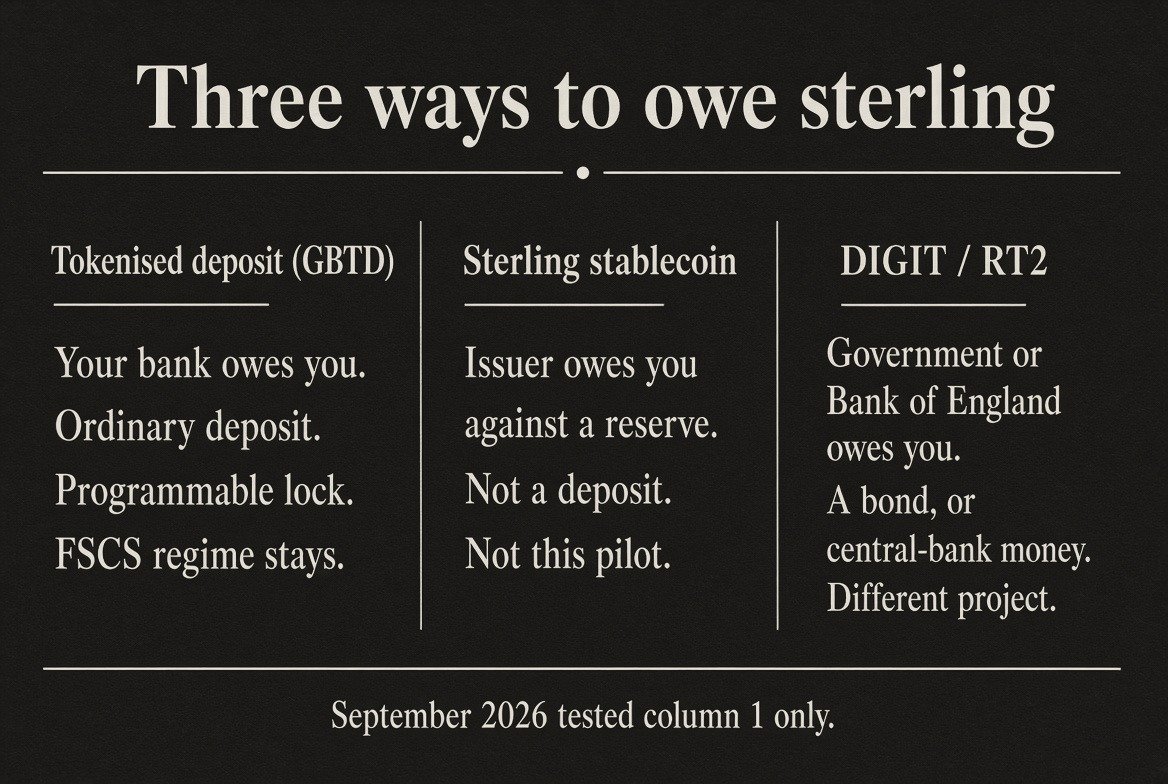
If a sentence in the press cannot survive that table, it is advertising.
The specialist version is the same table with the names filled in. GBTD is the successor-in-practice to the UK Regulated Liability Network experiments. UK Finance opened the live pilot phase in September 2025 with six banks and three use cases: marketplace payments, remortgaging, and digital-asset settlement. Monzo joined as the seventh participant in January 2026. Quant provides the shared infrastructure. Ledger Insights’ account of the design is the one that matters for interoperability: each bank keeps its own tokenised-deposit solution; GBTD is the messaging and clearing layer between them, not a single pot of money. That is why the pilot can be both “interbank” and “still your bank’s liability.” The pound does not leave the club to become a bearer instrument on a public chain.
What the pilots actually did
Two remortgages. One marketplace pattern. Both used the same primitive: lock the funds, release them when a condition is met.
In the remortgages, deposit funds were locked in the customer’s account and released automatically at completion. UK Finance says this cuts manual checks and settlement delay, and can leave the customer earning interest until the moment of completion. The pilots also looked at a digital connection to HM Land Registry, so a future completion might not depend on someone refreshing a portal. Lloyds, NatWest and Barclays were the banks on those tickets.
In the marketplace test, programmable deposits locked the buyer’s money and released it only when the goods were treated as exchanged. Reuters was careful, and the care is the point: while money moved between accounts, no real goods changed hands. It was a simulation of a private sale, not a shop that opened. HSBC was in the trio. The other two banks in that trio were not named in the wire copy.
The feature doing the work in both cases is not “blockchain.” It is the lock. Ordinary bank money can already be earmarked by a solicitor’s undertaking or an escrow account. Those tools are slow, manual, and full of people. The pilot’s claim is that the same economic idea (money that waits) can be expressed as a condition on the deposit itself, and can fire across more than one bank without a new kind of money being invented to carry it.
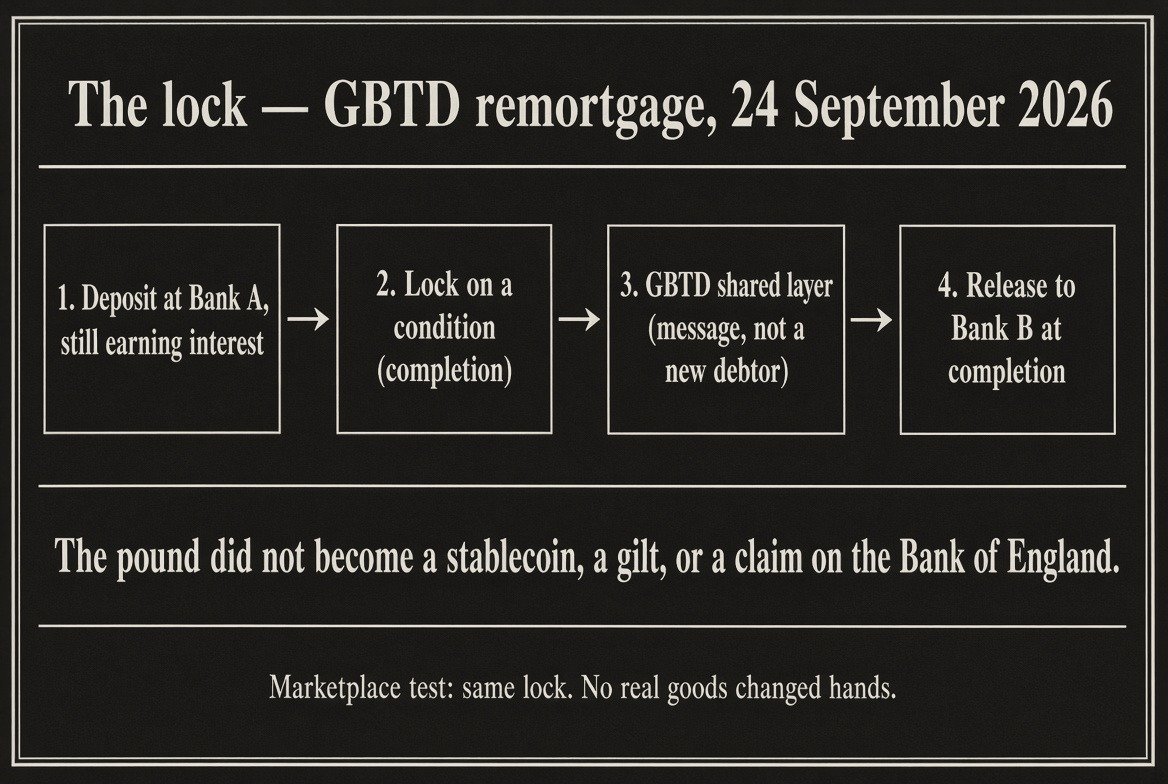
That is a modest claim. It is also the only claim the evidence supports. Treat anything larger as a forecast.
What they did not do
A reader who arrived from a tokenised-fund page will look for a number. There isn’t a useful one.
There is no public register of holders, because this is not a fund share. There is no AUM print, because the stock is the participating banks’ ordinary deposits, of which a slice was represented for a test. There is no redemption window in the BUIDL sense, because the customer’s claim was already a deposit: the “exit” is the account they already have. There is no secondary market to quote a basis against. There is no weekend clock to fail, because the pilots were scripted banking-day events, not a 24/7 rail in production.
UK Finance has said further pilots will try to link tokenised customer money to digital-asset settlement, and that banks intend to issue digital debt that can be traded and settled with these deposits, with coupons paid in tokenised deposits. Reuters, quoting UK Finance, added a nearer organisational fact: the project plans to establish a company, write a rulebook, and have the banks issue three digital bonds in the first quarter of 2027 that can be traded and settled with tokenised deposits. None of that has happened. A plan to issue is not an issue.
The Bank of England’s preference, stated again around this announcement, is the preference this series already treated as policy: it would rather banks innovate with tokenised deposits than with privately issued stablecoins. Preference is not a mandate, and it is not a timetable. It does explain why the UK’s loud sterling experiment in September was a deposit handle and not a new coin.
Where this already sat in the series
This note exists so the 24 September headline does not look like a gap in work that closed on the 25th. It is not a gap. It is a cell.
In The Neutral Engine (31 August), GBTD appears once, in the Synchronisation Lab table, beside LSEG, under “multi-purpose orchestration.” The Lab is the Bank’s way of auditioning an operator without becoming one. UK Finance has since said GBTD sits inside that Lab as a way to explore atomic settlement in central bank money. The August point survives: sterling stays in RT2, external ledgers stay external, the operator in the middle is still contested. A remortgage lock does not choose the operator.
In The Private Rail (16 September), the American version of the same object is drawn in two strokes. The single-bank garden (JPMD, Citi Token Services, BNY) moves among one bank’s own clients. The interbank piece was the missing one: Nellie Liang’s line at Brookings in April, quoted there, was that interbank settlement of tokenised deposits on private blockchains “does not exist” yet. The Clearing House’s network, aimed at the first half of 2027, is the American attempt to build it. GBTD is the British attempt, and it is ahead of TCH on one narrow fact: a customer payment has now moved between rival UK banks as a tokenised deposit. Neither network is a rail a treasurer can book against tomorrow morning. A deposit token that cannot leave its issuing bank is a product. One that can be cleared to another member bank is an infrastructure. GBTD has shown the second in a pilot. It has not opened it.
In The Shared Marketplace, Agorá’s legal conclusion is the sentence GBTD is acting out in sterling: a tokenised deposit remains an ordinary liability of the issuing bank; a tokenised reserve remains an ordinary claim on the central bank; the new object is where those two pre-existing claims can meet. Agorá tested that meeting across currencies, including sterling tickets from Lloyds. GBTD is testing it inside one currency, at retail size, with a lock. Same primitive. Different room.
In The Wiring (23 September), the uncomfortable layer is the core. A token can be final on a shared platform and still be a pending item in the batch system downstairs. Essay 01’s requirement on the UK core was: trigger back to RT2, not a shared mint. The pilots do not show that trigger firing in production. The Bank’s own timing for a live synchronisation capability remains 2028.
In The Map (25 September), the deposit-token row was drawn from the American side, because that is where three networks had announced themselves and still could not speak: TCH, Keystone, Cari. The UK cell was empty on that table because the live tickets had not yet been written up inside the series. This note fills the cell. It does not add a row.
Apply the map’s two questions.
Who provides the cash leg? The participating bank. The customer’s claim is on Barclays, or Lloyds, or HSBC, not on Quant, not on UK Finance, not on a pooled sterling token. GBTD is the switchboard.
Who will that cash leg not talk to? Anyone outside the seven, until a rulebook says otherwise. A sterling stablecoin. A public-chain wrapper. DIGIT, until someone builds the delivery-versus-payment path the pilots have only promised. RT2, until synchronisation leaves the Lab. The partition is not dramatic. It is the point of doing this inside the banking club.
Customer deposit (still the bank's liability) | | lock on a condition (completion / goods) v GBTD shared layer (Quant platform, seven banks) | | release to the other bank's customer v Receiving deposit (that bank's liability) Not in this picture: RT2, DIGIT, a stablecoin reserve, a public chain.
DIGIT is the other headline, and it is not this one
From 2024 the UK has had a project called the Digital Gilt Instrument, DIGIT. On 14 July 2026 the Chancellor said Britain aimed to issue a digital sovereign bond by early 2027, with further issuance after the pilot. HSBC’s Orion platform was selected in February 2026 to run it. The Bank has said it will work so the instrument can be used as collateral in its own operations. That is a government bond. GBTD is customer money. UK Finance has been explicit that tokenised deposits are meant to be able to sit under ambitions such as DIGIT. Reuters’ report that the GBTD banks plan three digital bonds in the first quarter of 2027, settled with tokenised deposits, is a bank plan sitting next to a sovereign plan. They can share a quarter and still be different instruments.
| GBTD | DIGIT | |
|---|---|---|
| What it is | A handle on an existing bank deposit | A new government bond |
| Who owes | The issuing bank | HM Government |
| What September 2026 proved | Lock-and-release on two remortgages and one simulated purchase | Nothing; issuance is still a 2027 aim |
| What early 2027 might add | A company, a rulebook, three bank digital bonds settled in deposit tokens | A pilot sovereign issue on HSBC Orion |
| What this series will not do | Print it as a daily tape | Invent a holder count that does not exist |
A labelled row is more useful than a page that pretends a pilot is a market.
What to watch, and what not to mistake for progress
Four facts would change the cell. None of them is a conference.
A rulebook with a name on it, and a company that can be sued or supervised. Until then, “interoperable” means “these seven, in a pilot.”
A ticket that is not a test. A remortgage in which the Land Registry leg is live, or a marketplace payment in which goods actually move, would be a different sentence from the one Reuters was right to write.
The reserve leg. GBTD inside the Synchronisation Lab is the banks raising their hand for the operator role in Essay 01. A live synchronisation against RT2 would be the cash-leg event. The Bank’s timing for that capability remains 2028. Do not bring the date forward because a mortgage completed on a Wednesday.
The bond leg. Three digital bonds in the first quarter of 2027, coupons in tokenised deposits, would be the first time this rail had an asset to settle rather than a condition to wait for. That is also the quarter aimed at for DIGIT. If both appear, the map’s questions still apply. A bank bond settled in Barclays deposit tokens is not a gilt settled in RT2.
What not to watch: price, TVL, a holder table, a redemption word. Those belong to fund shares and wrappers, which are a different page on this site. GBTD does not yet have a daily object. It has a pilot, a primitive, and a place on a map that was already drawn.
The useful picture
For the reader who wants the mechanism without the institutions, the remortgage is enough.
The borrower already has the money. It sits in their bank as a deposit, still earning interest, which is the detail UK Finance is right to emphasise: the lock is not a transfer to a solicitor’s client account that goes dead. At completion the condition fires. The deposit token is released to the party who should receive it, which in these tests was across banks, on Quant’s shared layer. The borrower’s claim never stopped being a claim on their own bank until the moment it was paid away. No new coin was minted to carry the pounds across the street.
For the reader who wants the institutions, the stack is short.
The customer sees a bank. The bank sees its own deposit system, plus a token handle. GBTD sees messages between those handles. Quant built the platform the messages run on. UK Finance convenes the club. Linklaters worked on the transactions. EY is on the programme. The Bank of England is not in the payment. It is in the background twice: as the supervisor that would rather this experiment happen in deposits than in stablecoins, and as the owner of RT2, which is where any future atomic settlement in central-bank sterling still has to land. DIGIT, when it exists, sits beside this stack as an asset, not inside it as money.
That is the whole machine. It is smaller than the headline, and more serious.
Where this leaves the page
The Cash Leg closed on 25 September with a working rule. Who provides the cash leg. Who that cash leg will not talk to. GBTD answers both, for now, in sterling. The cash leg is the member bank. It will not yet talk to a stablecoin book, to a non-member, or to the gilt. The pilots of 24 September are evidence that the lock works on a scripted ticket. They are not evidence that London has chosen its operator, issued its digital gilt, or replaced Faster Payments.
Patience here is not a mood. It is the difference between a condition that fired in a pilot and a rail a payment can depend on. The series was early on the question and early, deliberately, on the monetisation of an answer. This note is the same posture applied to a headline that arrived in the right week: present, sourced, and unwilling to promote a test into a market.
The pound waited until completion. That is the news. Everything else is still a timetable.
Notes
1. UK Finance, “Tokenised sterling deposits — GBTD initiative,” announcement of the September 2026 retail live pilots, including the two remortgage completions and the marketplace transaction. https://www.ukfinance.org.uk/tokenised-sterling-deposits-gbtd-initiative
2. UK Finance, “UK Finance announces live pilot phase to deliver tokenised sterling deposits,” September 2025, six founding banks, three use cases, Quant, EY, Linklaters, and the explicit link to DIGIT and the National Payments Vision. https://www.ukfinance.org.uk/news-and-insight/press-release/uk-finance-announces-live-pilot-phase-deliver-tokenised-sterling
3. Reuters, “UK banks make first interbank transactions using tokenised deposits,” 24 September 2026. Two remortgages; a marketplace simulation in which no real goods changed hands; Bank of England preference for tokenised deposits over stablecoins; plan for a company, a rulebook, and three digital bonds in the first quarter of 2027 settled with tokenised deposits. https://www.reuters.com/business/finance/uk-banks-make-first-interbank-transactions-using-tokenised-deposits-2026-09-23/
4. CoinDesk, “UK’s largest banks complete world’s first interbank transactions using tokenized deposits,” 24 September 2026. https://www.coindesk.com/business/2026/09/24/uk-s-largest-banks-complete-world-s-first-interbank-transactions-using-tokenized-deposits
5. Ledger Insights, “UK tokenized deposit platform GBTD conducts first live transactions,” 24 September 2026. Retail-first design; each bank keeps its own tokenised-deposit solution; GBTD as messaging and clearing; lock used in every initial ticket; interest continuing until completion. https://www.ledgerinsights.com/uk-tokenized-deposit-platform-gbtd-conducts-first-live-transactions/
6. Capital Pioneer, “GBTD runs UK’s first live transactions,” 25 September 2026. HM Land Registry connectivity explored; further tests planned for digital-asset settlement. https://capitalpioneer.co.uk/gbtd-runs-uks-first-live-transactions/
7. Bank of England Synchronisation Lab. GBTD is a participant, paired in our August table with LSEG under multi-purpose orchestration. See Revix Analytics, “The Neutral Engine,” 31 August 2026. https://revixanalytics.com/notes/cash-leg-neutral-engine/
8. Revix Analytics, “The Private Rail,” 16 September 2026, on the single-bank deposit token and the missing interbank leg. https://revixanalytics.com/notes/cash-leg-private-rail/
9. Revix Analytics, “The Shared Marketplace,” on Agorá’s two-layer split: tokenised deposits remain bank liabilities; tokenised reserves remain central-bank claims. https://revixanalytics.com/notes/cash-leg-shared-marketplace/
10. Revix Analytics, “The Wiring,” 23 September 2026. https://revixanalytics.com/notes/cash-leg-the-wiring/
11. Revix Analytics, “The Map,” 25 September 2026. The two questions this note applies. https://revixanalytics.com/notes/cash-leg-the-map/
12. Reuters, “UK to issue first ‘digital’ bond by early 2027, finance minister says,” 14 July 2026. DIGIT timetable; HSBC selected to run the platform; Bank of England collateral work. https://www.reuters.com/world/uk/uk-issue-first-digital-bond-by-early-2027-finance-minister-says-2026-07-14/