The Cash Leg · Intermezzo · Halfway · 12 September 2026
Bond Markets: “The Free-Money Era Is Over”
Why yields are rising in Britain, America , Japan and why this is a negotiation among a country’s own lenders, not a rerun of 1973, 1987 or 2008
I. Underneath the “smoke cover”
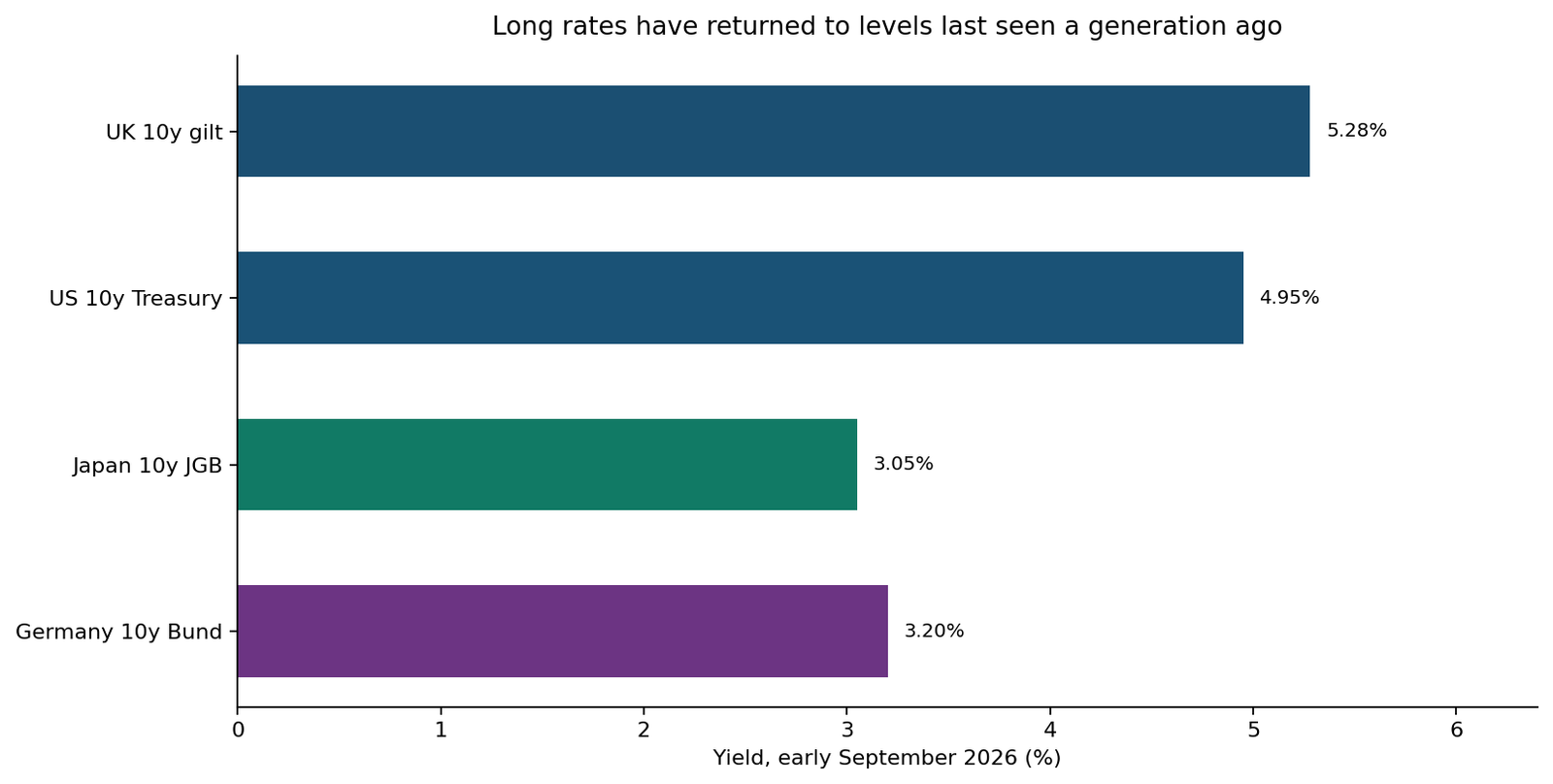
Something odd has been happening in financial headlines this year. Central bankers speak in careful phrases. Finance ministers talk about fiscal headroom and credibility. Behind the language, government bond yields have climbed to levels not seen in a generation across the largest developed economies. Japan’s ten-year yield has crossed 3 per cent for the first time since 1996. Britain’s thirty-year gilt has traded near 5.9 per cent, its highest since the late 1990s. America’s ten-year Treasury has pressed toward 5 per cent. German bunds have reached a fifteen-year high.
To the average reader this can sound abstract, until it is not. Mortgage rates follow. Currencies wobble. Politicians discover that the Autumn Budget is being written, in part, by people who will never stand for election. The temptation is to reach for an old script: oil shock, inflation spiral, systemic crash. Those scripts do not fit. Oil is around one hundred dollars a barrel, but the United States is now a net energy exporter, China holds large strategic reserves, and Britain is no longer the weakened, import-dependent economy of the mid-1970s. Inflation has been sticky in places; it has not become the decade-long stagflation of fifty years ago. Nor does this resemble 2008, when institutions failed and liquidity vanished, or 1987, when a crash tore through equity markets in a day.
What is happening is narrower and, in a way, more interesting. The people who buy government bonds (pension funds, insurers, banks, asset managers, and in several countries the central bank itself) are the same ecosystem that issues, regulates and spends the money. They are asking for a better price. Yields are rising because the free-money era that ran from the late 1990s through the zero-rate years and the pandemic is over, and because governments kept spending as if it were not. The market is not panicking. It is negotiating. This essay sets out who those buyers are in Britain, the United States, Japan and China; why corporate America has suddenly become a rival borrower of sovereign scale; why the political lock-in after Covid made fiscal honesty so hard; and why the most realistic technical exit now on the table (the tokenisation of government debt) can widen the buyer base and make each bond work harder, but cannot replace the conversation with voters that the last thirty years have postponed.
II. Who actually buys the bonds
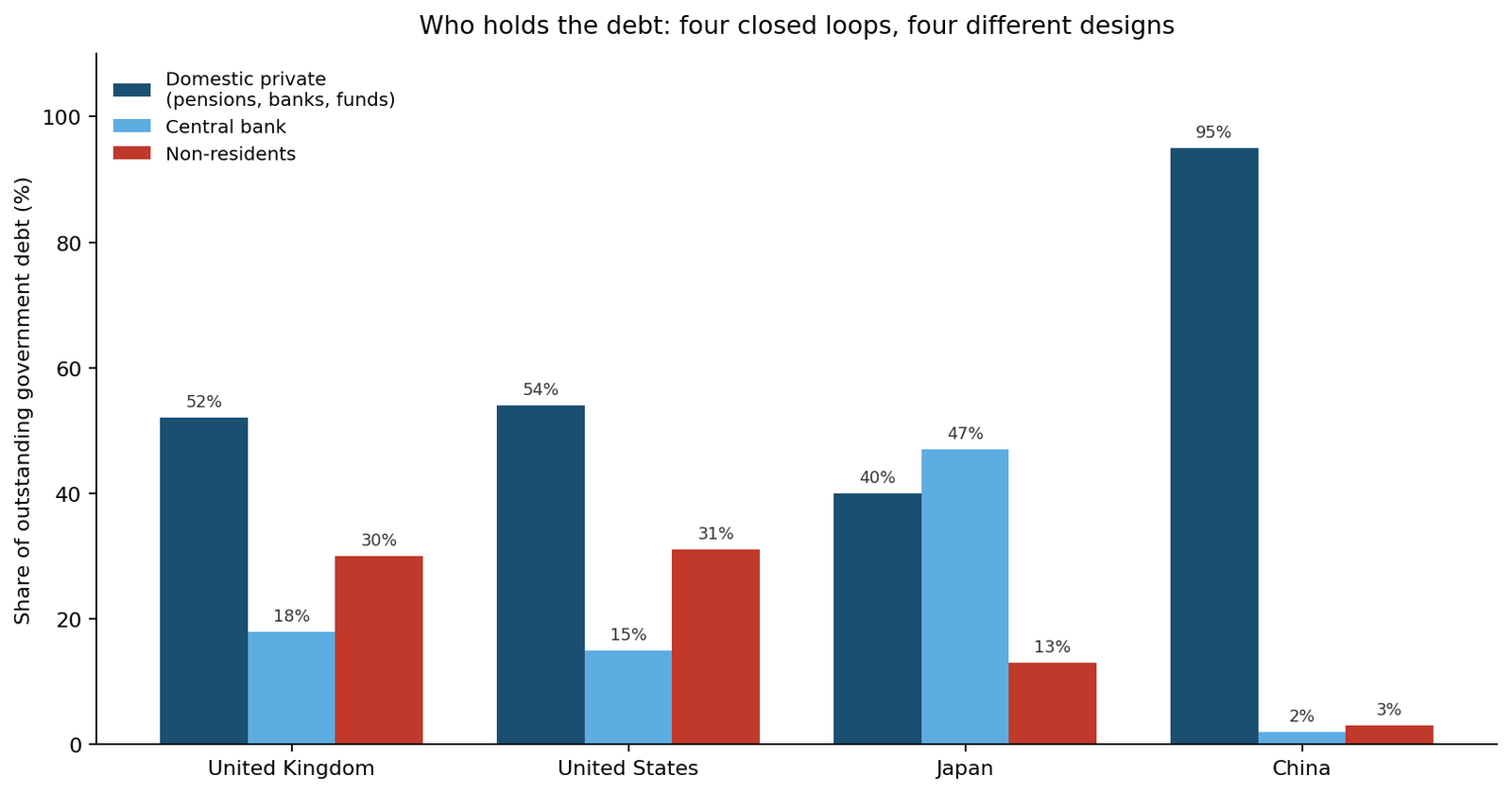
When a government spends more than it collects in tax, it sells bonds: IOUs that pay interest over a stated life. The popular image is of “the world” lending to a country. The reality is more concentrated, and it differs sharply by jurisdiction. The cast of buyers is similar everywhere (central banks, pension funds and insurers, commercial banks, asset managers, foreign official institutions) but the proportions are not. Those proportions determine how quickly a government feels pressure when confidence slips.
What is striking is how few of these buyers sit outside the domestic political economy. Central banks set interest rates and also hold the bonds. Regulators require banks to hold high-quality liquid assets and then rely on those same banks to absorb issuance. Pension funds benefit from state retirement policy while pricing the credit of the government that writes the rules. This is not a conspiracy. It is how modern sovereign markets are built. It does mean, however, that the bond market is less an anonymous foreign judge than an interconnected system in which referees, coaches and players overlap.
| Market | Typical investors | Foreign holders | Central bank share | What matters |
|---|---|---|---|---|
| United Kingdom (gilts) | Pensions, insurers, banks | ~30% | ~18% (falling) | Domestic, duration-hungry, increasingly price-sensitive |
| United States (Treasuries) | Domestic funds, banks, households, hedge funds | ~30-33% | ~14-17% | Global reserve asset; private demand now the marginal buyer |
| Japan (JGBs) | Bank of Japan, banks, life insurers | ~8-14% | ~43-48% | Closed loop; foreigners mostly in T-bills |
| China (CGBs) | State commercial banks | <3% | Small direct share | Administratively absorbed; weak independent price signal |
Britain
Gilts have long been a domestic story. Defined-benefit pension funds and insurers were structural buyers of long-dated and index-linked paper because it matched liabilities decades ahead. That pillar has been shrinking as schemes close and defined-contribution saving grows. The Bank of England, which once held more than a third of the stock under quantitative easing, now holds around 18 per cent and is a seller, not a buyer. Overseas investors hold a remarkably stable share of about 30 per cent since the “kindness of strangers” has not grown, but it has not fled either. What has grown is the role of other financial institutions, including hedge funds, and a still-modest but fast-rising retail presence in short, low-coupon gilts, attracted by tax treatment and yields that finally look like a return. Newly issued debt is still absorbed first by domestic non-banks; the price-sensitive margin, however, is increasingly foreign and opportunistic.
The United States
Treasuries remain the world’s safe asset, which is why America can run a different experiment from everyone else. Foreign official buyers (central banks warehousing dollars) used to dominate the overseas slice. Their share has faded; foreign private holders, including funds booked in the Cayman Islands, London and Luxembourg, now outrank official accounts. At home the Federal Reserve has shrunk its portfolio. The slack has been taken up by banks (under post-crisis liquidity rules), money-market funds (especially in bills), households buying directly from TreasuryDirect, and hedge funds running basis trades. Foreigners still hold roughly a third of publicly held debt. Japan, Britain and a string of custodial centres sit at the top of the country list. The dollar’s reserve role is the cushion no other sovereign enjoys. It is not a blank cheque. Domestic investors have become the marginal buyer, and they have opinions about yield.
Japan
Japan is the purest closed loop in the developed world. Around nine-tenths of the debt is held at home. The Bank of Japan still owns close to half of JGBs, the residue of yield-curve control and years of buying whatever was required to keep long rates near zero. Banks, life insurers and public pensions take most of the rest. Foreigners are a single-digit to low-teens share of the stock and cluster in short bills. That architecture is why a debt-to-GDP ratio north of 230 per cent did not produce a gilt-style drama. It is also why 2026 matters. As the Bank of Japan steps back and global inflation makes zero forever harder to defend, domestic banks and pensions must relearn how to be price-makers. Ten-year yields above 3 per cent are the first public evidence that even this system has a limit.
China, the outlier
On the surface China resembles Japan: almost all the paper is domestic. The resemblance ends there. Commercial banks (especially the large state institutions) hold the overwhelming majority of government and policy-bank bonds, often two-thirds or more of the sovereign book, because deposits need a home and the bonds are tax-advantaged. Foreign holdings of onshore government debt remain a few per cent. There is no independent pension-fund vigilante in the Western sense. Official central-government debt looks manageable; once local-government vehicles are included, augmented public-sector debt sits, on IMF-style estimates, well above 100 per cent of GDP, and broader private plus public debt is in a different league. Beijing manages this with administrative tools (swaps, extensions, directed buying) not with a market-clearing yield. Tokenisation in China, as we shall see, is being built as control infrastructure, not as a new social contract with independent lenders.
III. This is not the 1970s, and it is not 2008
A serious essay has to kill the wrong historical analogies before they colonise the argument. The 1970s combined an oil embargo, a quadrupling of crude prices from a low base, unionised wage indexation, a United Kingdom still dependent on imported energy, and an America that was not yet a shale power. Supply broke. Inflation became a regime. Sterling was a crisis currency. None of that is the present tense. A hundred-dollar barrel is expensive, but it is expensive inside a system that has spare capacity, strategic stocks and, in America’s case, self-sufficiency. China can lean on reserves. Supply chains have been stressed; they have not snapped in the way that turned the oil shock into a decade.
Nor is this 2008. In 2008 the problem was the plumbing of private credit: leveraged intermediaries, opaque assets, a run on wholesale funding. Government bonds were the asset people fled toward. In 2026 government bonds are the asset whose price is being marked down so that they can compete for a finite pool of long-term capital. Liquidity in core markets has been strained at times (March 2020 remains the warning) but there has been no general inability to issue. Buyers exist. They want better terms.
The closer rhyme is the original “bond vigilante” episode of the early 1980s, named by Ed Yardeni in 1983. Lenders decided that fiscal trajectories were sloppy and demanded compensation. Yields rose. Governments were forced to change course. The mechanism is the same. The cast is more domestic now, and the preceding sin is different: not a burst of 1970s inflation alone, but a thirty-year habit of treating near-zero rates as a permanent endowment.
IV. The free-money ratchet
Start the clock in 1997 and skip 1987. The subsequent three decades delivered a sequence of shocks that each seemed to justify easier money: the dot-com bust, 2008, the euro-area crisis, Covid, and a long zero-rate interval in which crypto and other speculative cycles flourished on the back of abundant liquidity. After each shock, policy rates were cut or held down, and after 2008 central banks bought the bonds themselves. The pandemic was the extreme case. Governments said, credibly, that they would print and spend because a disease had closed the economy. That was an emergency. The emergency ended. The spending habit did not.
This is the political meaning of “fiscal responsibility” in 2026. It is not a lecture about Victorian thrift. It is the observation that voters were taught, for three years of genuine crisis and then for the years after, that the state could create money and transfer it without an immediate bill. Furlough, stimulus cheques, emergency credit, energy subsidies: each had a case. Together they reset the baseline. Tightening after the fact is electorally poisonous. No government wants to be the one that says the free-money era is over. So deficits became structural. Ageing added a second, quieter pressure on health and pensions. Debt-to-GDP in Britain approached 100 per cent. In America the stock kept climbing through an expansion. In Japan the central bank had already socialised the consequence.
The bond market is what remains when the ballot box will not hold that conversation. Pension funds demanding a higher gilt yield are, in many cases, the same institutions that pay the pensions of the citizens who receive the spending. That is not hypocrisy. It is fiduciary duty colliding with political convenience. The vigilantes are not rewarding virtue. They are pricing the absence of a plan. Rising yields are the only lever left once quality and safety are no longer differentiators — because a gilt and a Treasury are still among the safest claims on earth. If they must clear against a larger menu of other high-grade paper, the only instrument is price.
V. Britain as the sharp case
The United Kingdom sits in the awkward middle of the four-country comparison, which is why it has felt the discipline first and loudest. It is heavily domestic, like Japan, but it does not have Japan’s decades-long culture of absorbing paper at any price, nor the Bank of Japan’s willingness to own half the market. It has a meaningful foreign slice, like America, but it does not issue the reserve currency. After the Truss mini-budget of September 2022, investors learned that a British government could lose the gilt market in days. That memory still sits in prices. It is not, however, the whole story. Today’s pressure is slower and structural: debt near 100 per cent of GDP, weak trend growth, an ageing population, and a central bank that is selling gilts into the same market the Treasury must tap.
The political calendar has added uncertainty rather than relief. Andy Burnham became prime minister on 20 July 2026 and appointed John Healey, a former defence secretary with Treasury experience but no recent fiscal brand, as Chancellor in place of Rachel Reeves. Gilt yields ticked higher around the handover. By early September the ten-year gilt was trading above 5.2 per cent and the thirty-year near 5.9 per cent. Commentators describe the Budget of 28 October as an event at which “the bond market is writing the budget.” Estimates of the hole that must be closed merely to restore spring headroom run to around £11 billion before any new ambition. Defence, which Mr Healey has argued should rise, sits on the other side of the ledger.
None of this is a solvency crisis. Britain can still issue. The question is the terms, and whether a new government will tell a tired public that the pandemic exception has expired. That is a credibility problem. It is solvable. It is also exactly the sort of problem democracies postpone until the price of postponement shows up in the long end of the curve.
| Metric | United Kingdom | United States | Japan | China |
|---|---|---|---|---|
| Debt / GDP (order of magnitude) | ~100% | High, rising | >230% | Official modest; augmented much higher |
| Reserve-currency cushion | None | Dollar: decisive | None | None (ambition only) |
| Can the central bank still absorb? | Selling (QT) | Shrinking | Still huge, stepping back | Directed banking system |
| Independent price signal? | Yes, sharp | Yes, global | Yes, newly reawakening | Weak |
| Main constraint in 2026 | Fiscal arithmetic + politics | Issuance scale + private buyers | BoJ exit + inflation abroad | Hidden local debt, not yields |
VI. A new rival at the long end: corporate America
Sovereigns are no longer the only borrowers of size in the high-grade long market. Until 2024 the large American technology companies known as hyperscalers (Amazon, Alphabet, Meta, Microsoft, Oracle and their closest peers) barely issued. Cash flow paid for capital spending. The artificial-intelligence build-out changed the arithmetic. Capital expenditure on data centres, chips and power has run ahead of free cash flow. In 2025 those firms issued on the order of $180-200 billion of investment-grade debt. Through late summer 2026 the figure was already around $320 billion of long-term paper and related financing, a sum JPMorgan has compared to roughly two-thirds of long-term Treasury coupon issuance over the same stretch. Street forecasts for the year cluster between $250 billion and $400 billion once the wider AI-adjacent complex is included.
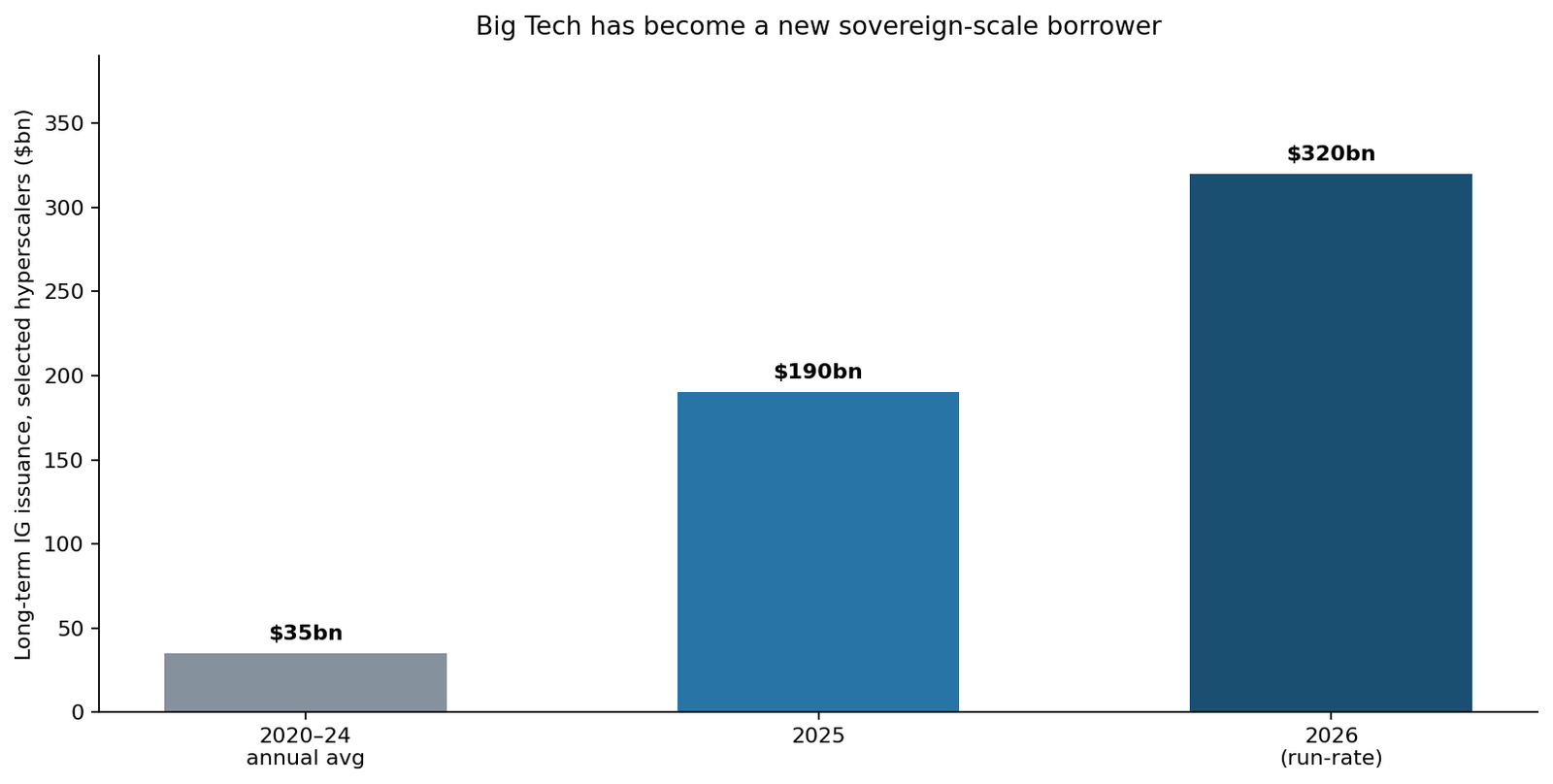
The important fact is credit quality. This is AA-rated paper, often with maturities of fifteen, thirty, even forty and a hundred years. It competes directly with thirty-year gilts and Treasuries for the same liability-matching capital: pensions, insurers, official institutions. When a company prints a $30 billion thirty-year bond, it absorbs duration that would otherwise have gone into government paper. Buyers frequently hedge the rate risk by selling the equivalent Treasury, adding a second wave of supply at the same point on the curve. Analysts have begun to call this reverse crowding-out: instead of the state squeezing out companies, the AI cycle is forcing the state to pay up.
The investor base did not grow by a matching amount. The same institutions now face a larger menu. Governments cannot compete on perceived safety with Microsoft or Alphabet at the long end; in some recent episodes top corporates have even borrowed more cheaply than their sovereigns. So the sovereign’s remaining tool is yield. That is why the corporate boom belongs inside a sovereign-debt essay. It is another reason the free-money era cannot return by stealth. Duration has a scarcity value again, and two sets of AAA-adjacent borrowers are bidding for it.
VII. Why the picture it is serious, not catastrophic
Alarm travels faster than proportion. Four qualifications keep the argument honest.
First, these are still the most trusted credits on earth. Rising yields mean buyers are asking for a better price, not that buyers have disappeared. That is a different condition from an emerging-market stop.
Second, debt-to-GDP ratios above 100 per cent are not historically unique. Advanced economies have carried such loads after wars and worked them down through growth, inflation and fiscal effort. The absolute numbers look vast because the economies are vast.
Third, a price on public debt can be productive. It forces governments to prefer projects whose return exceeds the cost of funds. The alternative (a decade of rates pinned at zero) was not costless. It subsidised duration, inflated asset prices, and taught politics that constraints were optional.
Fourth, the commentary loop is part of the volatility. Twenty-four-hour markets and social media reward the most extreme frame. Measured analysis (this is a credibility problem among domestic institutions) travels less well than “collapse.” The underlying situation does not require collapse language. It requires governments to re-earn the trust of their own lenders.
VIII. An infrastructure exit: tokenisation
If the political problem is courage, the technical problem is the infrastructure. Over the past two years, and with unusual intensity in 2026, the same four systems have begun to move government debt onto distributed ledgers. This is not a substitute for fiscal arithmetic. It is the first credible infrastructure answer to a problem that has been treated as only fiscal or monetary. Used honestly, tokenisation widens who can hold the debt, how fast it can move, and how much work each bond can do. Used as a trick, it merely finds new buyers for the same deficit.
Britain is closest to a sovereign-native experiment. The Digital Gilt Instrument, DIGIT, has been contracted to HSBC’s Orion platform and is being prepared inside the Digital Securities Sandbox, with a first G7 digital sovereign issue aimed at early 2027. The Bank of England has said it wants DIGIT eligible as collateral in its own operations and is working toward a live synchronisation service later in the decade. More immediately, the Bank’s proposed regime for sterling systemic stablecoins would back those coins largely with short UK government debt at around 70 per cent in steady state, in bills of six months or less. The Debt Management Office is already asking how that demand should shape T-bill supply. That is not a cryptocurrency curiosity. It is a new, rules-based buyer of gilts being written into regulation.
America is building the rails first and leaving official issuance for later. The stock of tokenised Treasuries is still only about $15-16 billion, noise against a market of more than $27 trillion. BlackRock’s BUIDL fund is the largest single product. The change that matters is post-trade. DTCC ran live production trades in July 2026 (Treasury repo, delivery-versus-payment, collateral pledge, securities lending) and is opening a Tokenisation Service in October covering Treasuries, Russell 1000 equities and major exchange-traded funds. Broadridge, Canton and a working group of more than fifty firms sit behind that launch. DTCC’s useful statistic is not the $16 billion. It is that only about a tenth of global high-quality liquid assets are actually used as collateral, and tokenised workflows could lift that utilisation by a third or more. Same stock of bonds; more funding capacity.
Japan is treating the technology as a way to keep a closed-loop market usable after the Bank of Japan steps back. A working group of the three megabanks, SBI, BlackRock Japan and the exchange is designing tokenised JGBs and on-chain repo in a market worth about $1.6 trillion. The prize is twenty-four-hour collateral and the ability to raise dollars or euros against a JGB token without waiting for Tokyo hours. Yen stablecoins may now hold short JGBs in their reserves. That is the Japanese cousin of the British stablecoin–T-bill loop: digital cash that must buy government paper.
Europe has removed the barrier that made digital bonds second-class. From 30 March 2026, distributed-ledger securities issued through a central securities depository are eligible Eurosystem collateral. The European Investment Bank has already issued ledger-native commercial paper that was pledged at the Bundesbank. Project Pontes, due in the third quarter of 2026, is meant to settle such trades in tokenised central-bank money. Volumes remain small. The legal fact is not.
China, again, is the outlier. It is not opening the government-bond market to a global retail or decentralised buyer base. It is folding bonds, fiscal payments and settlement into a state stack: the e-CNY at enormous pilot scale, CIPS, the mBridge multi-currency experiment, and isolated ledger bond issues settled in digital yuan. Hong Kong’s digital green bonds sit between the two models — Western in form, strategic in purpose. Tokenisation there is control infrastructure.
| Market | Status | Current infrastructure | Why it matters |
|---|---|---|---|
| United Kingdom | DIGIT targeted Q1 2027 | Sandbox; stablecoin backing in bills; collateral work | First G7 digital sovereign; new T-bill buyer |
| United States | Not yet official | DTCC service Oct 2026; ~$16bn tokenised T-bills | Collateral mobility, not new Treasury issuance |
| Japan | Working-group pilots | On-chain JGB repo design; stablecoin reserves in JGBs | 24/7 collateral after BoJ steps back |
| Euro area | SSAs and corporates first | DLT paper eligible at ECB; Pontes Q3 2026 | Makes digital bonds first-class collateral |
| China | State-directed pilots | e-CNY settlement of selected bonds; HK issues | Control and payment rails, not open price discovery |
Three consequences follow for the argument of this essay.
First, tokenisation can expand the table. Fractional gilts, round-the-clock access and stablecoin reserve rules create buyers who were not in the auction room: platforms, foreign wallets, retail accounts that can hold a slice of a bond rather than a fund wrapper. Mandatory reserve demand is the most important of these, because it is not discretionary.
Second, it can make the same bond do more work. If a thirty-year gilt can be pledged, recalled and re-pledged in minutes, pension funds and banks need less idle inventory to stay liquid. That eases, at the margin, the crowding from hyperscaler thirty-year paper. It does not shrink the deficit. It raises the carrying capacity of the existing stock.
Third, it can make self-regulation visible. Coupons, sinking funds, even simple rules that constrain new long issuance above a stated ratio of national income can be written into the instrument. That is the politically dangerous gift of the technology. The public does not have to understand a ledger. It has to accept that the IOU is no longer a foggy promise managed in Whitehall and Threadneedle Street, but a programmable claim. Transparency as discipline is precisely the “harsh condition” democracies have spent thirty years avoiding.
What tokenisation cannot do is print real savings. If issuance stays on the pandemic ratchet, the new rails simply sell the same paper faster to a slightly larger crowd. Stablecoin demand for bills is a recirculation of existing cash, not a new surplus. Hyperscalers will tokenise their bonds too; the competition for duration does not vanish when both sides move on-chain. A programmable gilt that actually constrained spending would require the courage the period from 1997 through zero rates and Covid has shown is scarce.
IX. Conclusion: four pictures, one sentence
Put the four markets together and the uniform-crisis narrative falls apart. Britain, America and Japan are variations on a single dynamic: domestic lenders (pensions, banks, and in Japan the central bank itself) recalibrating how much risk they will absorb from their own governments. None faces an imminent solvency event. All face a solvable problem of credibility after a long period in which historically low rates hid the cost of accumulation. China is a structurally different case: a closed loop without an independent price signal, managing a larger and murkier debt stock by administrative means.
Corporate issuance has entered that story as a competitor, not a side-show. A handful of companies now request hundreds of billions a year from the same long-duration buyers. Governments cannot out-quality them. They can only out-yield them. That is why legacy curves have had to give investors a better deal.
Tokenisation is the first serious attempt to change the pipes rather than the politics. It can broaden the buyer base, raise the usefulness of each bond, and if anyone dares it can encode the constraint the ballot box has refused. The technology is no longer the bottleneck. Acceptance of the constraint still is.
The sentence worth leaving with a general reader is therefore simple. Bond markets are not passing a mysterious external judgment on these countries. They are the pension funds of their own citizens, their own banks, and in some cases their own central banks, saying through the price they will lend at that the free-money era is over. How each government answers that sentence over the next year will matter more than the raw debt totals. The harsh condition is not collapse. It is honesty.
Note on sources and figures
Holder shares and yield levels are rounded from national flow-of-funds accounts, debt-management reports, Bank of England and Bank of Japan publications, US Treasury TIC data, and market screens as of 11 September 2026 (UK 10-year gilt near 5.3 per cent; 30-year near 5.9 per cent). Hyperscaler issuance figures follow 2026 market tallies from bank research (including JPMorgan and related press summaries) and should be read as orders of magnitude, not audited totals. Tokenisation timelines follow official notices from the Bank of England, HM Treasury, DTCC, the ECB and Japanese industry groups in 2026. This essay is an explainer, not investment advice.