The Cash Leg · Essay 09 of 11 · International Monetary Fund · 21 September 2026
The Rules Without a Rail
How the IMF tried to stop two clubs becoming two systems
This morning Frankfurt switched a rail on. The institution that spent the year warning about two rails owns neither of them.
This morning the Eurosystem switches on Pontes. Tokenised securities on private distributed-ledger platforms can settle the cash leg in central-bank money with cash tokens on a Eurosystem ledger, or a trigger that walks back into T2. Day one is narrow on purpose: 09:00 to 16:00 CET, euro only, T2 business days. Pricing is a one-off EUR 15,000 for a market DLT operator and EUR 2,500 for a participant, with no running tariff in the opening phase. Somewhere in the run-up the ECB dropped the word “pilot.” This is a production service, launched on the date essay three wrote down. At 17:00 CEST Christine Lagarde opens a closed roundtable in Frankfurt and Piero Cipollone chairs the panel. That is a go-live. It is not yet a book of tickets. Market infrastructure houses still talk about first bond issuances in the months after the switch, not before lunch.1
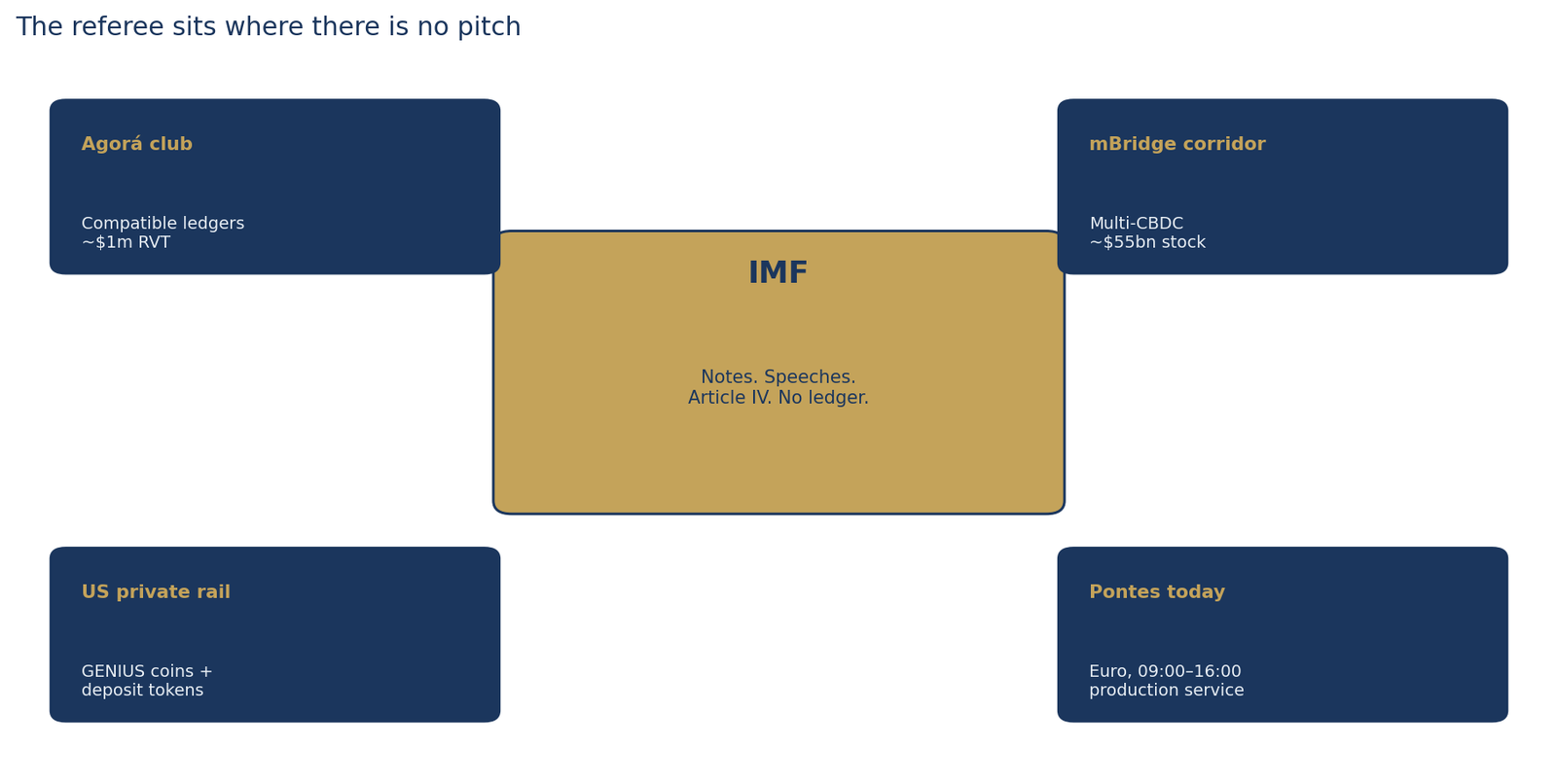
Now the turn. The institution that spent more of 2026 warning about fragmentation than any other did not switch anything on this morning. The International Monetary Fund has no Pontes, no Agorá node, no mBridge seat. What it has this week is two staff Notes and a conference speech. Sit with that asymmetry. The actor most anxious about the world’s tokenised money pulling apart owns none of the pipes that would hold it together.
The job the Fund actually has
“The IMF should do something about fragmentation” hides a vacancy. The mandate is the international monetary system (exchange rates, balance of payments, the architecture) not a market infrastructure. The Fund can write taxonomies. It can put central bankers in a room. It can, in an Article IV consultation, note in diplomatic English that a member’s tokenisation framework carries stability risk, and publish the staff report, without power to compel a change outside a lending arrangement. Where a country is already borrowing, conditionality can touch the financial sector. That lever reaches the members who need the money. It does not reach the self-financing jurisdictions this series has spent eight essays on. The Fund cannot finalise a ticket, run a ledger, or order a reserve token to talk to another reserve token.10
This protagonist is a referee with no pitch. Authority is real. Infrastructure is absent. Every subsequent claim in the Notes has to be read against that limit or the reader will mistake analysis for a switch.
The vacancy has a geography. The members most able to fragment the system (the reserve-currency issuers, the Gulf hosts of sukuk stock, the operator of mBridge) are the members least reachable by programme conditionality. An Article IV paragraph can name a risk in New York, Frankfurt, Beijing or Riyadh. It cannot rewrite GENIUS, Notice 42 or a Shariah standard. The Fund’s hardest audience is therefore the audience it can only persuade. That is not a criticism of the Notes. It is the reason a five-pillar list, published as staff analysis, is doing as much work as the institution is institutionally allowed to do.
What remains useful is still useful. Surveillance language travels. An FSAP can put tokenisation risk on a formal page a finance ministry cannot easily lose. A G20 note can force two clubs to sit in the same annex even if they will not share a node. None of that settles a ticket. All of it is how a referee without a pitch still changes the terms on which the next pitch gets built. The essay that pretends the Fund is powerless and the essay that pretends the Fund is a standard-setter are both wrong in the same way: they skip the middle, which is influence without a switch.
What 2026 actually published
Work from the documents. Commentary has, in places, run ahead of the claim.
The first document is IMF Note 2026/001, Tokenized Finance, dated 2 April, signed by Tobias Adrian. Tokenisation, it says, is a structural shift in financial architecture, not a faster pipe. Permissioned shared ledgers, programmable assets and smart-contract risk management move trust into code and key-holders a supervisor cannot always reach. From that diagnosis comes the five-pillar roadmap. The cover is equally important: the Note is the author’s view, disseminated quickly, not Board-approved doctrine. Treat it as the best official thinking the Fund has put on paper this year. Do not treat it as a standard.2
The second is IMF Note 2026/006, The Rise of Tokenization, 1 July, Adrian with Yaiza Cabedo and Tommaso Mancini-Griffoli. April diagnosed. July sorted. A three-layer stack: infrastructure, assets, services. A three-asset taxonomy: tokenised deposits, stablecoins, tokenised central-bank reserves. A ledger matrix, building on their own 2023 work with single ledger, compatible ledgers, common ledger. Read against this series the sort is clean. Agorá is compatible-ledger: a unifying deposit surface over jurisdictional reserve ledgers. A fully centralised Eurosystem platform leans common-ledger. London’s synchronisation is compatible-ledger of another kind, a trigger across systems that stay separate. The July Note names Pontes and Appia as public infrastructure private platforms will emulate, because every participant wants to remain compatible with central-bank money. Whatever rail the central bank lays, the private sector walks toward it. That is influence without a mandate.3
The third document is a speech. On 11 May, at the Boston and New York Fed conference on stablecoins and tokenisation, Adrian named the four supports that have historically kept one unit of money as good as another: settlement finality, the central bank as the last settlement asset, standing liquidity facilities, deposit insurance. Tokenisation does not retire those supports. It makes the pauses in which they used to work disappear. A book that margins itself at three in the morning has no overnight window left for a human to notice. Agorá was cited as the live experiment that at least designed with those four supports in mind rather than bolting them on later.4
A fourth piece of work is the Fund being candid that Notes will not close what they describe. Itai Agur and Alexander Copestake’s working paper, first out in 2025 and still being updated in 2026, models tokenised-market coalitions. Brokers with different market power form platforms. Partial coalitions steal flow from the excluded. Technical progress that makes tokenisation cheaper can increase fragmentation rather than reduce it. Neither public-private cost-sharing nor an interoperability mandate, used alone, reaches the social optimum. The combination might. Getting the combination requires exactly the coordination the Fund is best placed to argue for and least equipped to enforce.5
The five pillars, forced onto this series
On the page the pillars look like prudential hygiene. Laid over the eight architectures already written, they become a scorecard. Not a ranking of countries. A test of whether the sentence survives contact with a real cash leg.
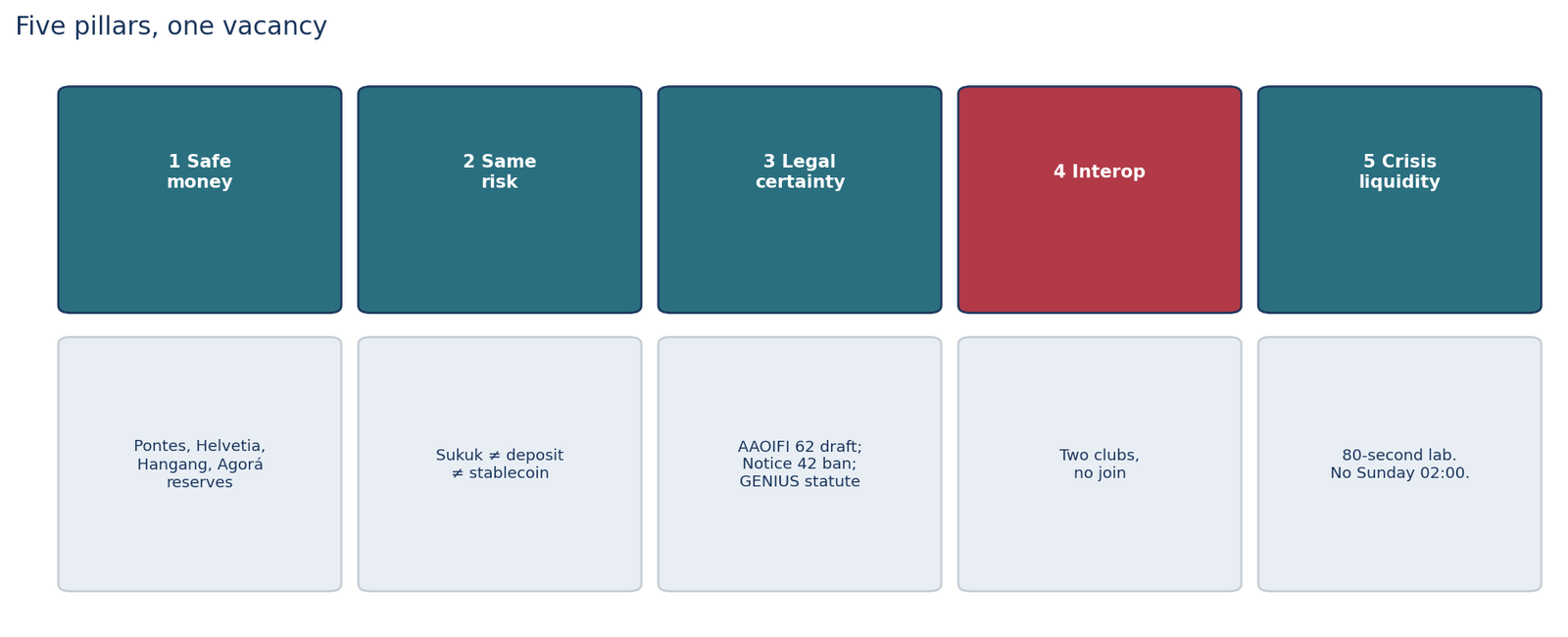
Pillar one: anchor settlement in safe money. Systemically important tickets should settle in assets that minimise credit and liquidity risk. Pontes, Helvetia, Hangang’s wholesale layer, and four of the five central banks that issued reserve tokens in Agorá’s July test satisfy the pillar by construction. GENIUS-regulated dollar stablecoins satisfy a weaker version of the Treasuries and insured deposits in the reserve stack, never a direct claim on the Fed. The e-CNY satisfies it at home. mBridge satisfies it only inside its own bloc, and then mostly in one currency.7
Pillar two: same activity, same risk, same regulatory outcome. The FSB-IMF line, written first for crypto, now pointed at tokenised liabilities. Essay five already strained it. A tokenised deposit, a wakalah sukuk token and a GENIUS dollar coin can all move value and close a trade. They sit under three legal religions that do not bind one another. “Same activity” is easy to say in Washington. It is hard to say in a Shariah board and a CSRC notice in the same week.8
Pillar three: legal certainty. What is a token: title, a claim, evidence of a right, a licence to use a smart contract? AAOIFI Standard 62 is still being revised. Notice 42 answered the question for the mainland by prohibition: outside a state channel the activity is illegal financial activity. GENIUS answered it for the dollar wrapper by statute. Three certainties. No common noun.
Pillar four: interoperability and coordination. Essay eight already ran this test. Agorá’s list and mBridge’s list do not overlap. That is design, not a scheduling error. Two blocs, two rails, two reasons not to build the join. A Note cannot create a node that neither club will host.
Pillar five: liquidity and crisis tools rebuilt for a book that never sleeps. Conventional systems have pauses as in overnight, weekend, a cut-off after which the ticket waits. Atomic, continuous settlement sells the absence of those pauses. Agorá’s eighty-second lab tickets prove the mechanism under a runbook. They have not met a funding hole at 02:00 on a Sunday in a currency whose home window is shut, with no standing facility built for that hour. Nothing in this series has tested pillar five under stress, because nothing in this series has yet run at a scale where stress is the subject rather than the risk register.
| Pillar | Who already built toward it | Who built away from it | What is still missing |
|---|---|---|---|
| Safe money | Pontes, Helvetia, Hangang, Agorá reserve tokens | GENIUS coins as the US cash leg; mBridge as a one-currency corridor | A shared definition of “systemically important” across blocs |
| Same risk | FSB-IMF language; MiCA / GENIUS as regional tries | Sukuk vs deposit vs coin still three religions | A binding cross-border mapping |
| Legal certainty | Notice 42; GENIUS; Pontes as production law inside the euro | AAOIFI 62 still draft | Title that survives a court in two clubs at once |
| Interop | Compatible-ledger design inside Agorá | Agorá ∩ mBridge = empty | The join itself |
| Crisis liquidity | Acknowledged in the May speech | No Sunday facility on any live token rail | A test that is not a lab |
Table 1. The scorecard is not a league table. It is a list of sentences that do not yet have a global subject.
Three settlement assets, one job, no chosen winner
The cleanest frame the Fund produced all year is the three-way taxonomy. This essay will not collapse it into a podium.
Tokenised bank deposits keep the two-tier system. The token is still a claim on a named bank. Deposit insurance and prudential rules travel with it. The cost is speed. Once those deposits move at ledger speed, the liquidity backstop has to move with them. Always-on settlement is always-on refinancing risk.
Stablecoins buy reach a single bank’s deposit token cannot match. “As good as cash” then depends on three variables that change at the border: reserve quality, issuer solvency and governance, and the statute GENIUS, MiCA, or a ban. Same technical object. Different money.
Tokenised central-bank reserves carry no credit risk on the cash leg in their own currency. The cost is institutional. The central bank must run or closely oversee programmable infrastructure. Switzerland has years of live production. London is still in a lab. Frankfurt opened a bounded service this morning. Washington has a project membership and no reserve token in the July run.
Scale is why the Fund cannot treat the private wrapper as a rounding error while it waits for public rails to mature. Visa’s adjusted stablecoin series (bots and treasury loops stripped out) printed $1.79 trillion of volume in June 2026, a record, sixty-three percent above May and more than double the prior year. USDC took about two-thirds of that adjusted flow; USDT about a third. The Fund’s own Q1 monitor still put stablecoin market capitalisation around $300 billion and reminded readers that most activity remains trading-related. Both facts can sit in one paragraph. Adjusted monthly flow is already large. It is not all payments. It is large enough that pillar one reads less like a preference and more like an institution trying to catch a private market that scaled first.6
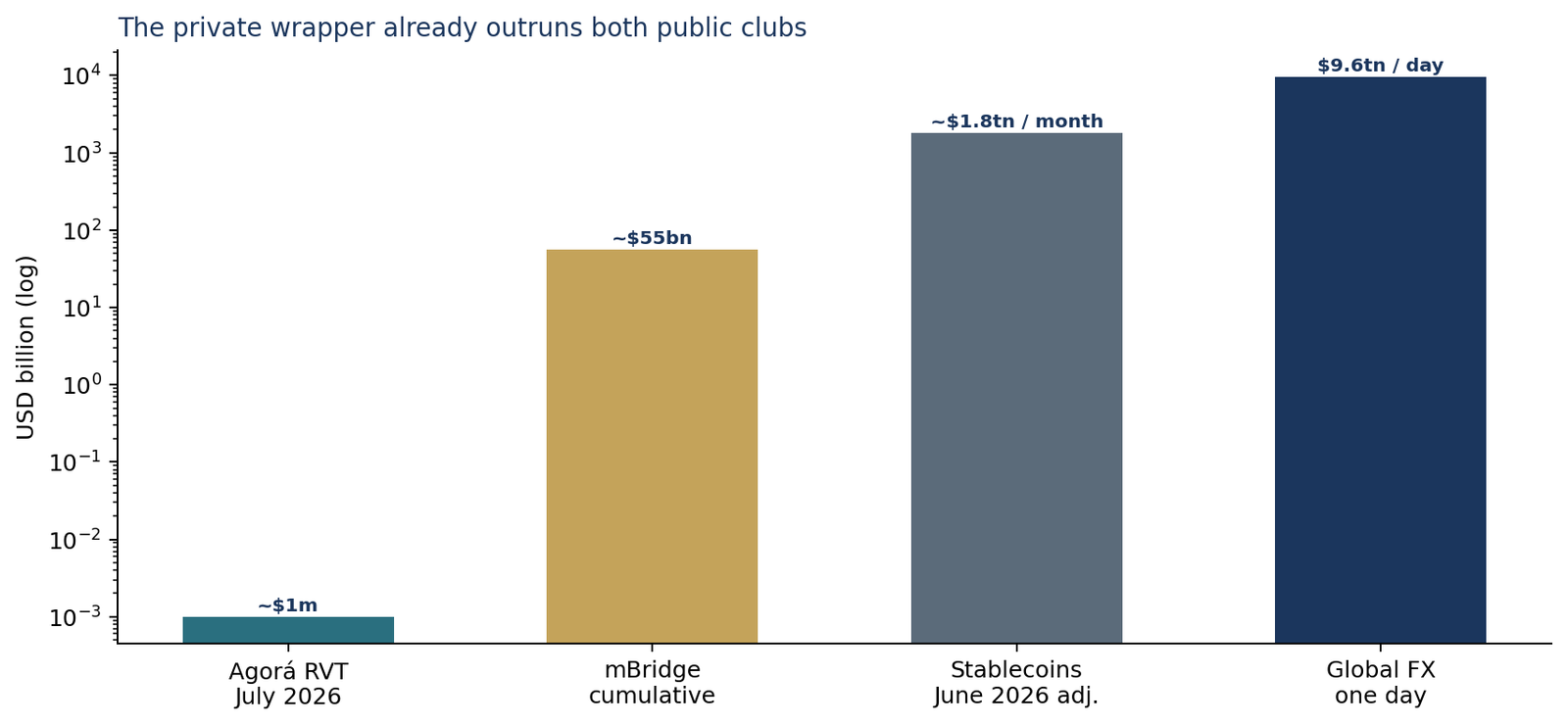
The Notes do not rank the three assets. They say all three will coexist. The policy question is whether the safeguards around coexistence (safe anchors, consistent treatment, legal nouns, a join, crisis tools) arrive before coexistence hardens into partition. September 2026 is not a forecast of that future. It is a photograph of all three assets alive in the same week.
Coexistence without singleness is not a stable middle. It is a spread. Treasurers already live with small basis between deposit money at two banks; the whole point of central-bank settlement is that the spread collapses at the end of the day. A tokenised world that never shares a settlement asset never gets that collapse for free. Each night (or each block) the basis has to be traded, margined or ignored. Ignored is how it becomes a crisis. Traded is how it becomes a business line. Neither outcome is the monetary system the Fund is charged with watching. Both are already visible in miniature: a dollar that is a bank token on Agorá and a dollar that is a GENIUS coin on a public chain and a dollar that never appears on mBridge at all.
Pontes as exhibit, not climax
It would be tidy to write this morning as the Fund’s warning answered by Frankfurt. It is not. What went live is the bounded service essay three described: euro, office hours, a 2027 extension toward 22.5 hours, 24/7 and multi-currency parked with Appia in 2028. Cipollone’s three risks (platform fragmentation, loss of the public settlement asset, dependence on infrastructure Europe does not control) are as live at 09:00 as they were in August. Europe still runs 31 CSDs, 14 CCPs and 323 trading venues. A production cash-leg inside one currency area does not join Agorá to mBridge. It does not bind Beijing, Washington or Riyadh. It makes one bloc’s rail harder to walk back from. That is a real achievement. It is a narrower one than a launch-day headline can carry.9
Keep the other wall too. Lagarde can speak, in the same week, about Pontes and about the retail digital-euro law she wants the legislator to finish before the year ends so a mid-2027 pilot can happen. Those are two projects. This series has already spent an essay refusing to fold them. Wholesale settlement for tokenised securities is not a wallet in a citizen’s pocket. Mixing them is how today’s go-live gets mis-sold.
Why a roadmap is not a join
Name the limit in the body. The Fund can write that systemically important settlement should sit in safe money. Beijing reached that conclusion and then locked the other doors. Washington reached the opposite conclusion and licensed the wrapper, keeping a public token off the table into 2030. The Gulf and Malaysia reached legal certainty through contract law still being rewritten for a token, with Standard 62 unfinished. Seoul reached interoperability by wiring fiscal machinery rather than a capital-markets club. Four starting points. Four traditions. Four versions of “anchor and clarify.” No paragraph the Fund published this year contains a standard all four would sign. Next year’s Notes are unlikely to invent one. Coordination that cannot be enforced is still worth writing. It is not a join.
Schnabel’s Jackson Hole discussion of Duffie, two weeks ago, restated the Fund’s cousin argument from the BIS side: as a wholesale settlement asset, well-designed stablecoins are dominated by central-bank money because only the central bank can supply liquidity elastically when the ticket flow does not pause. That is pillar one in another building. It still does not connect the two clubs. It tells you why each club wants its own public token and why neither will accept the other’s.
The singleness of money
Under the pillars sits one fear, and it is allowed to be the centre of the piece. Modern money assumes that a euro is a euro in whichever bank booked the deposit, whichever app displays it, whichever ledger it sits on. That property is singleness. It is not a law of nature. It is an achievement, maintained by the four supports Adrian listed in May, mostly out of public view, so that an ordinary holder never has to ask whether two euros are the same euro.
If a euro on Pontes, a dollar inside a GENIUS coin, a deposit token on Agorá and an e-CNY on mBridge stop being substitutes at par under stress (not in a lawyered pilot, but in a funding squeeze, on a weekend, in a currency pair nobody put in the runbook) tokenisation will not have modernised the monetary system. It will have partitioned it along the legal and geopolitical lines the first eight essays traced one at a time, without anyone taking a formal decision to partition anything. Essay eleven draws that map. This essay only has to make the map feel like a stability question rather than a plumbing diagram.
Singleness fails quietly. The first ticket that cannot be converted at par without a committee will not look like a crisis in the first hour. It will look like a basis. Then a queue. Then a rule that says this token is not that token after all. The Fund’s Notes are an attempt to write the committee’s terms of reference before the queue forms. They are not the committee.
Hold the May speech against the April Note for a moment, because the two lists are not the same object and collapsing them is how the argument gets sloppy. The four supports (finality, the central-bank settlement asset, standing liquidity, deposit insurance) are the historical machinery of singleness inside one monetary system. The five pillars are the policy programme for keeping that machinery alive once money lives on more than one ledger. Pillar one restates the settlement asset. Pillar five restates standing liquidity for a book that does not close. Pillars two, three and four are the new work: treating unlike legal objects as like economic ones, writing title that a court in two clubs can read, and building a join that neither club currently wants. The speech is diagnosis of what already kept par. The Note is a to-do list for a world in which par is no longer inherited.
That distinction matters for the next essay. A vendor can code finality rules. It cannot invent deposit insurance across a stablecoin and a reserve token. It cannot write AAOIFI and GENIUS into one core. When the instruction arrives as “support both clubs,” the missing pillars become missing product features. The Fund’s vacancy will then show up not as a diplomatic problem in Washington but as a backlog in Milwaukee, Geneva and London.
Close
The IMF wrote rules for a rail it does not run, does not own, and cannot compel. This morning one member of one bloc switched a rail on, on the date it named. The other bloc will not plug into it. That is not an oversight. It is the architecture. A referee with no pitch can still call the shape of the game. It cannot make the two teams share a ball. Pontes is a good rail. It is not the join. The Notes are a good list. They are not the standard. Holding those four sentences in one morning is the whole of this essay.
The next essay turns to the houses that have to cut the wire. Vendors will be asked, this year and next, to build cores that serve both worlds at once. “Both” is beginning to look like an instruction no core can obey, and the first place that instruction will break is not a communiqué. It is a product roadmap.
Sources and notes
1. ECB / Eurosystem Pontes: production service from 21 September 2026. Two models — cash tokens on a Eurosystem DLT, or a trigger into T2. Day-one window 09:00–16:00 CET on T2 business days, euro only. One-off fees EUR 15,000 (operator) and EUR 2,500 (participant); no running tariff in the opening phase. 2024 exploratory trials: 64 participants, ~€1.6 billion settled. Appia blueprint targeted 2028; 24/7 multi-currency mid-2028. Lagarde and Cipollone host a Pontes launch roundtable in Frankfurt at 17:00 CEST today. Wholesale service; not the retail digital-euro legislative track.
2. Tobias Adrian, Tokenized Finance, IMF Note 2026/001, 2 April 2026. Staff analysis, cover disclaimer: author’s views, not Board doctrine. Structural-shift thesis. Five-pillar roadmap: safe settlement asset; same activity / same risk / same outcome; legal certainty; interoperability and coordination; liquidity and crisis-management frameworks rebuilt for continuous settlement.
3. Adrian, Yaiza Cabedo and Tommaso Mancini-Griffoli, The Rise of Tokenization, IMF Note 2026/006, 1 July 2026. Three-layer stack (infrastructure / assets / services). Three settlement assets: tokenised deposits, stablecoins, tokenised central-bank reserves. Ledger models: single, compatible, common. Names Pontes and Appia as public infrastructure private platforms will tend to emulate.
4. Adrian, Tokenized Finance and Money, remarks to the Third Conference on Stablecoins and Tokenization, Federal Reserve Banks of Boston and New York, 11 May 2026. Four historical supports of par exchange: settlement finality, central bank as ultimate settlement asset, standing liquidity facilities, deposit insurance. Cites Agorá.
5. Itai Agur and Alexander Copestake, Optimal Policy for Financial Market Tokenization, IMF Working Paper 2025/185, updated through August 2026. Coalition-formation model: neither public-private cost-sharing nor interoperability mandates alone reach the social optimum; the combination might.
6. Visa Onchain Analytics / Allium, June 2026: adjusted stablecoin transaction volume $1.79 trillion (record), +63% month-on-month, +125% year-on-year. USDC about 67%, USDT about 32%. Adjusted series strips bots, treasury loops and wash-like activity. IMF Crypto Assets Monitor Q1 2026: stablecoin market cap around $0.3 trillion; most volume still trading-related; real-world payments a small, fast-growing slice. Do not treat $1.79 trillion as all payments.
7. Carry-forward from this series: Agorá RVT ~CHF 800,000 / ~$1 million, five testing central banks (essay 08). mBridge public stock ~$55.5 billion, ~95% e-CNY (essay 06). BIS Triennial Survey April 2025: FX $9.6 trillion a day. Pontes design and fees (essay 03).
8. FSB-IMF “same activity, same risk, same regulatory outcome” (2023 crypto synthesis), extended in the 2026 Notes to tokenised liabilities. AAOIFI Shariah Standard 62 still under revision (essay 05). Yin Fa [2026] No. 42 (essay 06). US GENIUS Act / statutory CBDC restraint into 2030 (essay 07).
9. Cipollone, Bundesbank symposium 26 August 2026 and “From vision to delivery,” BIS reprint 15 September 2026: Europe’s 31 CSDs, 14 CCPs, 323 trading venues; Pontes as the near-term public cash-leg; Appia as the 2028 blueprint. Isabel Schnabel, “Central banks on-chain,” Jackson Hole discussion of Duffie, 15 September 2026: stablecoins dominated by central-bank money as a wholesale settlement asset because only the central bank supplies elastic liquidity.
10. IMF Articles of Agreement and surveillance practice: Article IV consultations; programme conditionality only where a member is already borrowing. No mandate to operate a settlement system or to compel reserve-token interconnection.