The Cash Leg · Essay 04 of 11 · Republic of Korea · 10 September 2026
The Two-Tier State Stack
How Korea is using tokenisation to spend public money
The first three essays in this series asked how a trade settles. This one asks how a subsidy is allowed to move. Same rails. Different question.
This month, about ₩30 billion of South Korean treasury money is scheduled to travel on a blockchain for the first time, and the interesting fact is not the chain. It is the sequence. Before a won reaches an electric-vehicle charging operator, a smart contract is supposed to test three things: is the vendor on the approved list, is the clock inside the permitted window, does the use sit inside an allowed category. Only if all three clear does the token move. If any one fails, nothing happens. Fraud is blocked before the payment, not reconstructed in an audit.
That is a different problem from anything covered so far. The Bank of England’s lab is testing whether a securities trade can settle atomically. Helvetia is testing whether a bond can. Pontes is testing whether a tokenised asset can settle against Eurosystem money. All three are versions of delivery-versus-payment. Korea’s EV-charging pilot is not asking that. It is asking whether the state can write its own spending rules into the instrument, so that misuse is structurally hard rather than merely punishable. That is a governance project wearing payments clothes. Call it what it is: a two-tier state stack of wholesale central-bank infrastructure under commercial-bank tokens under programmed public spending.
What Hangang is not
The persistent international label is “Korea’s digital won,” as if the Bank of Korea had shipped a retail CBDC onto citizens’ phones. The label is wrong in a way that changes the architecture.
At the base sits the Digital Currency System, a permissioned ledger the Bank of Korea operates which is reported as Hyperledger Besu, an Ethereum-compatible enterprise stack. On that layer the Bank issues tokenised reserves: wholesale CBDC, available only to the nine participating institutions, never held directly by an ordinary resident. Helvetia and Pontes do a version of the same thing. Supervised money, for supervised firms.
Above that sit deposit tokens, issued not by the central bank but by each of the nine commercial banks: KB Kookmin, Shinhan, Hana, Woori, NH NongHyup, Industrial Bank of Korea, Busan Bank, and, from Phase 2, BNK Gyeongnam Bank and iM Bank. Each token is a claim on that bank, reserved one-for-one against wholesale CBDC at the Bank of Korea. This is the layer a user actually touches. Open a Hangang wallet and you hold your bank’s token, not a direct liability of the central bank. It is the two-tier structure of modern banking (central-bank money underneath, commercial-bank money on top) rebuilt on one programmable ledger instead of siloed cores that do not speak.
Above that, from Phase 2, sits a third layer with no real twin in this series: programmed fiscal flows. Subsidy budgets, starting with the climate ministry’s EV-charging build-out, move as deposit tokens that already contain the conditions. Recipients open dedicated wallets. Officials have said the point is end-to-end visibility of how public money travels, in real time, rather than a paper reconstruction later. A second use-case has already been named: ministry operating expenses. The longer official ambition, stated when the treasury MOU was announced in March, is that a quarter of treasury disbursement should travel in digital form by 2030.
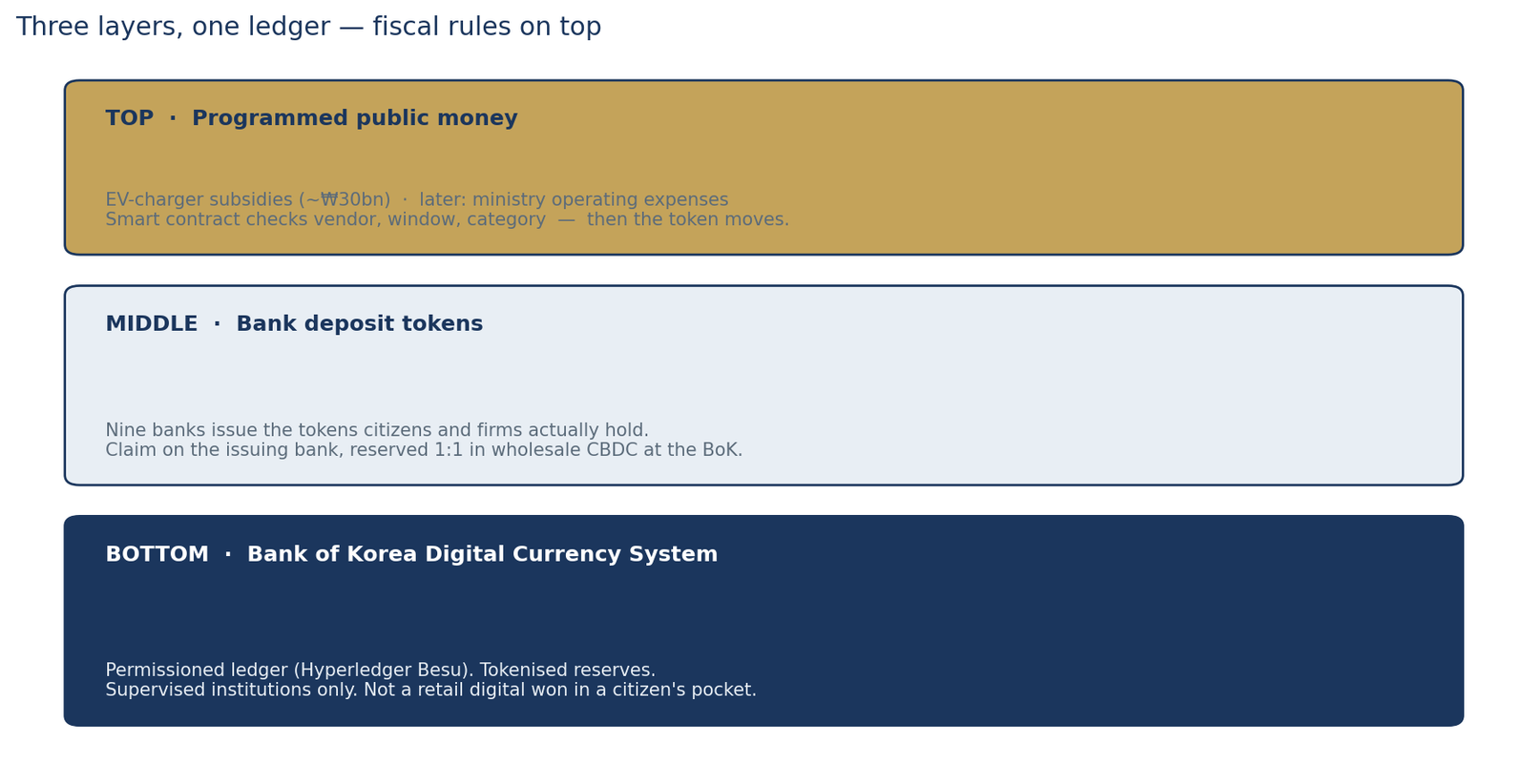
Stack the three and the accurate sentence appears. Hangang is a fiscal-and-banking architecture. Wholesale reserves, commercial deposit tokens and government spending rules are built as linked layers, not as three systems to be reconciled after the fact. The pedigree is the BIS “unified ledger” sketch of 2023: tokenised reserves, tokenised deposits and tokenised assets on one programmable platform so that messaging, checks and value can happen together. London is testing a switch across ledgers it does not own. Frankfurt is building a centralised cash-leg service. Seoul took the BIS drawing and built the most literal working copy currently running as in domestically focused, operationally under one central bank.
The numbers, without inflation
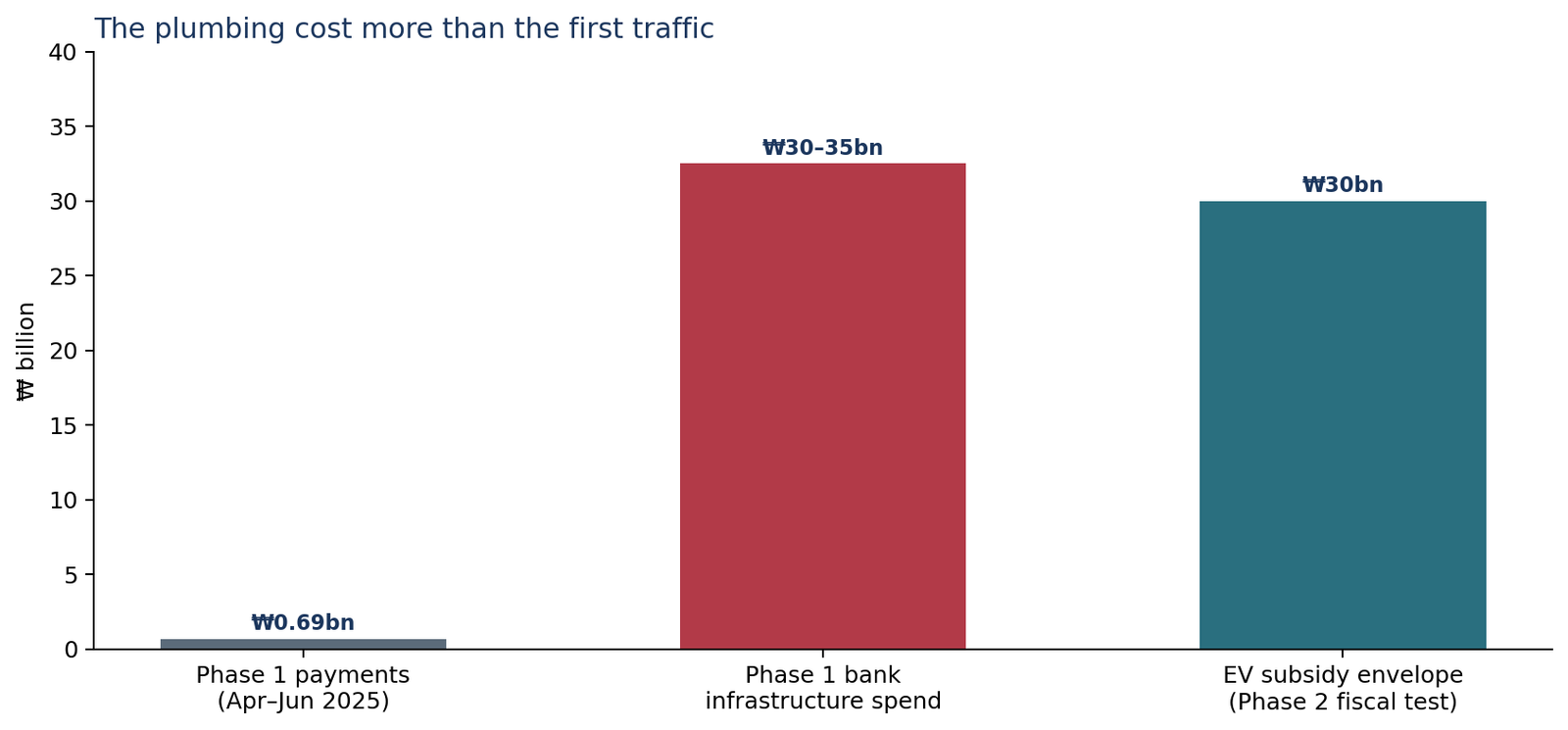
Phase 1 ran from April to June 2025 with seven banks and a thin merchant set. Of 100,000 citizens invited, about 80,000 to 81,000 opened wallets. Payments came to roughly ₩692 million which is on the order of half a million dollars. Audit material later showed about ₩1.64 billion converted into tokens, of which only 42 percent was actually spent. The participating banks are widely reported to have spent ₩30-35 billion building the pipes. That ratio should sit in the open. Phase 1 proved the plumbing could run in public. It did not prove that ordinary Koreans particularly wanted it.
Phase 2 launched formally in March 2026 and moves into large-scale live testing this month. Nine banks. Wallet capacity up from 100,000 to 500,000. Individual limits up from ₩1 million to ₩10 million. New functions: peer-to-peer transfers, biometric login, automatic top-up from a linked deposit. And a separately awarded path through Toss Payments (a ₩9.6 billion gateway contract) so that tokens can hit existing small-merchant terminals without a hardware rip-out. That last design choice is more important than the contract value. A tokenisation project that asks every corner shop to buy a new box dies on cost. A project that rides the box already on the counter might live.
On 15 July the Financial Services Commission designated Phase 2 an “innovative financial service.” Sandbox status. No fixed end-date. A central bank does not take the exit date off a pilot it expects to wind down next quarter. That is a confidence signal, not a slogan.
The nine banks are not a boutique club. Together they hold more than four-fifths of domestic bank assets. If Hangang commercialises, it commercialises across the core of the Korean deposit franchise, not around it. That is why the Phase 1 cost-to-traffic ratio stung: the institutions that would have to live with a loss-making rail are the same institutions that hold the country’s deposits. Phase 2’s consulting work on revenue and cost, funded from the Bank of Korea’s own budget through October, is an admission that technical success is not the same as a business.
| Measure | Phase 1 (2025) | Phase 2 (2026– ) |
|---|---|---|
| Banks | 7 | 9 (add Gyeongnam, iM) |
| Wallet cap | 100,000 invited | 500,000 authorised |
| Wallet limit | ₩1 million | ₩10 million |
| What moved | Consumer payments at a handful of chains | Same, plus programmed treasury subsidies |
| Recorded volume | ~₩692 million paid | ₩30 billion EV envelope in scope |
| Legal status | Time-boxed test | FSC sandbox, no fixed end |
The tension programmed money creates
There is a question Bank of Korea press notes understandably leave in the margin. What does it mean for a government to be able to decide, in advance, exactly what a firm or a citizen may do with money it has been given.
The EV-charging case is a sympathetic one. A bounded category. Vetted commercial operators building public kit. The case for pre-set conditions is clean and the risk of overreach is low. The architecture that enforces those conditions is not bounded. The same logic that confines a charger subsidy to an approved vendor and a window can, in principle, confine any later disbursement to any conditions a government writes whether is a welfare payment spendable only in certain shops, relief that expires on a date, a grant that will not release the next tranche until a behaviour is shown.
None of that is happening beyond the subsidy pilot. Precision matters. Hangang’s programmability today is scoped to public-sector disbursement, not to a citizen’s ordinary deposited funds, which remain bank deposits as before. Officials have framed the work as fraud prevention and spending transparency. Those are uncontroversial goals. Whether the framing holds as the stack scales, and whether the Digital Asset Basic Act eventually draws a hard line around where programmability may stop, is not answered by anything published. It is the open question this series flags and does not settle, because Korea has not yet had to settle it in court or in a general welfare programme.
The stated destination makes the question sharper rather than softer. If a quarter of treasury disbursement is to travel this way by 2030, the EV-charger envelope is a first room, not the house. Ministry operating expenses as a second pilot would take programmed conditionality out of infrastructure grants and into the daily cash of the civil service. That is still public money. It is no longer a single, tidy capex programme. Readers should hold both facts at once: the present use-case is narrow and defensible; the architecture and the 2030 target are general.
The legal calendar is the second engine
The stack would not travel beyond domestic payments without law moving in parallel. The law is running on two tracks that only loosely share a timetable.
The first track is the Digital Asset Basic Act: stablecoins and the wider digital-asset frame. It has had a hard year. Passage in 2026 is still possible and still not guaranteed. Full implementation, which needs subordinate rules, is widely put in 2027 at the earliest. This is the track that would recognise won-backed stablecoins and open more of the currency’s cross-border plumbing. It is, today, still not law. The FSC and the Bank of Korea remain publicly divided on who should govern a won stablecoin.
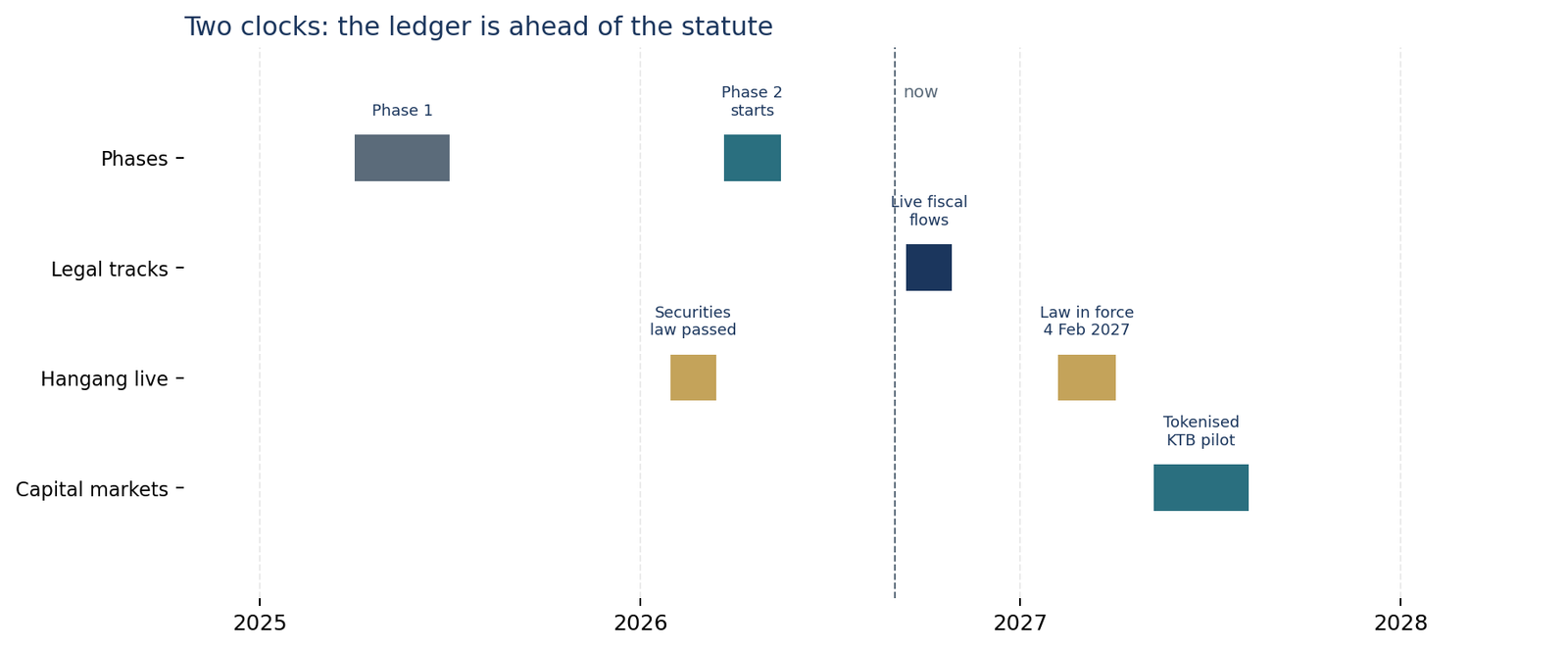
The second track moved because Seoul decoupled it from that fight. On 15 January 2026 the National Assembly passed amendments to the Electronic Securities Act and the Capital Markets Act. Blockchain ledger records gain legal effect, including a presumption that the rights they show are valid. Most of that law takes force on 4 February 2027. On 4 September 2026 the FSC published the three-stage roadmap that follows. Stage one, at go-live: privately placed money-market funds and private bonds for institutions, unlisted shares via a trust structure, publicly offered fractional securities. Stage two: publicly offered securities if stage one holds. Stage three: on-chain settlement using stablecoins as the cash leg (T+1 and T+2 replaced by near-instant delivery-versus-payment) once the stalled stablecoin statute finally arrives.
A third, narrower piece sits on both. The finance ministry’s mid-year roadmap flagged a tokenised government-bond pilot for 2027, designed to plug into the Bank of Korea’s existing CBDC infrastructure rather than stand alone. Hangang’s wholesale layer, proven so far against subsidy flows, is already booked for a capital-markets test within a year of this essay. Tokenising state-owned real estate for retail investors has been discussed in the same packet. That is ambition. It is not yet issuance.
| Track | Status on 10 Sep 2026 | What waits on it |
|---|---|---|
| Hangang Phase 2 | Live fiscal testing, sandbox, no end-date | The stack itself |
| Electronic Securities / CMA amendments | Passed Jan 2026; in force 4 Feb 2027 | Legal tokenised securities |
| FSC three-stage STO roadmap | Published 4 Sep 2026 | Private MMFs/bonds first; public offers later |
| Digital Asset Basic Act | Still draft; BoK-FSC split on governance | Won stablecoins; stage-three on-chain DvP |
| Tokenised KTB pilot | Flagged for 2027 | Hangang wholesale layer in a bond market |
Read together, the calendar is sequencing, not chaos. Pass the securities foundation first because it needed less political negotiation. Let stablecoin law take the time it takes. Build the technical stack fast enough that it is waiting when either statute arrives. Every jurisdiction in this series has met the same mismatch between code and parliament. Korea decided not to wait for them to rhyme. Yesterday’s FSC roadmap is the proof: the securities clock now has dates; the stablecoin clock still does not.
A domestic ceiling, honestly drawn
The Korean won was 1.8 percent of global foreign-exchange turnover in the April 2025 BIS survey, twelfth among currencies. Sterling, in the same survey, was 37.8 percent of the market. Nothing in Hangang changes that arithmetic. Nothing in a stalled Digital Asset Basic Act positions the won as a rival settlement currency to the dollar, the euro or the pound. What Hangang can achieve, it achieves first for Korean citizens, Korean banks and Korean public spending. That is a serious domestic modernisation. It is a different ceiling from London’s horizontal FX bet or the Eurosystem’s continental service. International coverage that treats a well-run domestic pilot as imminent global significance is doing the reader a disservice.
Where Korea does sit at the global table
It would be a mistake, though, to force Hangang into the London-versus-Frankfurt operator argument and then dismiss it when it does not fit. Hangang is not a horizontal synchronisation contest. It is not a centralising public operator in the Pontes sense. It is built to make public spending auditable as it moves. Most of its relevance is inside the border. Honesty requires saying so.
There is one place the work joins the global architecture question without being stretched. The Bank of Korea is among the central banks that sat in Project Agorá’s real-value testing this summer where the BIS-convened attempt at a shared programmable platform for wholesale cross-border payments. Agorá’s own drawing separates tokenised commercial-bank deposits on a unifying layer from tokenised reserves that stay on jurisdictional ledgers, one per currency area, so that no central bank surrenders domestic control of its money to join. The technical family under Agorá’s shared ledger is the same Besu stack Hangang runs. Bank of Korea officials have said, in as many words, that Hangang’s domestic build is part of why Seoul could take that seat early, alongside Mexico, as a non-reserve-currency central bank. The honest global claim is therefore narrow and real: Korea’s reserves-and-deposit-token pattern is the pattern the major central banks are now testing for cross-border use, and Korea earned the invitation by having already built it at home.
That is where this essay stops. The next one Friday 11 September essay 5 on Islamic/GCC programs.
Sources and notes
1. Ministry of Economy and Finance / Ministry of Climate, Energy and Environment / Bank of Korea, March 2026: pilot of treasury disbursement via wholesale CBDC and deposit tokens. Envelope: about ₩30 billion for medium-speed (30–50 kW) EV charging facilities. Korea Environment Corporation to select operators and pay subsidies as deposit tokens. Stated aim: 25 percent of treasury disbursement in digital form by 2030; a second use-case flagged for ministry operating expenses.
2. Bank of Korea descriptions of Project Hangang / Digital Currency System: permissioned ledger, commonly reported as Hyperledger Besu; wholesale tokenised reserves issued only to participating banks. Deposit tokens issued by those banks, reserved one-for-one.
3. Phase 2 bank list: original seven (KB Kookmin, Shinhan, Hana, Woori, NH NongHyup, IBK, Busan Bank) plus BNK Gyeongnam Bank and iM Bank. Secondary reporting: the nine hold more than 80 percent of domestic bank assets.
4. BIS Annual Economic Report / unified-ledger writings, 2023 onward: tokenised reserves, tokenised deposits and tokenised assets on a shared programmable platform. Hangang is the most literal domestic build of that sketch currently running.
5. Phase 1 (Apr-Jun 2025): ~80,000-81,000 wallets of 100,000 invited; payments about ₩692 million; conversions about ₩1.64 billion, of which 42.1 percent spent (National Assembly audit material via Asia Business Daily). Bank infrastructure spend commonly reported at ₩30-35 billion. Merchant set was narrow (Kyobo, 7-Eleven, Ediya, selected Hanaro Mart, Home Shopping, COSMO, a delivery platform).
6. FSC designation of Hangang Phase 2 as an “innovative financial service,” 15 July 2026: sandbox, cap of 500,000 users, no fixed end-date. Toss Payments named preferred negotiator for a ₩9.6 billion gateway contract (July 2026) to reach existing merchant POS without new terminals. Wallet limits raised from ₩1 million to ₩10 million.
7. National Assembly, 15 January 2026: amendments to the Electronic Securities Act and Capital Markets Act, promulgated 3 February 2026, most provisions in force 4 February 2027. FSC policy roadmap, 4 September 2026: three phases as in private MMFs and private bonds plus unlisted shares via trust and fractional securities; then public offers; then on-chain settlement linked to stablecoins, contingent on Digital Asset Basic Act.
8. Digital Asset Basic Act still in draft as of early September 2026. FSC and Bank of Korea remain publicly at odds over won-stablecoin governance. Full implementation widely expected no earlier than 2027.
9. Ministry of Economy and Finance, July 2026 economic roadmap reporting: tokenised government-bond pilot planned for 2027, designed to link to existing BoK CBDC infrastructure; exploration of tokenising state-owned real estate for retail.
10. BIS Triennial Survey, April 2025 / Bank of Korea release: Korean won 1.8 percent of global FX turnover, 12th among currencies. Project Agorá: Bank of Korea among the testing central banks in the July 2026 real-value run; Hangang cited by BoK officials as the domestic capability that made early participation possible. Shared technical family: Hyperledger Besu.