The Cash Leg · Essay 02 of 08 · Switzerland · 3 September 2026
The Vertical Stack
How Switzerland turned tokenisation into a production line
Raised numbers ¹–¹⁰ mark sources. The full list is on the last page.
The first essay in this series described a rehearsal. This one describes a book that has already been written. On 1 December 2023 two Swiss cantons borrowed money in public, investors paid, and the cash leg cleared in tokenised Swiss-franc wholesale central-bank money on a regulated production platform. Nearly three years later, no other jurisdiction in this series can put a comparable live paper trail on the table. That is the claim. It is also the limit of the claim.
The Canton of Basel-City’s bond carried the ISIN CH1265890678. Basler Kantonalbank acted as issuer agent. The Canton of Zurich issued alongside it the same day. Both bonds lived on the SIX Digital Exchange central securities depository, with a live operational bridge back to SIX SIS, the conventional depository that has cleared Swiss securities for decades. The payment leg was not a test token and not a simulated ledger. It was wholesale CBDC issued by the Swiss National Bank onto a FINMA-supervised venue.1
A canton borrowed. Investors paid. The safest money in the system moved, atomically, against the asset. Everything else in The Cash Leg is still, in some important sense, a plan. Helvetia is the control case.
What happened and what the number is not
Scale first, because grand claims are exactly what this project does not need. By April 2025 the IMF’s financial-sector assessment put digital-bond issuance on SDX at about CHF 1.5 billion. A widely cited industry tally counts ten digital bonds near CHF 1.4 billion, seven of them settled in Helvetia wholesale CBDC. The issuer list is conservative Switzerland, not a crypto sandbox: the cantons of Basel-City and Zurich, the cities of Lugano and St Gallen, UBS, and (the detail that ends the “experimenters only” story) the World Bank, which priced a CHF 200 million seven-year digital bond on 15 May 2024 with Commerzbank as sole lead. In June 2024 the SNB itself issued CHF 64 million of one-week SNB Bills onto SDX: a live monetary-policy operation on a distributed ledger, which the Bank called a world first.23
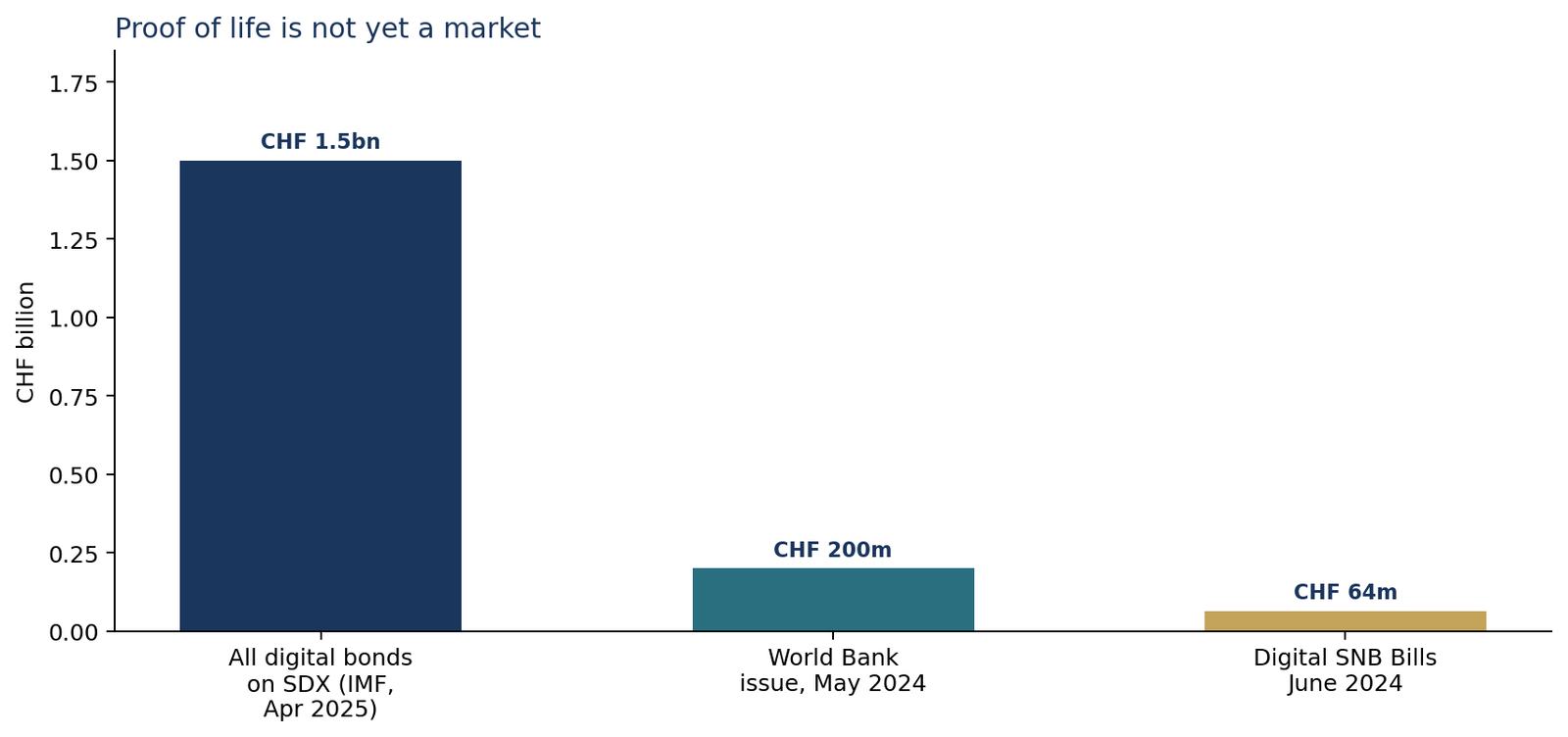
CHF 1.5 billion is roughly what a single mid-sized corporate can raise on a conventional exchange in an afternoon. Set against that, the honest sentence is not “Switzerland has tokenised its bond market.” It is: a small, carefully chosen set of highly creditworthy issuers have shown, repeatedly, in a live regulated environment, that wholesale CBDC can settle real transactions without the plumbing breaking. Proof of life is not nothing. It is not yet a market. Secondary trading in the digital book has so far been absorbed by ordinary SIX rails, not the DLT venue. That is a design fact, not a footnote.
The actual invention: two doors into the same room
The tokenisation debate likes a single switch as in: does the central bank issue a digital currency, yes or no. The SNB refused to answer with one yes. Helvetia has always run two technical approaches in parallel. That both now operate in production, side by side, is a more important Swiss invention than either door on its own.
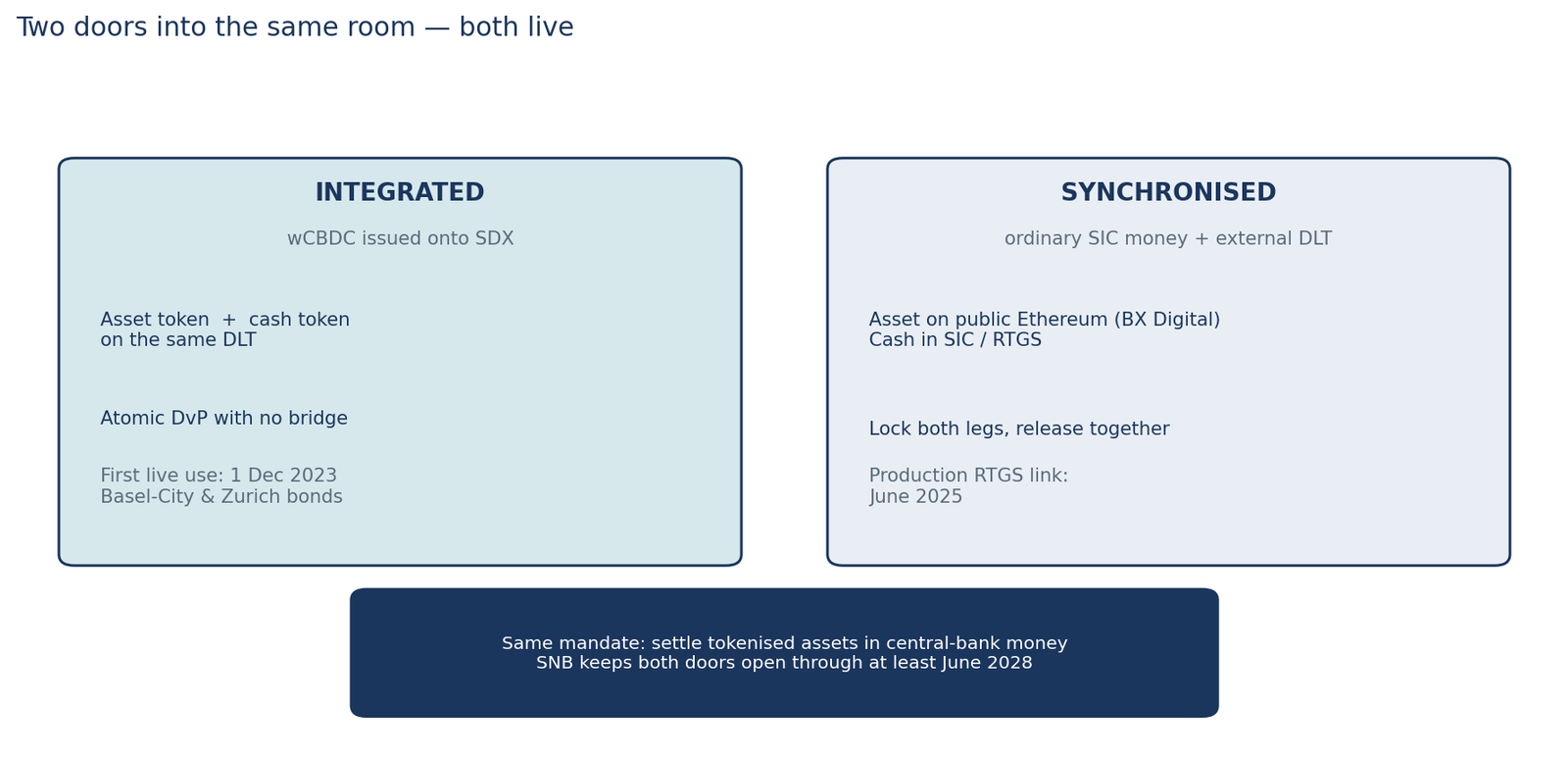
The integrated model puts wholesale CBDC onto SDX’s own ledger, so the asset and the cash leg exist natively on the same chain and exchange as delivery-versus-payment. That is what settled Basel-City, Zurich, the World Bank issue and the SNB Bills. There is no bridge to build. Money and asset already speak the same language.
The synchronised model does the opposite. Instead of issuing a new token onto a new platform, the SNB built a link between an external DLT venue and Swiss Interbank Clearing with the existing RTGS. Tokenised assets settle against ordinary, untokenised central-bank money; the two legs complete together or not at all. The first production user is BX Digital, a FINMA-licensed DLT trading facility. Its asset leg lives on public Ethereum. Its cash leg clears through SIC exactly as a conventional Swiss franc payment would. The SNB opened that production link when it extended Helvetia on 30 June 2025.45
Put the doors next to each other and the achievement is visible. It is not the wholesale CBDC, and it is not the RTGS link. Both exist elsewhere as experiments. It is that the SNB built both doors into the same room and is running them concurrently, in live production, and letting the use-case pick the rail. A digitally native platform with a hard legal and operational bridge back into the system it grew out of: that dual-rail design is the part that is hard to copy.
Thomas Jordan put the purpose in two sentences at the BIS in May 2024. Settlement in central-bank money removes credit risk and shrinks liquidity risk. It also reinforces central-bank money as the anchor of the system. Different transactions will prefer different doors. A canton distributing a bond to a small pool of institutions on a native DLT venue has no particular need for a legacy bridge. A trading facility built to onboard firms that will not migrate their treasury onto a new ledger needs the SIC link. Helvetia treats the choice of rail as a variable, not a religion. That is a more expensive way to run a pilot. It is also the only way to learn which model the market prefers rather than to guess.6
| Integrated (SDX) | Synchronised (BX / SIC) | |
|---|---|---|
| Cash leg | SNB wCBDC token on the venue DLT | Ordinary sight deposits in SIC |
| Asset leg | Tokenised bond on SDX CSD | DLT asset on public Ethereum |
| Atomicity | Native DvP, same chain | Coordinated lock-and-release across two systems |
| First production | 1 December 2023 | RTGS link live from June 2025 |
| Who it suits | Closed institutional primary issues | Venues that refuse to move the cash ledger |
Why a small jurisdiction could go vertical
None of this happened because Switzerland is mysteriously more innovative than its neighbours. That is the explanation the domestic financial press likes, and this series should not use it. A handful of pre-existing conditions made a vertical, single-stack bet rational here and irrational in most other places.
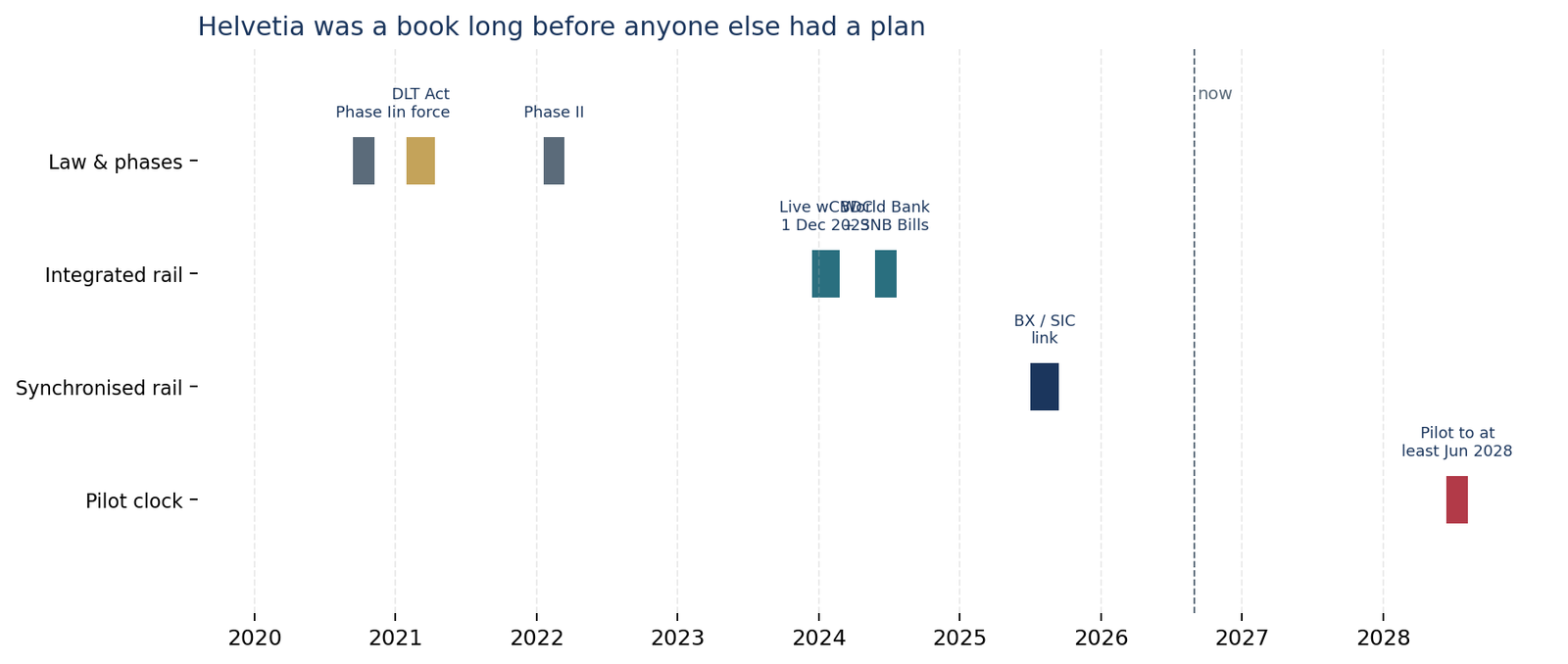
Law first. The DLT Act is not a “blockchain statute.” It is a bundle of amendments. From 1 February 2021 a security can be born on a ledger: articles 973d and following of the Code of Obligations give a token the legal functions of a certificated security. The DLT trading-facility licence followed on 1 August 2021. Most jurisdictions were still arguing, in 2021, whether a token could even be ownership. Switzerland had already written the answer into the civil code.7
Then the counterparty. SDX is not a startup bolted onto the exchange. It is a SIX subsidiary (the same group that runs the cash equity market and the national CSD) licensed by FINMA as financial-market infrastructure. The SNB was never asked to trust an unproven venue. SDX arrived carrying the incumbent’s balance sheet and the incumbent’s supervisor.
Then concentration. The SNB now lists nine banks as eligible for wholesale CBDC: four cantonal banks, Raiffeisen Switzerland, Hypothekarbank Lenzburg, UBS, Commerzbank and BCV. That is not six hundred institutions. Coordinating nine names around a single pilot is a different political technology from coordinating the euro area. Remove the smallness and the vertical stack does not degrade. It stops.4
The commodity cluster belongs here as supporting geology, not as the thesis. Geneva and Zug book on the order of a third of internationally traded oil and a very large share of freely traded grains. Komgo, a Geneva-founded platform backed by banks and houses including MUFG and Société Générale, digitises trade-finance documents. It is more mature on letters of credit than on settlement, and it is not wired into Helvetia. It is evidence that the same small country already concentrates the adjacent pipes a vertical cash-leg might one day touch. It does not explain why Helvetia works. It explains why Switzerland, specifically, could attempt the stack.9
The years nobody watched
Helvetia III only looks sudden if you start the clock in December 2023. Phase I, a proof of concept with the BIS Innovation Hub’s Swiss Centre, SIX and the SNB, finished in late 2020 and showed that both the integrated and the synchronised models could work as in a test environment, with no real money. Phase II, finished in January 2022, showed that wholesale CBDC could plug into commercial and central-bank core systems, and that issuing it on a privately operated DLT platform was legally sound under Swiss law. That second finding is easy to skip. It is why Phase III could go live without another three years of counsel.8
| Date | What became real | What it still was not |
|---|---|---|
| Feb / Aug 2021 | DLT Act: ledger-based securities; FMI licence | A live cash token |
| Late 2020 / Jan 2022 | Helvetia I and II close | Production money |
| 1 Dec 2023 | Cantonal bonds settle in live wCBDC | A market |
| May–Jun 2024 | World Bank bond; SNB Bills on SDX | Permanence |
| 30 Jun 2025 | RTGS link with BX Digital; pilot extended | A choice of one rail |
| Jun 2028 | Current official floor for the pilot | A decision to keep wCBDC forever |
What does not travel
Here is the tension, without hedging. Almost nothing about this specific stack is exportable.
No other country in this series combines a DLT-specific securities statute that has now been stress-tested by three years of live issuance, a CSD willing to operate a production bridge between a new DLT platform and its own legacy books, a central bank willing to issue live wholesale CBDC onto a third-party platform rather than insist on running the ledger itself, and a club of institutions small enough to coordinate. Remove any one of those four and the Swiss model does not bend. It fails.
The United Kingdom has deep law and a renewed RTGS. It also has a fragmented banking system and a central bank that has chosen not to issue a token of its own, preferring a contested synchronisation operator in front of RT2. The euro area has scale and nineteen legal systems. Korea has state capacity, but Hangang is a two-tier deposit-token design aimed at programmed public flows, not a wholesale bond stack which treating it as “retail CBDC for citizens” would repeat a mistake this series has already retired. Switzerland’s advantage is not a policy other central banks forgot to copy. It is closer to geology: decades of institutional density in a jurisdiction small enough for density to cohere.
That is also the implicit British rebuttal. If the Swiss model only works because of conditions unique to Switzerland, it is a superb domestic achievement and a poor template. A neutral, asset-agnostic synchronisation layer is what you build if you believe the Swiss stack cannot be shipped. Whether that belief is wisdom or an alibi is what the rest of this series is for.
What it is, said plainly
The caveat easiest to lose is the one the SNB repeats in every extension notice. Helvetia is not a general-purpose digital franc. There is no retail token. Ordinary residents cannot hold it, will not see it in a banking app, and are unaffected in daily payments. Jordan has said he sees no case for a retail CBDC. This is wholesale settlement kit, for supervised institutions, for a narrow set of instruments: bonds, short SNB bills, and now tokenised assets whose cash leg still clears in SIC. The current official floor is June 2028. Every communiqué still says the same sentence: none of this is a commitment to introduce wholesale CBDC on a permanent basis.56
That carefulness is the most Swiss fact in the file. Three years of real transactions, a dual-rail design that actually connects new pipes to old ones, and an institution that will still not say “permanent.” It is the opposite of London’s named 2028 capability and the opposite of the ECB’s dated Pontes launch. Switzerland arrived first, built the thing nobody else has matched in production, and has spent three years declining to declare victory.
There is a test for separating a plan from a book, and it is not volume. A plan describes a target architecture. A book has had to resolve the fights that only appear when real money moves: what happens when a canton’s agent and a commercial settlement desk disagree about timing on a live DvP; what a supervisor requires before an RTGS link may touch a public blockchain; what a compliance department needs before it will buy a bond nobody has bought in this form. Switzerland has been through that friction since December 2023. The same institutional names keep coming back. Nobody returns to a process that broke. That is the unglamorous meaning of proof of life: not that the market is large, but that the participants chose to reuse it.10
Whether the refusal to say “permanent” is prudence, or a tacit admission that even the country doing this best is still unsure it wants to do it forever, is a question this series leaves open. The next essay turns to the problem Switzerland never had to solve: not one small cooperative centre, but nineteen.
NEXT IN THE CASH LEG
03 The Centralizing Operator - Euro area. Pontes is aimed at 21 September 2026. The Eurosystem is installing itself as the link, not certifying outsiders the way London is. That is a governance choice, not a wiring diagram.
Then: 04 Korea · 05 United States · 06 BIS / Agorá · 07 IMF · 08 Vendors.
Sources and notes
1. SIX / cantonal issuers, 1 December 2023: Canton of Basel-City digital bond, ISIN CH1265890678; Canton of Zurich issued the same day. Settlement in SNB wholesale CBDC on SIX Digital Exchange, with an operational bridge to SIX SIS.
2. IMF Financial Sector Assessment, Switzerland, 2025: digital-bond issuance on SDX about CHF 1.5 billion as of April 2025; SDX CSD then had 12 participants. SUERF Policy Note (drawing on SDX): ten digital bonds near CHF 1.4 billion, seven of them inside Helvetia Phase III.
3. World Bank / IBRD, 15 May 2024: CHF 200 million, seven-year digital bond, ISIN CH1353258168, sole lead Commerzbank; primary settlement in wCBDC; listed on SDX and SIX Swiss Exchange. SNB Economic Note / IMF FSAP: digital SNB Bills of CHF 64 million, June 2024, five pilot banks, seven-day tenor — first live monetary-policy operation on a DLT production platform.
4. SNB, Questions and answers on Project Helvetia (current): integrated settlement (wCBDC on the SIX Digital Asset Platform) and synchronised settlement (tokenised assets against traditional central-bank money via an RTGS link). Eligible wCBDC banks as listed by the SNB: Aargauische Kantonalbank, BCV, Basellandschaftliche Kantonalbank, Basler Kantonalbank, Commerzbank, Hypothekarbank Lenzburg, Raiffeisen Switzerland, UBS, Zürcher Kantonalbank.
5. SNB press release, 30 June 2025: Helvetia extended at least to mid-2027 and expanded to an RTGS link with BX Digital. Current SNB Helvetia page and FAQ: pilot runs until at least June 2028; extension is not a commitment to permanent wholesale CBDC. SNB: BX Digital uses the SIC link in a production environment; DLT assets settle on public Ethereum, cash on SIC.
6. Thomas Jordan, “Project Helvetia III,” BIS, 6 May 2024: settlement in central-bank money eliminates credit risk, reduces liquidity risk, and reinforces CB money as the system’s anchor. Jordan has separately stated he sees no case for a retail CBDC for the general public.
7. Federal Act on the Adaptation of Federal Law to Developments in Distributed Ledger Technology (DLT Act). Civil-law core (ledger-based securities, art. 973d ff. Code of Obligations) in force 1 February 2021; remaining provisions, including the DLT trading-facility licence, 1 August 2021.
8. Helvetia Phase I (BIS Innovation Hub Swiss Centre / SNB / SIX), concluded late 2020: technical feasibility of both models in a test environment. Phase II, concluded January 2022: integration with core banking systems and legal soundness of issuing wCBDC on a privately operated DLT platform. Phase III / Helvetia pilot: production from December 2023.
9. STSA / Suissenégoce historical estimates: Geneva region on the order of one-third of internationally traded oil and a large share of freely traded grains. Swissinfo, 2026: 35–50 percent of world grains often cited as booked out of Geneva and Zug. Komgo: Geneva-founded trade-finance documentation platform; not a Helvetia cash-leg.
10. SUERF, “Towards Tokenised Bond Markets?”: secondary-market liquidity in the Swiss digital-bond book has so far been absorbed by conventional SIX infrastructure, not the DLT venue.