Industrial systems · · 20 August 2026
Just-In-Time Production in an Era of Structural Imbalance
Why classical lean production no longer fits a world of China Shock 2.0, concentrated capacity, and coercive supply risk.
The Just-In-Time (JIT) system, developed within the Toyota Production System and subsequently diffused across global manufacturing, rests on a set of operating assumptions that prioritise the elimination of waste, the minimisation of inventory, and the precise synchronisation of supply with demand. Materials, components and intermediate goods arrive only as required for immediate use. Buffer stocks are treated as costly inefficiencies. Supplier networks are expected to deliver with high reliability, short lead times and competitive pricing under conditions of relatively open and predictable trade. These principles delivered substantial efficiency gains in stable environments characterised by diversified suppliers, reciprocal market access and gradual competitive adjustment.
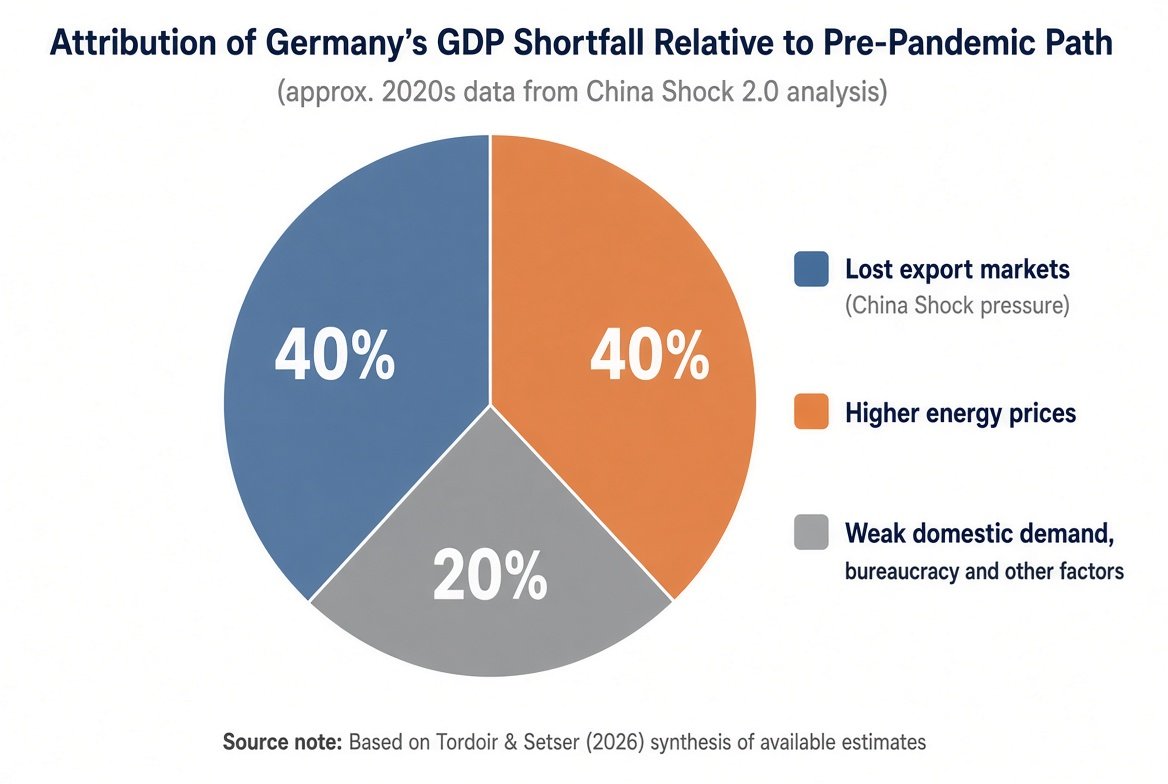
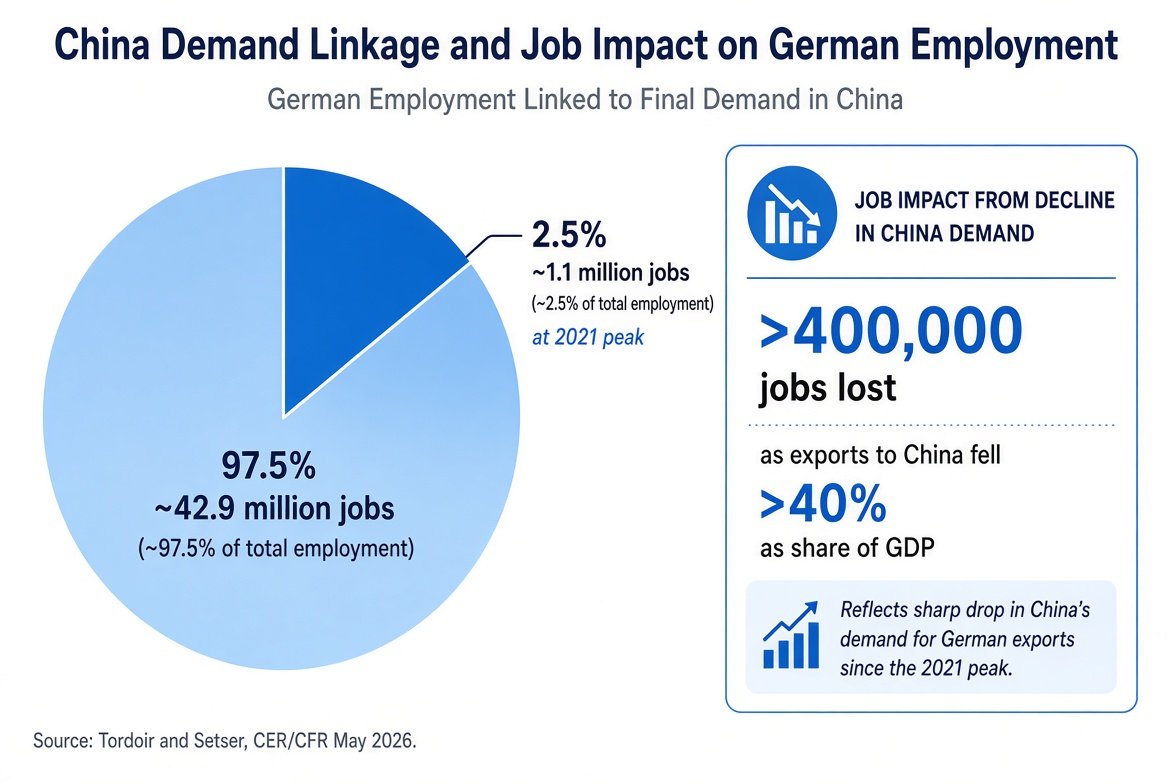
The policy brief China Shock 2.0: The cost of Germany’s complacency by Sander Tordoir and Brad Setser (Centre for European Reform / Council on Foreign Relations, May 2026) documents a fundamentally different environment. China’s export volumes have grown at more than twice the pace of global trade, driven by persistent high savings, large-scale industrial subsidies (estimated at approximately 4.4 per cent of GDP), an undervalued exchange rate, and a deliberate policy of displacing imports while expanding manufacturing capacity far beyond domestic absorption. Germany’s core industries — automobiles, machinery, chemicals and aircraft — are simultaneously losing share in the Chinese market, in third-country markets and at home. Cumulative drag from declining net exports has reached approximately 3 per cent of German GDP since late 2023. Exports to China as a share of GDP have fallen by more than 40 per cent from their peak, implying the loss of hundreds of thousands of associated jobs. Chinese car exports, annualised, already reached the 10-million-unit mark previously projected only for the end of the decade. Production of key capital goods and clean-technology products is concentrating in China, raising both commercial displacement and coercive leverage risks.
This analysis examines whether the pure form of JIT remains compatible with these realities. It concludes that the system, in its classical configuration, is no longer compatible with prevailing market conditions. Incremental adjustments are insufficient. The system requires major structural upgrading that effectively transforms its core logic, or, in critical and high-risk segments, de facto abandonment in favour of deliberately resilient architectures.
Foundational Assumptions of JIT and Their Historical Context
JIT emerged in post-war Japan under conditions of resource scarcity, limited domestic market scale and the need to compete against larger American producers. Taiichi Ohno and subsequent practitioners translated the insight that inventory masks problems into a rigorous discipline of continuous flow, pull systems (kanban), rapid changeovers and close supplier collaboration. The model presupposed that suppliers would respond flexibly, that logistics networks would function with high reliability, and that competitive pressure would operate primarily through quality, cost and innovation rather than through sustained, state-orchestrated overcapacity directed at foreign markets.
These assumptions held reasonably well during the period of expanding globalisation from the 1980s through the 2010s. Multinational firms constructed intricate, low-inventory networks spanning continents. German manufacturers, particularly in the automotive and machinery sectors, integrated deeply into Chinese supply chains and export markets, often localising production to secure market access and subsidies while maintaining lean inventory practices at home and across European operations. Efficiency metrics improved. Working capital was released. Quality feedback loops accelerated.
The model, however, treated geopolitical and macroeconomic distortions as exogenous shocks rather than as structural features of the competitive landscape. It assumed that large economies would eventually rebalance through stronger domestic demand, currency appreciation or loss of competitiveness. It further assumed that production would remain sufficiently diversified that no single jurisdiction could systematically underprice and displace entire industrial ecosystems while retaining coercive control over critical inputs.
The Structural Character of China Shock 2.0
Tordoir and Setser demonstrate that the current shock differs qualitatively from the earlier China Shock that primarily affected lower-value manufacturing in the United States after WTO accession. The present episode targets Europe’s high-value manufacturing core. China’s manufacturing surplus has expanded by nearly an additional percentage point of world GDP. Export volumes have risen more than 40 per cent since the pandemic while imports have stagnated. The resulting displacement is not confined to residual low-end sectors; it strikes automobiles, machine tools, chemicals and aircraft — precisely the sectors in which German and broader European comparative advantage was thought to be durable.
| Indicator | Value / Change | Source context (Tordoir & Setser 2026) |
|---|---|---|
| Cumulative net-export drag on German GDP (since late 2023) | ≈ 3% of GDP | Accelerating displacement |
| Decline in German exports to China (share of GDP from peak) | > 40% | Direct market loss |
| Peak German jobs linked to final demand in China (2021) | ≈ 1.1 million (≈ 2.5% of total employment) | High exposure |
| Estimated jobs lost from export decline to China | > 400,000 | Implied by >40% export-share fall |
| Chinese car exports (2025 Q4 annualised) | 10 million units | Earlier than decade-end forecasts |
| China’s overall export volume growth (2025) vs global trade | > 2× global trade pace | Structural surplus expansion |
| China’s manufacturing subsidies (approx.) | 4.4% of Chinese GDP (≈ $800bn annually) | Policy-driven overcapacity |
| Potential medium-term threat to German manufacturing output | Up to ~60–70% (broader European estimates higher for Germany) | Concentration risk |
Three interlocking distortions sustain the surplus. First, elevated household savings and weak consumption leave domestic absorption insufficient relative to manufacturing capacity. Second, industrial policy at scale — local and central subsidies, preferential credit, and explicit capacity targets — generates overcapacity that is exported rather than absorbed. Third, exchange-rate management prevents the renminbi from adjusting sufficiently to restore balance. The combination produces sustained volume growth in Chinese exports even as global trade expands more slowly, and it does so in products that directly compete with European output.
For Germany the consequences are acute. Industrial production has declined for multiple consecutive years. A substantial portion of the shortfall relative to the pre-pandemic growth path is attributable to lost external demand. Fiscal stimulus risks leaking into higher imports from China rather than supporting domestic production. The risk is not merely temporary market-share loss but the erosion of production capabilities, supplier ecosystems and innovation capacity. Once factories close and specialised skills dissipate, the high-productivity replacement activities that theory associates with creative destruction may never materialise. Concentration of global capacity in China simultaneously increases vulnerability to supply coercion, as already demonstrated in rare-earth markets.
Direct Incompatibilities Between Classical JIT and Present Realities
Classical JIT is optimised for environments in which suppliers compete on cost and reliability within a framework of reciprocal openness and gradual adjustment. The current environment features systematic, policy-driven underpricing and capacity expansion that is not constrained by domestic demand or by market-clearing prices. Lean inventory practices amplify exposure to this environment in several concrete ways.
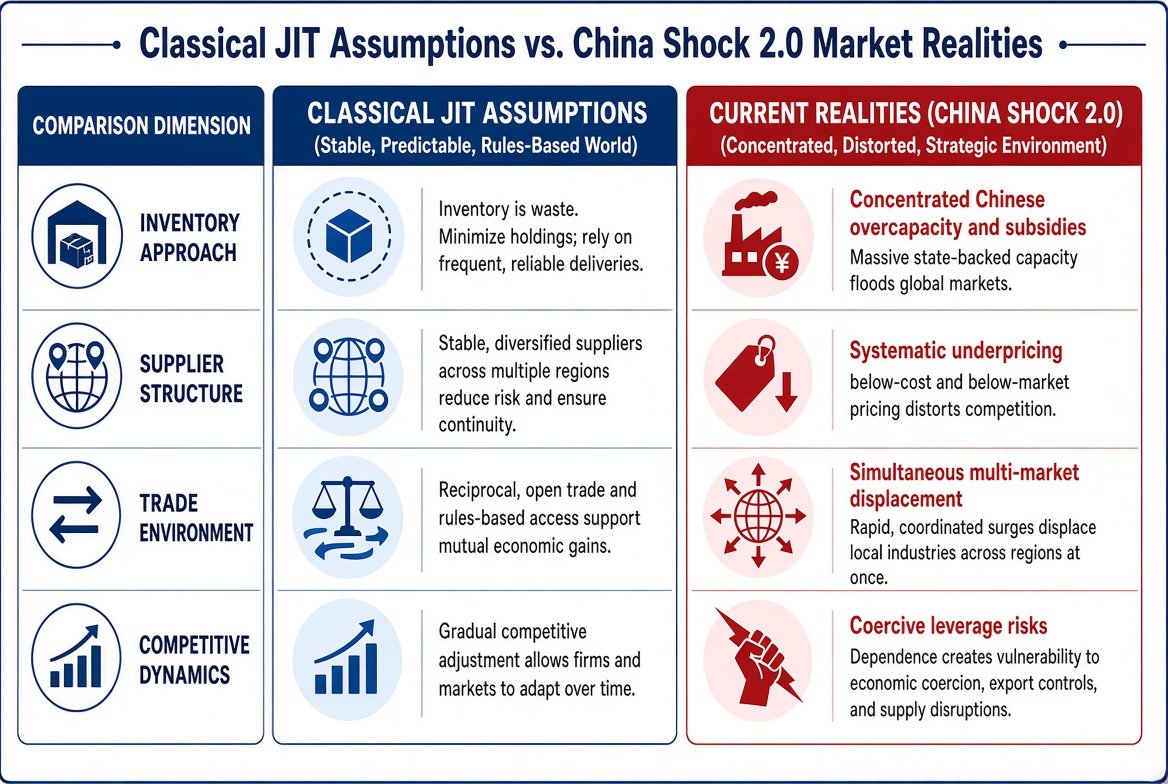
First, the absence of strategic buffers means that any interruption in the flow of Chinese intermediate goods, components or critical minerals immediately stops production. The same concentration that enables Chinese producers to underprice finished goods also concentrates upstream supply. Rare-earth processing, battery materials, certain semiconductor inputs and specialised machinery components illustrate the pattern. A lean European or North American plant that has optimised away safety stocks becomes hostage to decisions taken in Beijing or by Chinese provincial authorities.
Second, the assumption of diversified, competing suppliers no longer holds for many categories. When Chinese capacity in a given product line exceeds the non-Chinese global market, and when that capacity is supported by subsidies and an undervalued currency, alternative suppliers struggle to maintain scale. Dual-sourcing becomes difficult or prohibitively expensive. The kanban system’s requirement for frequent, reliable deliveries from multiple sources cannot be satisfied when the dominant source is both the low-cost provider and a strategic instrument of state policy.
Third, JIT’s emphasis on continuous flow and minimal work-in-process inventory presupposes stable demand signals and predictable logistics. The present shock introduces large, persistent shifts in relative prices and market access that are driven by policy rather than by underlying productivity differentials alone. Demand for European capital goods in China has contracted sharply; demand for Chinese finished goods in Europe and third markets has expanded. Lean systems transmit these demand shocks rapidly upstream, forcing abrupt capacity adjustments that destroy rather than redeploy specialised assets.
Fourth, the model’s historical success depended on the ability of high-wage producers to capture value through design, systems integration and branding while outsourcing volume production of intermediates. When the low-cost producer moves up the value chain into design, systems integration and branding — supported by scale, data advantages and industrial policy — the division of labour collapses. German automotive manufacturers that once supplied sophisticated components and machinery to China now face Chinese competitors that integrate those functions and export complete vehicles at scale. Lean inventory practices optimised for the earlier division of labour become liabilities once that division no longer exists.
Amplification of Risk in Practice: The Automotive and Machinery Complex
The German automotive sector provides a concrete illustration. Long-standing JIT and lean practices within the industry and its supplier networks minimised inventory at every tier. Many intermediate components and materials were sourced from, or through, Chinese supply chains. As Chinese vehicle exports accelerated and Chinese producers captured rising shares of both the Chinese domestic market and third-country markets, European producers faced simultaneous contraction of export demand and intensified competition at home. Lean systems left limited margin for absorbing the resulting volume declines without plant closures or abrupt supplier cutbacks.
Machinery producers confront a parallel dynamic. Germany has shifted from net exporter to net importer of certain capital goods from China. Lean practices that once supported efficient production of specialised equipment now confront a competitor that can offer comparable or superior machinery at lower prices, backed by scale and policy support. The disappearance of domestic production capacity in turn weakens the supplier base for remaining European manufacturing, further eroding the dense industrial ecosystems that lean methods were designed to optimise.
In both cases the classical JIT response — further cost reduction, tighter inventory control, and deeper collaboration with remaining suppliers — exacerbates rather than mitigates the structural problem. Cost reduction cannot offset systematic underpricing of this magnitude. Tighter inventory control increases rather than decreases exposure to concentrated supply. Collaboration with Chinese suppliers may secure short-term continuity while accelerating technology transfer and long-term displacement.
Why Incremental Adaptation Is Insufficient
Conventional responses to JIT’s vulnerabilities — selective safety stocks for critical items, multi-sourcing where feasible, and digital visibility tools — address symptoms rather than the underlying incompatibility. Selective buffers raise average inventory costs and partially reverse the efficiency gains that justified JIT in the first place. Multi-sourcing is feasible only when alternative suppliers of comparable quality and scale exist; in many categories they do not. Digital tools improve detection and coordination but cannot create non-existent alternative capacity or neutralise policy-driven price distortions.
The deeper requirement is a shift from pure flow optimisation to deliberate architectural resilience. This entails accepting higher steady-state inventory and capacity redundancy for strategically important categories; reconstructing regional or allied supply networks even at a cost premium; embedding reciprocity and local-content requirements into procurement and industrial policy; and treating certain production capabilities as public goods rather than as pure private cost centres. In practice, such measures amount to a major upgrading of the production system that abandons the classical JIT premise that inventory is almost always waste and that global optimisation under open trade is the default.
In the most exposed sectors the logical endpoint is partial scrapping of pure JIT. Critical components, materials subject to concentrated processing, and finished goods facing systematic overcapacity competition cannot safely operate on lean principles. Strategic stockpiles, dual production footprints, and longer-cycle planning become necessary. The resulting system retains lean disciplines where conditions remain stable and competitive, but subordinates them to resilience criteria wherever China Shock dynamics dominate.
Conclusion
The market realities documented by Tordoir and Setser — sustained Chinese manufacturing surpluses, policy-driven overcapacity in high-value sectors, simultaneous displacement across multiple markets, and rising coercive leverage — are incompatible with the operating assumptions of classical Just-In-Time production. Lean inventory, tight supplier synchronisation and the presumption of diversified, market-driven competition cannot be maintained when a single large economy systematically expands capacity beyond domestic demand and exports the surplus under conditions of currency management and industrial subsidy.
Pure JIT is therefore no longer a viable default architecture for exposed manufacturing systems. Incremental upgrades that merely add limited buffers or visibility tools leave the core vulnerabilities intact. What is required is major upgrading that redefines the system’s objectives: resilience and strategic autonomy must rank alongside, and in critical domains above, pure inventory minimisation. In the most vulnerable segments this upgrading is functionally equivalent to scrapping the classical model and replacing it with hybrid or deliberately buffered architectures. Failure to undertake such a transformation risks the progressive erosion of production capabilities, the concentration of global capacity in a single jurisdiction, and the associated economic and strategic costs already materialising in Germany’s industrial heartland.
The efficiency achievements of JIT under earlier conditions remain real. They do not, however, constitute a permanent entitlement to operate under assumptions that the current structure of global production and trade has rendered obsolete.
References
Tordoir, S. and Setser, B. (2026), China Shock 2.0: The cost of Germany’s complacency. Policy Brief, Centre for European Reform / Council on Foreign Relations, May 2026. Available at: https://www.cer.eu/publications/archive/policy-brief/2026/china-shock-20-cost-germanys-complacency. Supporting quantitative estimates and sectoral illustrations are drawn from the same policy brief and contemporaneous 2026 reporting.