The Plant · Essay 03 of 04 · 21 October 2026
The Box
The machines that hold time and keys.
I. The claim
Finality is not an idea. It is a clock and a key in a cage.
In the vocabulary of tokenised markets, finality is a property of a protocol. A transfer is final when it can no longer be reversed, and the rules that make it so are specified in software and discussed in terms of probabilities, confirmations and thresholds. At that level the word is accurate. It is also incomplete. A market participant does not experience finality as a probability. They experience it as the moment at which a counterparty releases the goods, a lender releases the collateral, or an issuer honours a redemption. That moment depends on two facts about the physical world. Someone with the authority to move the asset must have done so, and the move must have happened at a time that every party accepts. Authority is exercised with a key. Time is supplied by a clock. Both are machines, and both sit in rooms.
The first essay stood in the hall and found a fence, a feed and a landlord. The second followed the cable between halls and found thirteen Atlantic systems and a short list of beaches. This essay goes inside the cage, to the objects that matter most for what a token can claim to be. There are three, and they are routinely run together under the single word "blockchain." The first is the ledger machine, which holds the entries. The second is the key machine, which holds the authority to change them. The third is the clock, which holds the hour. They have different owners, different failure modes and different recoveries. The argument of the essay is that the second and third are far more concentrated, and far less replicated, than the first.
Three machines, not one. The ledger is copied. The key and the clock are not.
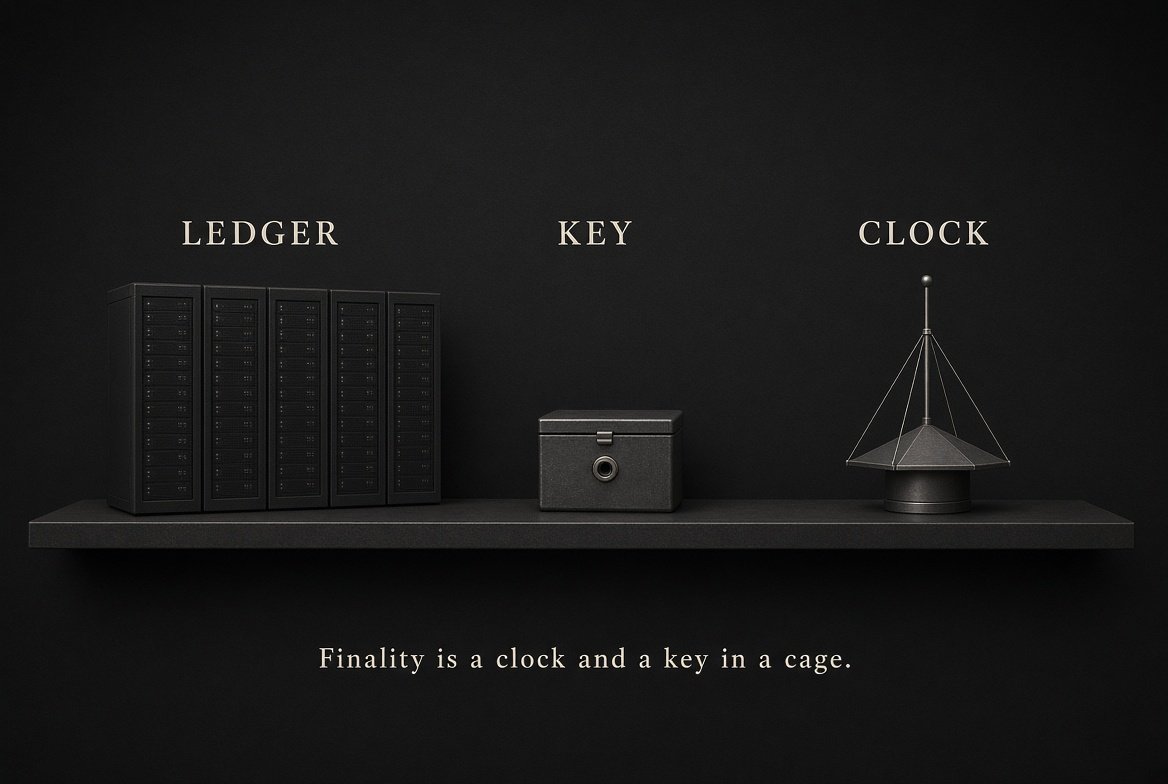
The method is unchanged. Sit with a real plant, then write the shape. Three objects are visited. The first is the signing box and the room in which its secret is born. The second is the time source, which for most of the world is a small antenna on a roof. The third is the price-feed machine, treated as what it physically is: a sensor wired to a chain.
This is not a cryptography tutorial, and it does not discuss algorithms. The mathematics is assumed to work. The question is about the object that guards the secret, the object that keeps the hour, and what happens to a market when either is unavailable, wrong or lost.
II. The signing box
Start with the object that does the signing.
A hardware security module, usually called an HSM, is a hardened computer built to do one thing: hold a secret and use it without ever revealing it. In practice it is a rack-mounted unit, or a card that slides into a server, with a plain metal case and a few ports. A request goes in, a signature comes out, and the secret never leaves. The point of the design is that the machine can be asked to act with the key without any person, program or administrator being able to read the key itself. Ownership, at this layer, is not a name on a register. It is the ability to cause that signature.
The protection is physical as much as digital. The enclosure is built to be tamper-evident and, in the better units, tamper-responsive. Mesh and sensors inside the case detect drilling, probing, extremes of temperature and abnormal voltage, and a small battery keeps the sensing circuit alive when the unit is unpowered. If the circuit concludes that the box is under attack, it erases the secret. The box is designed to destroy what it guards rather than surrender it. Units of this kind are tested against published standards. The one institutions cite is the US FIPS 140 series. FIPS 140-3, published by NIST in March 2019, superseded FIPS 140-2 and sets four increasing levels of security for a cryptographic module, covering physical security, roles, interfaces and the management of the secret.1 An institution buying a box for serious custody will usually insist on one of the upper levels. A small number of manufacturers dominate the market. That is a form of concentration, and it belongs with the landlord problem of the first essay rather than with the mathematics. The essay does not name them. The point is the count, not the brand.
The box does not act alone. Around it sits a policy layer, the rules that decide when it may sign. A withdrawal above a limit needs more approvers than a withdrawal below it. A new destination address needs a waiting period. A request outside business hours needs an escalation. The rules are written in software, but their force comes from the box, because the box will not sign unless the approvals it has been configured to require are physically presented. Those approvals take the form of a quorum: several authorised people, each holding a smart card or a token with a personal code, and a rule that no single person can authorise a signature alone. The arrangement is known as dual control, or, when it extends to a larger group, a threshold of m of n. One person knows part of the procedure, another knows another part, and the key itself is known to no one.
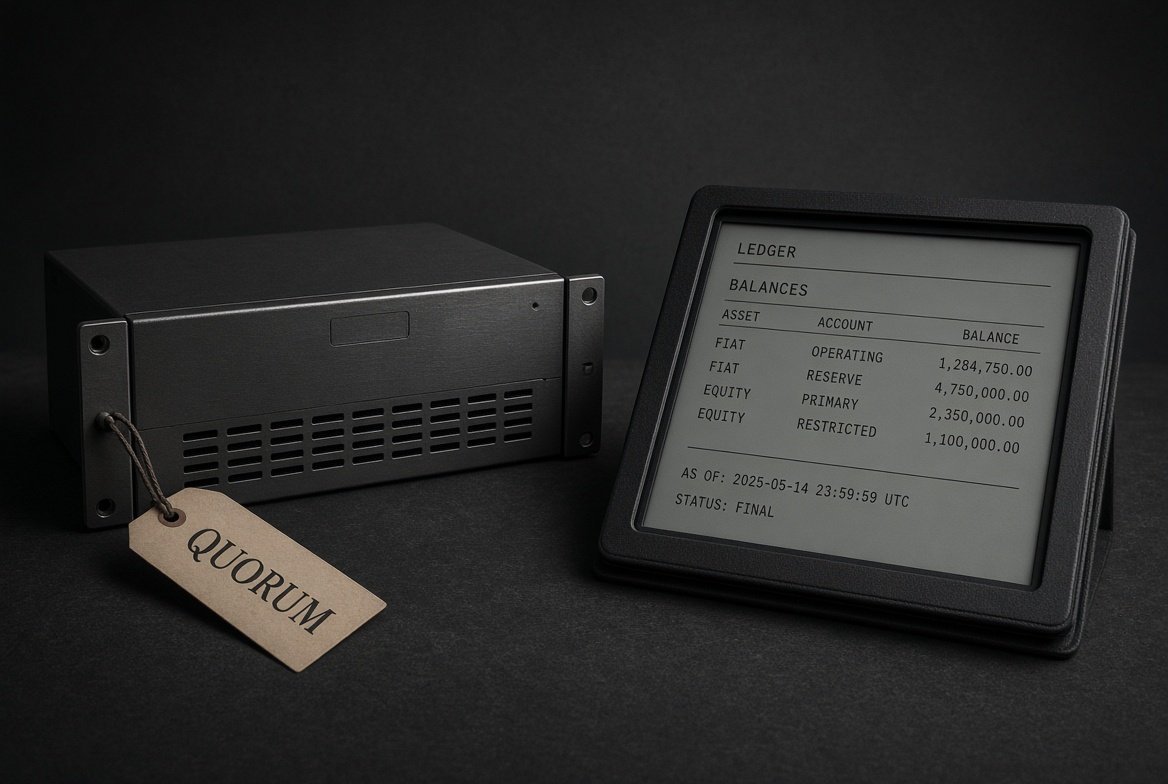
This is where the abstract claim about tokens meets its physical form. Whoever can cause the box to sign controls the asset. That is what ownership of a token consists of in practice: the ability to produce an authorisation that the ledger will accept. For an individual, the box is a phone or a small device in a pocket. For an institution holding assets on behalf of thousands of clients, the box is a set of units in a cage, behind a mantrap, inside a hall of the kind already described, and the business of custody is, to a first approximation, the business of guarding the door through which authority flows.
Two facts follow, and they are the ones the vocabulary of resilience tends to skip. The first is that the asset is bearer in a stricter sense than most paper ever was. The ledger does not know who is at the keyboard. It knows only that a valid signature arrived. The second is that the box is a single point of authority to a degree that the ledger is not. The ledger is copied across many halls. The key, by design, is not. Replication is the ledger's defence. It is the key's liability. Every extra copy is another place the secret can leave.
| Object | What it holds | How it is protected | What "lost" means |
|---|---|---|---|
| Ledger machine | The entries | Copied across many halls | One copy failing is tolerated |
| Signing box | The authority to change them | Few copies, tamper response, a quorum | The asset is visible and unmovable |
| Policy layer | When the box may sign | Limits, waiting periods, hours | A rule that was not the rule the signers saw |
| Quorum | The people who present the approval | m of n, cards, codes | A signature that is valid and wrong |
| Individual device | The same authority, smaller | A pocket | A lost phone is a lost exit |
Figure 1. What the box is, and what it is not.
III. The room where the secret is born
A key must come into existence somewhere, and the moment of its creation is the most delicate event in its life.
The best-documented example is public, and it is not a bank. The root of trust for the internet's naming system, the key that anchors the digital signatures on the domain name hierarchy, is generated and managed in a recurring, scripted event run by IANA under ICANN. The ceremony takes place in one of two key-management facilities, on opposite coasts of the United States: Culpeper, Virginia, in the east, and El Segundo, California, in the west. It is attended by crypto officers drawn from the technical community, by staff, and by external auditors. A written script is followed line by line. Cameras record the room. Scripts, logs and recordings are published afterwards. The process is audited against a SOC 3 framework. Every physical item (the cards, the laptop, the boxes) is sealed in a numbered tamper-evident bag, checked against a log and signed for. A quorum of the crypto officers, smaller than the full set and long published as three of seven, must be present with their credentials before the signing box can be activated. Credentials sit in safe-deposit boxes inside the ceremony facility. A log notes who opened which door at what minute.2
The details are instructive because they show how a secret is treated when it matters, and because the institutional custody world uses the same grammar in a smaller room. A bank or a regulated custodian generating the master keys for a custody system will run a key ceremony of its own, with witnesses, a script, sealed evidence and a recorded log. The rooms differ in glass and in budget. The principles do not. The public ceremony is useful here precisely because it is public. Most custody ceremonies are not, and the reader should not mistake the existence of a procedure for the publication of one.
The room is usually shielded. A Faraday enclosure, lined so that radio signals do not pass the walls, does two jobs. It limits what the equipment inside can leak through electromagnetic emissions, which a patient attacker can in principle read from outside. And it limits what a phone, or a radio someone has carried in, can send out while the ceremony is under way. Mobile phones are left at the door. Entry is through a mantrap. A guard stands outside. None of this is exotic. It is the same fence as the hall, drawn tighter around a smaller object.
The machine used in the ceremony is air-gapped. It has no network connection of any kind. Data moves in and out on physical media that are inspected and logged. The laptop that runs the procedure is often bought for the purpose, kept between events, and used for nothing else. The aim is narrow and worth stating without romance. The one moment at which the root secret exists in a form that could be copied must be a moment at which no network can carry it away. After the ceremony, the secret exists in the boxes, and in the shares held by the officers. The main risk is no longer creation. It is loss, and it is the gap between what the signers believe they are signing and what the box is asked to sign.
That second risk is not theoretical, and it is not a failure of the mathematics. On 21 February 2025, Bybit lost control of a cold wallet holding 401,347 ether, more than $1.4 billion at the time, the largest theft of tokens on record. The signatures were genuine. The quorum was met. The signers approved what the interface showed them as a routine internal transfer. What the quorum actually authorised was a change to the wallet's own logic, after malicious code had been served through the Safe{Wallet} front end from a compromised developer machine, aimed at those signers and not at everyone else. The FBI attributed the operation to North Korea's Lazarus group, tracked as TraderTraitor.3 The ledger did what it was asked. The box did what it was asked. The procedure failed in the only place the procedure can fail, which is between the eye and the signature. A quorum is a control against one person. It is not a control against a screen that lies to all of them at once.
IV. The backup in the second city
A key that is destroyed is as final as a key that is stolen. If the only box holding the secret is lost, burned or erased by its own tamper circuit, then every asset it controlled can no longer be moved, and no authority anywhere can fix that. The asset remains on the ledger, visible to everyone and usable by no one. Finality, in that case, has arrived from the wrong direction. The holder cannot get out.
So the secret must exist in more than one place, and this is where the engineering turns uncomfortable. Every additional copy is an additional target. The art lies in making the copies useless to anyone who obtains fewer than the quorum. The secret is split into shares, each held on a separate card or sealed in a separate box, and distributed among the officers and vaults so that no single location, and no single person, holds enough to reconstruct it. The public ceremony does this in the open. A custodian does it under a contract the holder will not see.
The backup site is then chosen on the same principle as the secondary sites of the market infrastructures in the first essay. It must be far enough from the primary that a single event cannot reach both: a flood, a fire, a regional power failure, a civil disturbance. The public key ceremony uses facilities on opposite coasts for exactly this reason. Culpeper and El Segundo are not a convenience. They are a distance. For an institutional custodian, the second site is usually a second city, often in a second jurisdiction, and it is held under its own contract with its own landlord. PFMI Principle 17, which the hall essay used for the two-hour recovery of a market infrastructure, asks for a secondary site with a distinct risk profile. A key backup is the same sentence, applied to a smaller object. The two hours were about resuming the system. Resuming the key is a different clock.
The second city brings the earlier essays back into the picture. It has to be reachable by cable if the backup is to be used in anything like real time, so it sits on the same corridors and depends on the same few beaches. It has a hall, with the requirements of the first essay. And it is reached by people. Restoring a key from backup is not a button. It is an event that needs a quorum of named individuals, in some cases in the same room, with their cards and their codes. If the officers are in different cities, they must travel. A storm, a strike, an airspace closure or a public-health restriction can turn a procedure of hours into a procedure of days. The cable essay's repair ship and this essay's quorum are the same scarcity in different clothes. Both are physical capacity that cannot be conjured when the event arrives.
There is also an honest asymmetry in how such systems are tested. Everyone rehearses the signing of a transaction, because it happens every day. Very few institutions rehearse the full restoration of a master key from a cold backup, because it is expensive, slow and disruptive, and because a failed rehearsal is itself a risk. A backup that has never been restored is a hypothesis. The market reasonably assumes that it works. Nothing in the daily operation of the system provides evidence one way or the other. That is not a scandal. It is the shape of a control whose success is defined by never being used.
V. The clock on the roof
The second machine is quieter and older. It tells everyone what time it is.
Find the antenna first. On the roof of almost any serious financial data centre, among the chillers and the cable trays, there is a small dome or a short mast, often with a lightning rod beside it. It is a satellite antenna, and it is listening to the navigation constellations, principally the American GPS system, with the European Galileo and others used alongside or instead. Each satellite carries atomic clocks and broadcasts the time. A cable runs from the antenna, down through the building, to a receiver in a rack. The receiver compares the signal with a local oscillator, a quartz crystal or, in better units, a rubidium reference, and disciplines it so that it stays in step with the sky. The unit is called a grandmaster. From there the time is distributed through the building over the network, using a protocol built to carry it with sub-microsecond precision, to every server that needs it.
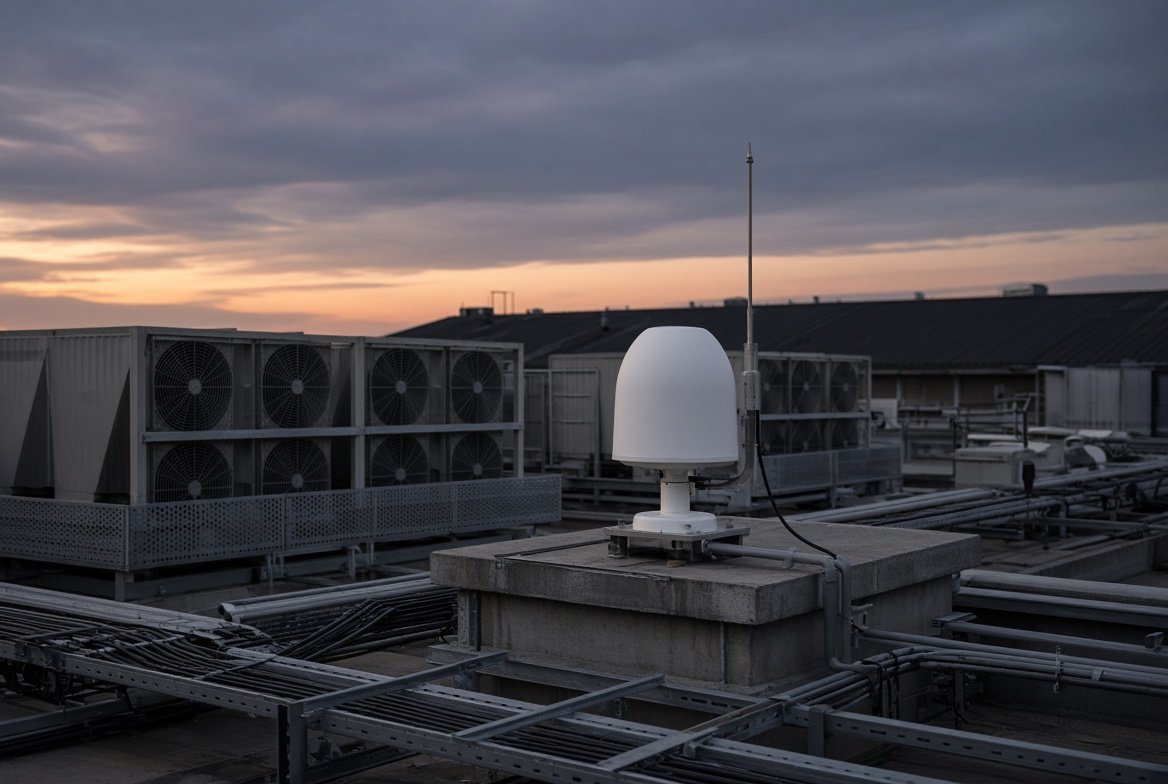
If the antenna loses the signal, the local oscillator carries on. This is called holdover. A decent quartz will keep a financial tolerance for minutes to a few hours. A rubidium reference can hold a tight tolerance for a day, and the better units for longer, before the drift exceeds what the venue has promised. The building's time is borrowed from satellites, and the borrowed hour can be lent for a limited time without a fresh signal. Holdover is a battery for time. Like the diesel in the hall, it is sized for an interruption, not for a new steady state.
The dependence is deep and mostly invisible, and it is written down. European rules for the markets in financial instruments require trading venues and their members to timestamp reportable events against coordinated universal time. Commission Delegated Regulation (EU) 2017/574, the technical standard known as RTS 25, sets the ceiling. Where the gateway-to-gateway latency of the trading system is at or below one millisecond, the maximum divergence from UTC is 100 microseconds, and the timestamp granularity is one microsecond or better. High-frequency algorithmic trading by a member has the same 100-microsecond ceiling. Other algorithmic activity is allowed one millisecond. Voice trading is allowed one second.4 The United States consolidated audit trail asks for a clock traceable to UTC as well, and for electronic order handling the working tolerance cited in the trade is tighter still, on the order of 50 microseconds. Behind coordinated universal time sit the national laboratories (the National Physical Laboratory in the United Kingdom, NIST in the United States, PTB in Germany) which keep the reference clocks and compare them through the international bureau that maintains the common scale. The chain from laboratory to rooftop to server is long. Almost all of it is routine. None of it is inside the protocol.
The vulnerabilities are well understood and rarely discussed outside the trade. The satellite signal is faint by the time it reaches the ground. It can be overwhelmed by a cheap jammer, or imitated by a spoofer that broadcasts a false time. Solar storms degrade it. Antennas and cables fail, and lightning finds them. Software that handles time has failed on its own. The leap second inserted at the end of 30 June 2012 caused outages in widely used systems, because a day with 86,401 seconds met code that assumed 86,400. On 26 January 2016 a fault in GPS ground software, triggered when the oldest satellite, SVN-23, was removed from the constellation, broadcast a UTC correction about 13 microseconds off on legacy signals. The US Air Force said the offset exceeded design specifications, lasted several hours, and was not jamming. Navigation was largely unaffected. Timing equipment was not.5 A 13-microsecond step is nothing to a person. It is a large fraction of the 100-microsecond ceiling RTS 25 sets for a high-frequency venue. Governments have since spent real money on terrestrial backups to the satellite signal, over fibre and over radio, precisely because the dependence has become the size of the market. The UK's National Timing Centre and the US effort around a complementary positioning, navigation and timing service are the public versions of the same worry. The roof is no longer considered enough.
A ledger would seem not to need any of this. A chain orders its own entries by its own consensus and has no need to know the hour in order to agree on a history. That is true, and it is the sentence that gets misread. Everything that touches the chain from outside does need the hour. Cut-off times, interest accrual, coupon dates, redemption windows, margin calls, regulatory reports and time-locked contracts are all defined in wall-clock time. On Ethereum the execution payload's timestamp is proposed by whoever builds the block. Clients accept it if it is after the parent and not unreasonably far ahead of the slot. The tolerance is a parameter, not a laboratory.6 The ledger can be indifferent to the hour. The market built on top of it cannot. A coupon that pays at a wall-clock instant does not care that the chain has its own sequence. It cares that the instant was the instant.
| Link | What it is | Tolerance it is asked to keep | How it fails |
|---|---|---|---|
| National laboratory | UTC, compared internationally | The reference | Not the usual failure |
| Constellation | GPS, Galileo, others; atomic clocks in orbit | The signal the roof listens to | A ground-software fault; a storm; a removal of a satellite |
| Roof antenna | A dome or a mast, a cable down | The building's view of the sky | Jamming, spoofing, lightning, a failed cable |
| Grandmaster | Receiver plus a local oscillator | Sub-microsecond inside the hall | Loss of signal; then holdover |
| Holdover | Quartz for hours; rubidium for a day or more | The venue's promised ceiling | Drift, once the loan runs out |
| RTS 25, fast path | Gateway latency at or under 1 ms | 100 microseconds from UTC | A 13-microsecond step is already material |
| Chain timestamp | Proposed by the block builder, accepted within a tolerance | The protocol's, not the laboratory's | A correct sequence with a wrong wall clock |
Figure 2. Where the hour comes from, and what breaks it.
VI. The sensor
The third object has been given a reputation that obscures what it is.
An oracle, in the language of tokenised markets, is the means by which a chain learns something that happened outside it. A chain can see its own entries. It cannot see a price, an interest rate, a share's net asset value, a bank balance or a delivery. Any number about the world that a contract depends on must be brought to it, and the thing that brings it is a machine.
Strip away the vocabulary and the object is a sensor, in the same sense as a thermometer on a boiler. A server in a hall connects to several sources, which might be trading venues, a benchmark administrator, or a data vendor. It reads the quotes, discards the outliers, takes a median or a weighted average, and signs the result with its own key. The signed value is then written to the chain, where contracts treat it as fact. As with the boiler, the control system does not check the thermometer. It obeys it.
Seen this way, the oracle is not an exotic feature of a new financial system. It is a familiar one with a smaller institution behind it. The traditional market has long relied on reference rates and benchmark administrators whose published numbers set the terms of loans, derivatives and funds. LIBOR was that object, and the scandal was not that a sensor existed. It was that the sensor could be talked to. The replacement rates are still sensors. They have administrators, methodologies and a clock. The sensor in the hall does the same job at a higher cadence and with less of the institution.
And it is built from all three machines at once. It reads from venues, which sit in halls and are reached by cables. It signs with a key, which lives in a box. And it stamps its readings with a time, which is borrowed from a roof. A price is always a price at a moment. A feed that delivers a correct value late has delivered a wrong one, and a contract that acts on it will not know the difference until someone outside the chain does.
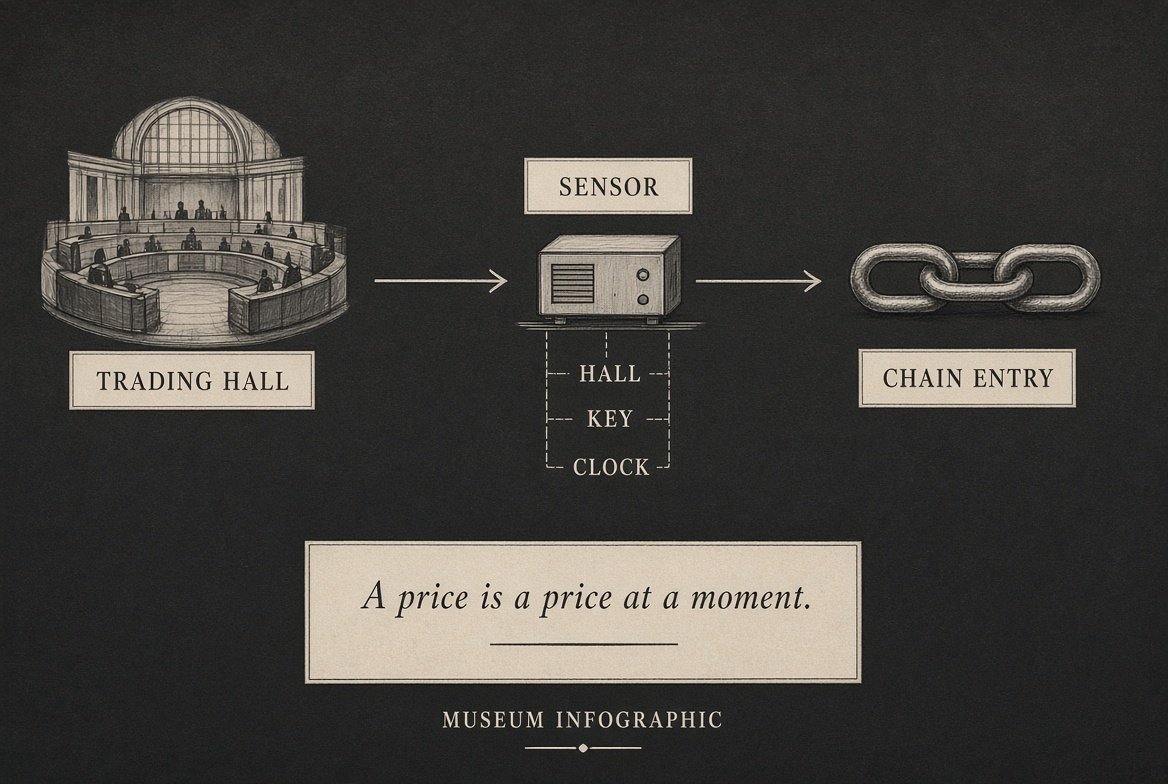
The failure modes follow from the construction, and they are ordinary. A sensor can go stale, continuing to report the last price after a venue has halted. It can be fed bad inputs, by a source that has been pushed or has simply broken. It can be switched off by its operator, in which case the last signed value sits on the chain as if it were still the world. It can be compromised if its key is stolen, in which case it will confidently report whatever the attacker wishes, and the signatures will verify. The chain cannot tell any of these from the truth. Whatever the sensor says becomes, for the purposes of the contract, what is so. That is not a defect in the chain. It is the definition of a sensor. The defect would be to treat the reading as a property of the token.
VII. Three machines, not one
It is now possible to say plainly what people conflate.
The ledger machine holds the entries. It is replicated across many halls, and its resilience comes from multiplicity. The loss of any single copy is tolerated by design, and the remaining copies agree on what the state is. It is public, in the sense that anyone can inspect it. Its characteristic failure is division, a disagreement among the copies about which history is correct. Division is unpleasant and, on the public chains that matter here, rare. It is also the failure the protocol was built to survive.
The key machine holds authority. It is not replicated in the same way. A secret is protected by having few copies, held in few places, behind many controls, because every copy is a liability. The resilience of the key machine comes from secrecy, quorum and procedure rather than from multiplicity. Its characteristic failures are loss and theft, and the second of these is a failure of process at least as often as of technology. The best-known thefts of tokens have rarely involved breaking the mathematics. Bybit is the clearest recent case, and it is not the first. The signers signed. The interface had already decided what they were shown.
The clock holds the hour. It is the most concentrated of the three. Its reference is a small number of constellations run by governments, its local copies are small boxes on roofs, and its resilience depends on a satellite signal, a holdover oscillator and a discipline loop. Its characteristic failures are drift, loss of signal and, in the worst case, a false but plausible hour. A false hour is worse than a dark one. A dark clock stops the venue. A lying clock lets it continue.
The three have different owners. The ledger belongs, in a public network, to no one in particular and to thousands of operators in practice. The key belongs to the holder or to the custodian acting for the holder. The clock belongs to a government, and is rented through a landlord's antenna. They also have different recoveries. A ledger that divides can be reconciled by the rules of the protocol, or by a social choice about which history to keep. A lost key cannot be recovered by any rule. A false hour can be corrected, but only after the damage it has done is known, and the correction does not unwind a liquidation that has already fired.
The distinction matters because the properties attributed to tokens (that they are resilient, that they cannot be seized, that they settle without a central party) are properties of the first machine. They are not properties of the second or the third. A token's strength at the level of the ledger tells us little about its availability at the level of the key, and nothing about its correctness at the level of the clock. Seizure, in particular, has changed its address. A state that cannot rewrite the ledger can still ask the custodian for the quorum, or jam the roof, or close the beach the second city depends on. The token has not become unseizable. The place of seizure has moved from the entry to the box.
| Machine | Resilience | Characteristic failure | Recovery | Owner |
|---|---|---|---|---|
| Ledger | Multiplicity. One copy may die | Division over which history | Protocol rules, or a choice of history | No one, and thousands of operators |
| Key | Few copies, quorum, procedure | Loss; theft; a screen that lies | A second city, if the quorum can travel | Holder, or the custodian |
| Clock | A constellation, a roof, holdover | Drift; silence; a plausible false hour | A terrestrial backup, after the damage | A government, rented via the landlord |
| Sensor | All three, in one reading | A stale, late, or signed-but-false price | None, inside the contract | Whoever runs the feed |
Figure 3. Three machines, three owners, three recoveries.
VIII. The stress shape
Cash Leg's test applies here in the same form. If the box goes dark, or the clock lies, does the token do what the thing it replaces would have done?
The status language does not need to be reinvented. Substitutes, when ordinary conditions hold. Watch, when one field is already the weak channel. Does not substitute under stress, when exit, cash, crowd or basis would not survive the stated shock. The shock here is authority, or the hour. The field it injures first is exit, because an exit that cannot be signed is not an exit. Basis follows, because the arbitrage that held the token to its twin was a signature.
Consider the box first. Suppose the signing infrastructure of an issuer of tokenised deposits or tokenised fund units cannot sign. The cause might be a failed unit, a compromised approval process that forces the issuer to halt, or a quorum that cannot be assembled. The ledger is untouched. Every balance is visible and correct. Three things stop at once.
Redemption stops. A holder who presents a token and asks for cash needs the issuer to authorise the burning of the token and the release of the underlying claim. Both steps need the issuer's key. Without it, redemption is a queue with no one at the window. The capped instant exit of September was a promise about time. This is the case where the promise has no signer. The cap is not the binding constraint. The box is.
Pledge stops. A token posted as collateral must be moved when the position changes, to a lender or to a clearing house, and it must be released when the position is closed. Movement needs a signature. A margin call that cannot be met by moving collateral becomes a default, and a release that cannot be authorised leaves the borrower unable to use an asset it still owns. The eligibility list of a later series will say which tokens may be pledged. It will not say that the pledge can be moved on the day the quorum is in the air.
The basis breaks. The token trades at par with the thing it represents because someone can create it and redeem it at par. When redemption halts, that mechanism fails, and the token trades at a discount to its claim. The discount is the market's price for the missing box. It is the same shape as the basis Cash Leg already watches between a token and its twin. The twin is intact. The door between them is shut.
The ledger is untouched. The authority is not. Balances do not redeem themselves.
These three failures do not arrive in sequence. They arrive together, because they share a single dependency, and they do not arrive politely. A conventional market can halt trading, announce the halt, and resume under rules written for the purpose. A market whose authority has gone silent has no such mechanism, because the machine that would announce the halt, authorise the resumption and reconcile the positions is the one that has failed. The silence is discovered, not declared. That is the difference between a venue that closes and a key that does not answer. The first is an operation. The second is an absence.
The second city does not fix this in the time that matters. Restoring a key from backup needs a quorum, travel and a procedure that has seldom been rehearsed, so the gap between the failure and the recovery is likely to be measured in hours or days, during which the market has no authority at all. PFMI's two hours were a target for information technology. They are not a description of a key ceremony. A holder who was promised an instant exit does not have two hours, and does not have the officers' diaries.
Now consider the clock. Suppose the time source is wrong, through jamming, spoofing or a fault, and the error is large enough to matter but not large enough to be obvious. The 2016 step was 13 microseconds and already inside the RTS 25 ceiling. A larger lie is available to anyone with a spoofer. The ledger continues to order entries. Cut-offs now fall at different moments for different participants. Interest accrues for the wrong number of seconds. A liquidation is triggered by a price that is stale, or is not triggered by one that is not. A time-locked release opens early or late. A sensor reports a value stamped at the wrong instant, and a contract acts on it. Disputes follow, and they are disputes about which clock was right, which a court will eventually have to decide by reference to a laboratory, not to the chain.
Compare the thing the token claims to replace. A banknote handed across a counter requires no key machine, no time source and no sensor. Its finality is the hand-over. The comparison does not condemn the token. It locates it. A token is a claim whose finality is conferred by machines, and the machines that confer it are few, concentrated and located. Where they are available, the token can settle faster and more cheaply than the paper it replaces. Where they are not, it does not substitute for anything. It waits.
| Shock | What still works | What the holder can do | Status |
|---|---|---|---|
| Signing box dark; ledger intact | Every balance, visible and correct | Nothing that needs a signature | Does not substitute under stress. Exit, pledge and basis fail together |
| Quorum shown a false screen, as on 21 February 2025 | The mathematics | Watch a valid signature do the wrong thing | Does not substitute. The control worked |
| Key restorable only in the second city | The shares, if the officers can travel | Wait hours or days | Watch. The backup is a hypothesis until rehearsed |
| Clock dark; holdover holding | The chain's own order | Trade inside the oscillator's loan | Watch. The loan is sized in hours, not in a new regime |
| Clock wrong by more than the venue's ceiling | The sequence | Dispute which hour was the hour | Does not substitute for any use that needed wall-clock time |
| Sensor stale or late | The last signed price | Act on a world that has moved | Watch, then does not substitute, once a liquidation has fired |
| Note across a counter | The hand | The hand | The thing the token does not replace |
Figure 4. The same test, applied to the box and the clock.
IX. What this does to the Cash Leg fields
The eight fields do not need to be rewritten. They need an owner for the signature and an owner for the hour.
Twin: the token still says it is a deposit, a fund share, a bill. If the twin can be touched only by a signature the issuer cannot produce, the twin and the token have come apart without either terms sheet changing. The basis is the price of that apartness.
Title: unchanged in law. An entry that cannot be authorised is not, for the hour, a title that can move. Visibility is not possession. The ledger's publicity is what makes the waiting visible.
Cash leg: a deposit token's cash leg is the bank. The bank moves it with a key. GENIUS and the ROAD to Housing Act decided who may issue. They did not put a quorum in the room, and they did not discipline a roof antenna.
Clock: the field this essay injures directly. Hours, finality, weekend. A twelve-second slot is the chain's allowance for the planet. A 100-microsecond ceiling is the venue's allowance for the sky. A capped instant exit assumes both, and assumes the box will sign. A weekend was already a clock problem in September. A dark box is a clock problem with no hands.
Pledge: a pledge that must be perfected by a signature is a pledge with a quorum. Eligibility lists do not mention the second city. They should, in the sense that matters on the day the officers cannot fly.
Exit: the September subject. Primary redemption plus a capped instant path. The cap is a rule. The instant is a path, from the cable essay, and a signature, from this one. A dark box is not a smaller cap. It is a closed window. The holder queue and the issuer queue are the same queue.
Crowd: holder concentration was September. Landlord concentration was the hall. Path concentration was the cable. Key concentration is this essay. A tight holder set, in a tight region, on thirteen systems, behind one quorum, is one crowd even when the validator count is large. The Bybit signers were a crowd of the relevant size. Three was enough.
Basis: the gap between token and twin. A missing signature opens it. A wrong hour opens it in a form that is harder to see, because both sides may believe they are on time. Nothing in the terms has changed.
None of this is a reason to abandon the fields. It is a reason to read a print that says "substitutes" as a statement about ordinary conditions on the box and the clock, not as a statement about the token in the abstract.
X. What the next object is
The hall gave the token a building. The cable gave the building neighbours. The box gives the token its authority and its hour, and shows that both are held by a very small number of objects that are neither copied widely nor easily replaced.
A box does not sign by itself. Beside every quorum is a set of people who must be present, awake, trained and trusted, and whose availability on a given day determines whether the market can act. The machines described here are operated by a workforce that has been mentioned only as a pair of hands: officers with cards, engineers with passes, guards, auditors, and the staff who hold the procedure in their heads. The next essay turns from the machine to the shift that runs it.
Next week: Essay 04, The Shift.
Notes
1. NIST, FIPS 140-3, Security Requirements for Cryptographic Modules, 22 March 2019, superseding FIPS 140-2. Four increasing levels. Physical security, including tamper evidence and tamper response, is part of the standard; zeroisation of the secret on a detected attack is the behaviour serious custody boxes are bought for. Manufacturers are deliberately not named. Concentration in the supply of the box is a landlord problem, not a mathematical one.
2. IANA root DNSSEC key-signing ceremonies. Facilities: Root Zone Key Management Facility East, Culpeper, Virginia; West, El Segundo, California (1920 East Maple Avenue on the Ceremony 62 script). Scripted, filmed, materials published, audited to SOC 3. Crypto-officer quorum long published as three of seven, smaller than the officer set. Credentials in tamper-evident bags, logged against safe-deposit boxes inside the facility. Ceremony 62 ran at El Segundo on 12 August 2026; Ceremony 65 is scheduled at Culpeper. The public ceremony is the documented grammar. A bank's ceremony is the same grammar in a room the holder does not see. "Safe inside a safe" is the popular compression; the published object is a tiered facility and a safe-deposit box, and the essay uses that.
3. Bybit, 21 February 2025. 401,347 ETH and other assets, more than $1.4 billion, from a cold wallet. NCC Group's technical analysis and Bybit's own forensic account: signers approved what the Safe{Wallet} interface presented as a routine internal transfer; the signed transaction changed the wallet implementation, after malicious JavaScript was served from a compromised developer machine. FBI attribution to Lazarus, tracked as TraderTraitor. The signatures verified. That is the point of the example.
4. Commission Delegated Regulation (EU) 2017/574, RTS 25, Annex Table 1. Gateway-to-gateway latency at or below 1 millisecond: maximum divergence from UTC of 100 microseconds, granularity of 1 microsecond or better. Above 1 millisecond: 1 millisecond. Table 2: high-frequency algorithmic trading, 100 microseconds; other activity, 1 millisecond; voice and certain request-for-quote, 1 second. MiFID II Article 50 is the parent obligation. US consolidated audit trail clock-sync for electronic order handling is commonly operated to about 50 microseconds of UTC; the figure moves with the plan and is cited as the American counterpart, not as a second European rule.
5. Leap second at 23:59:60 UTC on 30 June 2012: outages in systems that assumed 86,400 seconds, widely reported across Linux and Java estates. GPS timing anomaly, 26 January 2016: US Air Force 2nd Space Operations Squadron, a ground-software fault on removal of SVN-23, UTC on legacy signals off by about 13 microseconds (receiver analyses put the bad A0 parameter at 13.7), for several hours, not jamming or spoofing. Navigation largely unaffected. Timing equipment was not. Thirteen microseconds is a material fraction of the RTS 25 100-microsecond ceiling.
6. Ethereum execution-payload timestamps are set by the proposer of the block and accepted by clients if later than the parent and not beyond the client's future tolerance relative to the slot. The beacon chain's slot clock is the protocol's own sequence. Wall-clock uses (coupons, cut-offs, margin, regulatory stamps) sit outside it. Holdover durations are oscillator-class figures, not a promise: quartz in hours, rubidium in a day or more at a financial tolerance. Terrestrial backups: the UK National Timing Centre, and the US work on a complementary positioning, navigation and timing service, are the public record of the worry.