The Plant · Essay 02 of 04 · 14 October 2026
The Cable
Glass, landing stations and the speed of light.
I. The claim
Tokenised markets inherit the geography of the internet. Light is slow. That fact explains more than any design decision made by a protocol team or a bank about why validators, matching engines and settlement nodes crowd onto a few corridors. Those are the corridors the older market had already worn into the map.
The previous essay stood inside a hall and established that a token is an entry in a machine, housed in a building with a landlord, a grid connection and a postcode. A building alone settles nothing. The entry must be agreed with other entries, held in other buildings, and the agreement has to travel. It travels as pulses of light in glass, through conduits, across beaches, along the seabed and through rooms in which carriers hand traffic to one another. This essay leaves the hall and follows the cable.
The method is unchanged. Sit with a real plant, then write the shape. Three objects are visited. The first is a named submarine cable and its landing station. The second is an internet exchange, the physical room in which networks meet. The third is a corridor, the Atlantic one, where the delay between two sets of halls is the quantity the participants are, in effect, trading.
One distinction governs what follows. For most purposes the speed of light is irrelevant to a payment. A transfer that finalises in seconds is neither improved nor harmed by thirty milliseconds. Delay matters in three places. It matters where parties compete to be first. It matters where a protocol's timing assumptions meet the size of the planet. And it matters where a promise of "instant" is made between two locations. These are the places where tokenised markets are most ambitious, and they are the places the abstract vocabulary of rails and networks says least about.
The essay is not about wireless futures. It does not accept that the cloud is everywhere. The cloud is in particular halls, and the halls are joined by particular glass.
II. The glass
Begin with the physics, because everything else is a consequence of it.
Light in a vacuum travels at 299,792 kilometres per second. Light in ordinary optical fibre travels more slowly, because the glass has a refractive index of about 1.47, which cuts the speed by roughly a third. The usual working figure is about 200,000 kilometres per second, or five microseconds for every kilometre of fibre. The figure is dull, and it is also fixed. No amount of capital changes it, so long as the signal runs through ordinary glass. Capital can only buy a shorter path, a clearer glass, or a medium that is not glass.
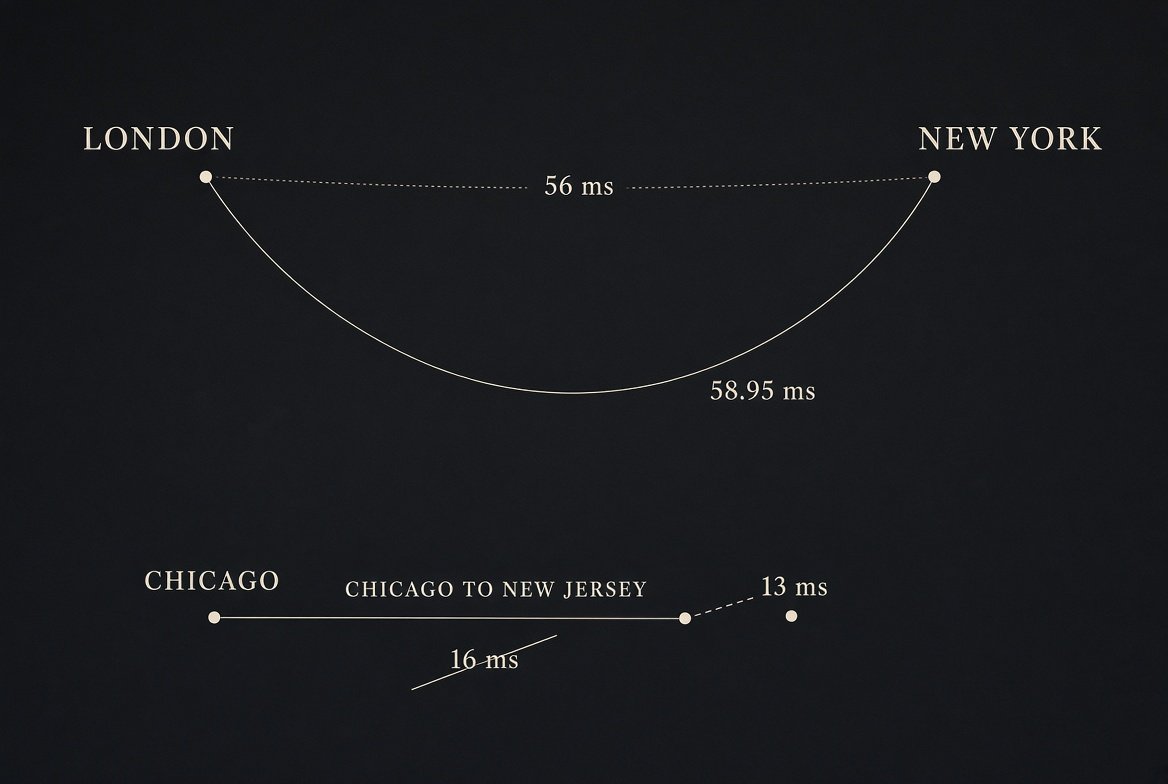
Apply it to the most commercially important pair of cities in the Atlantic economy. New York and London are about 5,570 kilometres apart along the great circle, the shortest path over the curve of the earth. At five microseconds per kilometre, a signal that could follow that path exactly would take about 28 milliseconds one way, and the round trip would take about 56. Cables do not follow great circles. They avoid the steepest seabed, they detour around hazards, and they land where a landing is permitted. Every real route is longer than the ideal, and the surplus is paid for in time.
Milliseconds are small on the human scale. A blink lasts a few hundred of them. On the scale of automated markets they are large. An algorithm can read a price, decide and submit an order in far less time than a signal needs to cross the ocean. A participant who sits ten milliseconds closer to a venue sees every price ten milliseconds earlier than a rival who sits farther away, and that margin can be monetised. The token does not know this. The participant who is late does.
Engineers have found ways to buy small improvements. Straighter routes shorten the distance. Hollow-core fibre, in which light travels mostly through air rather than glass, can approach the speed of light in a vacuum and removes close to a third of the delay, though it remains a niche and expensive product. Microwave links, which pass through air in a straight line, have been used between Chicago and New Jersey because radio in air outruns light in glass. Each of these is a purchase of time, priced by someone who values it. None of them repeals the planet.
The older market already knew this, and it priced the knowledge. Around 2010 a company called Spread Networks, founded by Dan Spivey and backed by James Barksdale, built a new fibre route between the Chicago futures cluster and the New Jersey equity halls, cutting through the Alleghenies and avoiding the towns the older routes had followed. The project is commonly put at about $300 million. The round trip fell from roughly 16 milliseconds on the legacy routes to about 13, later tightened to 13.1 and then 12.98.1 Within a few years microwave networks had undercut it, because air is faster than glass. In 2017 Zayo bought the company for $127 million. The episode is instructive for what it shows about the buyers. They paid a great deal for very little time, and the price was rational because the margin it purchased was larger than the cost. It is also instructive for what it shows about the asset. The cable was not a protocol. It was a right of way, a trench, and a few milliseconds. When a faster medium appeared, the trench kept its use and lost its premium.
The lesson carries over to tokenised markets without a change of subject. Wherever a token can be traded, borrowed against or liquidated by a party that competes on speed, the same economics apply. The cable is a latency product, and the market clusters where the product is best. A design that calls itself global is still a tenant of the trench.
| Interval | Roughly | What it decides |
|---|---|---|
| 5 microseconds | One kilometre of ordinary fibre | Nothing a person can see. Everything a route can sell |
| ~28 ms | Great-circle, New York to London, one way | The physical floor, if the cable were straight and in vacuum-glass |
| ~56 ms | The same, round trip | The number no real cable beats by much |
| 58.95 ms | Hibernia Express, tested, LD4 to NY4, round trip | The marketed floor of the Atlantic financial path |
| ~3 ms | Spread Networks' saving, Chicago to New Jersey | A purchase, later undercut by microwave |
| 12 seconds | An Ethereum slot | The protocol's allowance for the planet |
| 4 seconds | The attestation window inside that slot | Where lateness becomes a missed duty |
| A blink | A few hundred milliseconds | The human scale, which is the wrong scale |
Figure 1. What a millisecond is, and what it is not.
III. A cable and a beach
Make it concrete with one cable.
Hibernia Express entered service on 15 September 2015. It was the first new transatlantic system in more than twelve years, 4,600 kilometres, built by TE SubCom after the original vendor arrangement with Huawei Marine was dropped. Its operator marketed it on a single attribute. It was shorter and straighter than the older cables it competed with. Tested round-trip latency from Equinix LD4 in Slough to Equinix NY4 in Secaucus came in under 58.95 milliseconds, better than the design target, and the company had spoken of 59.5 in early tests.2 Those two buildings are the halls of the previous essay. The cable was built to join them.
The landings are a short list. Halifax, Nova Scotia. Brean, a seaside village in Somerset, on the Bristol Channel. A branch, announced in December 2014, comes ashore at Cork.3 Terrestrial routes then carry the signal onward to the great data-centre clusters, to London at one end and to the New York and New Jersey area at the other. The marketed round trip between those clusters sits in the high fifties of milliseconds, a few milliseconds above the great-circle floor and more than a fifth faster, on the subsea segment, than the next-best cable then in service. The surplus over the ideal is the price of a seabed that can actually be ploughed.
Pause at the cable itself. The popular image is a thick rope on the seabed. In deep water the cable is about the diameter of a garden hose, a bundle of hair-thin glass strands wrapped in copper and plastic. Closer to shore, where fishing gear and anchors are a danger, it is armoured with steel wire and buried by a plough to a depth of a metre or more. On Hibernia Express, more than half the route was buried, including over difficult ground, which is why the straight line was expensive. A modern system carries a handful of fibre pairs. The cable has little electronics in the ordinary sense, but it does need power. Every fifty to a hundred kilometres the signal is boosted by a repeater, a sealed unit that amplifies the light. The repeaters are fed with a constant direct current sent down a copper conductor in the cable, supplied from the shore at both ends at several thousand volts. If either shore end stops feeding, the ocean segment is not a cable. It is a hose.
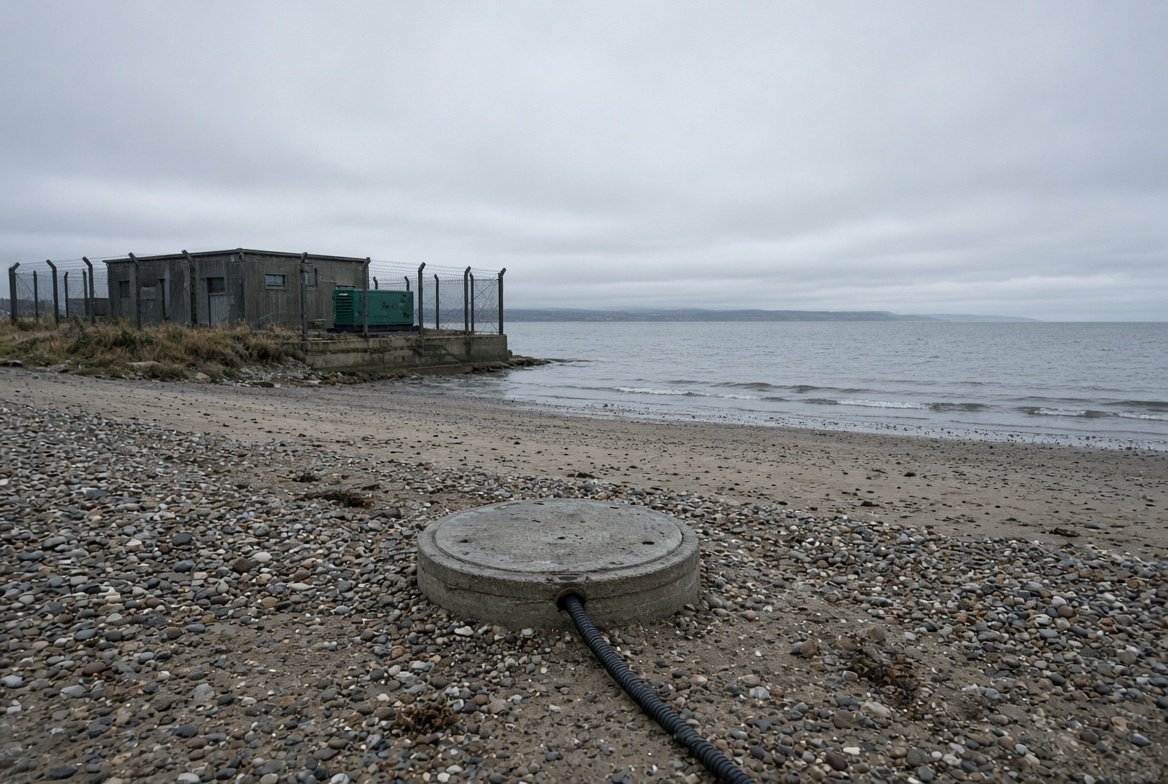
That supply is the first hint of what lies at the end. The landing station at Brean is not a dramatic building. It is a modest secure facility behind a perimeter, on flat coastal land, close to the shore where the cable comes up the beach. Somewhere between the sand and the building, the cable passes through a beach manhole, a concrete chamber in which the seabed cable is joined to the terrestrial one. Inside the building are two kinds of equipment. The first is the power-feed equipment, which converts the grid's alternating current into the stable high-voltage direct current the repeaters need, backed by batteries and generators of the kind described in the last essay. The second is the terminal equipment, the line terminals that turn the pulses in the glass into signals a carrier can hand on.
The landing station is therefore a hall in miniature. It has a landlord, a grid connection, a postcode and a fence, and it adds a fifth requirement the first essay's halls did not have: a beach. A cable cannot come ashore wherever it likes. It needs a stretch of coast where the seabed slopes gently, where the landing will not be disturbed by dredging or fishing, where the planning authorities have agreed to a crossing, and where the terrestrial network is within reach. Very few places meet all of these conditions, and the places that do are used again and again. Brean is one. Bude in Cornwall, on the other side of the same peninsula, is another, and has been a landing point for transatlantic cables for decades. Cork is a third, and it is a branch, not a second ocean. Virginia Beach, which hosts the American end of Marea, plays the same role on the western shore. Marea, ready for service in 2018, runs about 6,605 kilometres from Virginia Beach to Sopelana, near Bilbao, funded by Microsoft and Meta and operated by Telxius. It was built in part because Hurricane Sandy had shown what a single shoreline can do to a cloud.4 The map of Atlantic connectivity is not a map of the ocean. It is a map of a handful of beaches.
| Object | Hibernia Express | What it adds to the hall |
|---|---|---|
| Ready for service | 15 September 2015 | First new Atlantic system in more than 12 years |
| Length | 4,600 km | Longer than the great circle, shorter than the old routes |
| Tested round trip | Under 58.95 ms, LD4 Slough to NY4 Secaucus | Joins the two halls of Essay 01 |
| Landings | Halifax; Brean; Cork branch | Three beaches, not an ocean |
| Power | Shore-fed direct current to the repeaters | A cut at either end darkens the span |
| Burial | More than half the route, including hard ground | The straight line was a ploughing problem |
| Buyer | Financial firms, first | A latency product, priced as one |
Figure 2. One cable, as a plant.
IV. The room where networks meet
A cable ends at a landing station, but a message does not end there. It must be handed to a network that can carry it to the right building, and that handover usually happens at a physical meeting point.
An internet exchange is, in essence, a set of switches in a room. Networks that wish to exchange traffic directly (banks, carriers, content providers, trading firms, hosting companies) bring a cable from their own equipment to the exchange's switch and agree to pass traffic to one another across it. The exchange does not own the traffic and does not route it in any deep sense. It provides the shared floor on which the networks stand. The arrangement is called peering, and it replaces the longer route that traffic would otherwise take through a third party's network.
London's exchange, LINX, was founded in 1994 and operates switches in several data centres in the Docklands and elsewhere around the capital. Telehouse's Docklands campus, in a former industrial district on the Isle of Dogs, is its historic home. Frankfurt's DE-CIX, which began in 1995, has for years been among the busiest exchanges in the world by traffic, and Frankfurt's position as a hub for Europe is in large part a function of it. In New York, NYIIX, operated from the Telehouse estate, serves the same function in buildings in Manhattan and across the Hudson, in the same estate of carrier hotels and data centres that also hosts the trading halls described in the first essay.5
The pattern is the same in each. An exchange occupies a room, or several rooms, in a building that is already a landlord's carrier hotel. The room is cold, loud and secured. Along its walls run the meet-me rooms, where carriers terminate their fibres, and in the middle are the racks with the exchange's switches. The physical act of connecting two networks is a cross-connect, a length of fibre run by hand between two panels, ordered through the landlord and priced as a monthly fee. A cross-connect can be a few metres long. It is the cheapest and most consequential cable in the chain, because it removes a whole network's worth of detour.
This is where geography and commerce reinforce each other. A network that joins an exchange gains access to every other network already there, which makes the exchange more valuable to the next network to join, which draws more in. The result is not a design but a deposit. Over thirty years, the same few buildings in London, Frankfurt, Amsterdam, New York and a small number of other cities have accumulated the connections, and connections are the one asset that cannot be moved without losing their value. A new exchange with better technology and no neighbours has nothing to offer. The software can be copied. The neighbour cannot.
Tokenised markets arrive into this structure as tenants. A validator hosted in Frankfurt benefits from the proximity of other hosts for the same reason a trading firm does. A bank's tokenised deposit platform that needs low-latency paths to counterparties will find those paths in the same carrier hotels. The new market does not create new meeting places. It borrows the old ones, because the old ones are where the cables already are. Cash Leg described three American rails that do not talk by default. At the level of glass, the talking, when it happens, happens in these rooms. Interoperability is not only a missing product of statute. It is a cross-connect that someone has or has not ordered.
V. One update, hall to hall
Follow a single state update to see the whole chain at once.
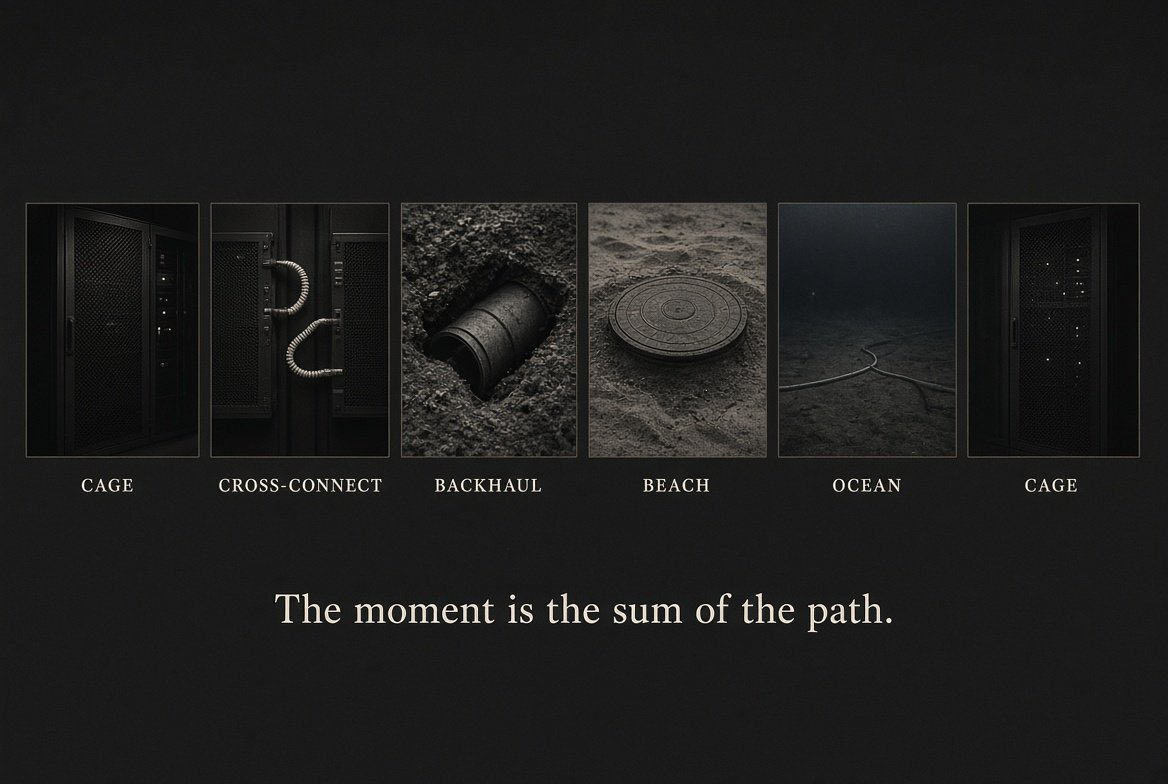
Suppose a participant in a New York hall submits an instruction that changes the state of a shared ledger whose other copies are held in a hall in London. The instruction begins in a server in a cage, in the manner of the first essay. It leaves the server through a short copper or fibre cable to a switch, and then through a cross-connect to a carrier's equipment in the building's meet-me room. These first metres are the last metres of a journey that begins deep inside the hall, and they are often the part that the participant has paid most heavily to shorten. A cage placed a few rows nearer the meet-me room, or in a building a few hundred metres nearer the exchange, can be worth a measurable amount. Spread Networks was a continent-scale version of the same purchase.
From the meet-me room the signal enters a carrier's terrestrial backhaul. This is ordinary buried fibre, running along a rail line or a motorway verge, through a duct that may be shared by several carriers. On the Hibernia path it runs to Halifax. This leg is long, and its route is set by rights of way that were settled decades ago. It is also the leg most often cut by something as unglamorous as a digger.
At the landing station the signal passes through the line terminal and into the submarine cable. Here the update spends the longest part of its journey. It crosses the ocean at about two-thirds of the speed of light, amplified by repeaters, buried in places and exposed in others. It comes ashore on the other side, through another beach manhole into another landing station, such as the one at Brean, and then onto another terrestrial backhaul that carries it across Somerset and into the capital's carrier hotels. There it passes through another meet-me room, another cross-connect and another cage. Only then is the entry written into the machine at the far end.
Count the dependencies. Two halls at the ends, each with the requirements of the first essay. Two sets of cross-connects. Two backhaul routes, each with its own rights of way and its own landlord. Two landing stations, each with power-feed equipment and a perimeter. A cable with repeaters whose supply depends on both shore ends. Every one of these is a physical object with an owner, and every one is a place where the signal can be delayed, rerouted or stopped.
| Leg | What it is | Who owns the delay | How it fails |
|---|---|---|---|
| Cage to switch | Metres, inside the hall | The tenant, and the rack position they paid for | A failed port, a full link |
| Cross-connect | A few metres, run by hand | The landlord, billed monthly | An order not placed; a panel mispatched |
| Backhaul | Buried fibre to the beach | A carrier, a duct, a right of way | A digger |
| Landing station | Power feed, line terminal, fence | The cable owner, the grid | A shore-end outage darkens the repeaters |
| Ocean | 4,600 km, ~two-thirds of c | The seabed, the plough, the beach | An anchor, a fault, a ship that cannot enter |
| The other shore | Beach manhole, backhaul, meet-me, cage | The same list, reversed | The same list, reversed |
| Round trip, tested | Under 58.95 ms, LD4 to NY4 | Physics, plus the surplus of a real route | A longer path, bought back at a higher price |
Figure 3. One update, New York hall to London hall, on the path Hibernia was built to sell.
The protocol does not see any of this. At the level of the ledger, a message is sent and, a moment later, received. But the moment is the sum of every item above, and the reliability of the message is the product of their reliabilities. A system's resilience is bounded by the weakest link on the paths it relies on, and in the Atlantic corridor the weakest links are few and well known.
VI. The corridor
Why do the participants in tokenised markets end up on the same corridor as the old market?
The answer starts with the protocols. Consensus systems that agree on a shared state must move messages between participants and wait for enough of them to arrive. Their timing parameters are chosen with the size of the planet in mind. Ethereum divides time into twelve-second slots. Within each slot a proposed block must reach a large share of the validating set within the first four seconds if it is to be attested in time. Bitcoin's ten-minute block interval was chosen in part so that propagation delays would be small relative to the time between blocks, keeping the rate of competing blocks low. The block time of a chain is, among other things, a statement about how long the designers expected the world to need to hear the news. Twelve seconds is a generous allowance for a planet whose oceans take sixty milliseconds to cross. It is not a generous allowance for a builder who is late to an auction measured in tens of milliseconds.
Within those timing rules there is room for advantage, and the room has been measured. A paper revised in April 2026, using location data on about 16,000 Ethereum validators, finds that the set clusters along the Atlantic corridor, especially in the United States and Europe, where latency to other validators and to infrastructure is most favourable. The protocol does not encode geography. The payoffs do. Validators who can hear a block sooner, and attest sooner, collect a systematic edge, and the edge is a location.6 Work on the block-building market makes the same point from the other end of the auction. Relays and their proxies sit at a few hubs with fast intercontinental distribution. Crossing the Atlantic on fast fibre is about 38 to 40 milliseconds, which at recent bid-turnover rates is several top-bid updates. Through 2025 the leading builders stopped sending bids across the ocean and used relays on the same shore as the builder. The auction compressed toward the fibre, and then refused to cross it.7
The node surveys of the previous essay are the building map of the same fact. Public-chain nodes concentrate in the eastern United States and in western and central Europe, with Germany, Finland, France, the Netherlands and Ireland prominent among the European locations. The two shores of the Atlantic, joined by a small number of cables, form a latency well into which stake and infrastructure settle. A participant outside it is a little late to every event, and over thousands of events lateness has a price.
The same logic operates in the traditional market, and the geography that results is familiar. Nasdaq's matching engine sits in Carteret, New Jersey. The New York Stock Exchange's sits in Mahwah. Both are in the northern New Jersey cluster that NY4 serves. The CME's futures are matched in Aurora, Illinois, which is why the Chicago to New Jersey route attracted the $300 million trench. London's venues and trading firms cluster in the Slough and Docklands estates, which is why a cable marketed to them is sold as a path from LD4 to NY4 and not as a path from "America" to "Europe." Each time a new category of market has arrived, it has located itself with respect to those existing points, because the existing points are where the counterparties are.
Asia follows the same logic with a different shape. The financial centres of Tokyo, Hong Kong and Singapore are joined by a dense set of intra-Asian cables, and the cross-connect and exchange estates of those cities concentrate the corresponding traffic. Several large crypto venues have placed matching engines in Tokyo cloud regions, which is the same pattern: choose the building that is nearest, in latency terms, to the largest number of counterparties. The pattern does not need a conspiracy. It needs a price for being late.
None of this is a design flaw in the sense the word is usually used. It is the ordinary consequence of an economic force acting on a physical constraint. Participants who compete on time will pay to be near one another, and the nearness is available in only a few places. The decentralisation of a token's governance does not alter this, because the decentralisation is of authority, not of location. Authority can be spread across thousands of holders while the machines through which they act sit within a few hundred metres of one another, or within one round trip of one another across a single ocean.
| Participant | Where the machine is | What the location buys |
|---|---|---|
| Nasdaq matching | Carteret, New Jersey | The equity cluster |
| NYSE matching | Mahwah, New Jersey | The same cluster, a few milliseconds away |
| CME matching | Aurora, Illinois | The reason the Chicago trench was dug |
| London venues | Slough, Docklands | LD4, Telehouse, LINX |
| Hibernia Express buyer | A path between those two | 58.95 ms, round trip, tested |
| Ethereum validators, sampled | US and Europe, Atlantic corridor | Earlier attestations; a location game |
| Relays and builders | North Virginia, Europe, a Japan instance | An auction that will not cross 40 ms if it can avoid it |
| A holder outside the well | A longer path | The same token, a later clock |
Figure 4. Who sits in the well, and why the well is Atlantic.
VII. The chokepoints
If the corridor is narrow, so is what carries it. The number of places where the physical network can be cut is small, and the number of vessels that can repair a cut is smaller.
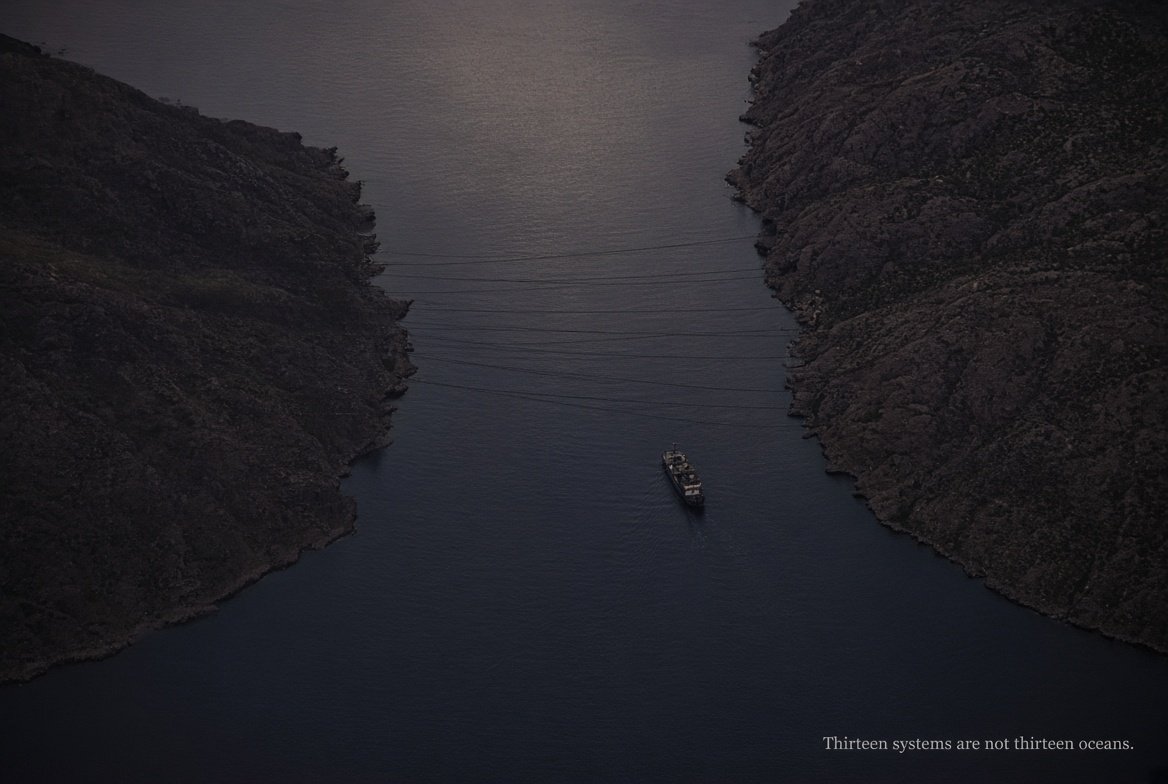
Begin with the count, because the draft's "fewer than two dozen" was the right direction and the wrong precision. TeleGeography's map, as of early 2025, showed 13 in-service transatlantic cable systems, and 17 segments that actually cross the ocean. Systems branch. Apollo, for example, crosses twice, north and south, with its own pairs of landing stations.8 Thirteen systems is not a mesh. It is a handful of ropes between a handful of beaches: Cornwall, Somerset, the south coast of Ireland, Nova Scotia, New Jersey, New York, Virginia, Massachusetts, and a few others. The Red Sea and the Strait of Malacca carry a disproportionate share of the cables between Europe and Asia. The waters off Taiwan carry a disproportionate share of those within East Asia. Each of these is a geographic funnel, and a funnel is a chokepoint whether or not anyone intended it to be.
Faults are routine. The International Cable Protection Committee puts the annual count at about 150 to 200, stable even as the network lengthened, with about 70 to 80 per cent caused by fishing and anchors. A SubOptic compilation of repair data put the 2010–2024 average at 199 faults a year, and fishing and anchoring at 86 per cent. In 2023 the ICPC counted 206 repairs across 136 jurisdictions. The longest took 947 days.9 The great majority are repaired without anyone outside the trade noticing, because traffic reroutes onto other cables. A few have been conspicuous, and the causes are disputed often enough that the essay should not settle them.
Cables in the Red Sea were cut in early 2024. The common account is an anchor drag from a vessel struck in the conflict and left adrift; repairs were slowed because ships could not safely work the area. Traffic moved to other paths, and the other paths were longer. Cables off Taiwan's outlying islands have been cut more than once; attribution has swung between accident and intent, and the essay does not need to choose. In the Baltic in November 2024 two cables were damaged. The ICPC's own note is the useful one: there was no service interruption, vessels were deployed, both were repaired within about two weeks, and the incident was operationally unremarkable even though it was politically loud. Later reporting cited US officials treating at least some Baltic cuts as accidents of inexperienced crews on poorly maintained ships.10 The causes remain argued. The effect is not. A small number of physical lines carry a very large share of traffic, and a single ship with a dragging anchor can reach more than one of them.
Then there are the ships. A cut cable is repaired by a specialised vessel, which locates the break, raises the cable to the deck, removes the damaged section, splices in a new length and lowers it back. The work takes days at the site and often weeks including transit, permissions and weather. The global fleet of cable ships is not large, and the subset on standing maintenance contracts is smaller still: a few dozen, stationed in ports around the world under long-term arrangements with consortia of cable owners. A 2025 industry study treated fifteen ageing maintenance vessels as needing replacement by 2040, thirteen of them before 2036, and saw room for the equivalent of up to five more in Asia.11 They cannot be conjured on demand. A sudden cluster of faults, or a fault in a place that ships cannot safely enter, can leave a cable down for a long time. The market in cable repair is a market in scarce physical capacity, of the same family as the transformer queue in the first essay. The queue there was for megawatts. The queue here is for a ship that can splice glass in a swell.
The financial system adapts to this by buying redundancy: several cables, several landing points, several carriers. It is effective, and it is why a single cut is usually invisible. Redundancy has a limit, and the limit is geographic. Two cables that land on the same beach, or pass through the same strait, are not independent in the sense that matters. A network that is diverse on paper can be concentrated in the one dimension, the physical corridor, where a single event can reach all of it. Thirteen Atlantic systems are not thirteen independent oceans.
| Chokepoint | Scale | What "diverse" fails to mean |
|---|---|---|
| Atlantic systems in service | 13 systems, 17 crossing segments, early 2025 | A branch is not a second ocean |
| Named beaches | Brean, Bude, Cork, Halifax, Virginia Beach, and a short list of others | Two cables, one beach, one storm |
| Annual faults | ~150–200; ~200 average, 2010–2024 | Mostly anchors and fishing, not drama |
| A bad repair | 947 days, the longest of 206 repairs in 2023 | The tail, not the average |
| Repair ships | A few dozen on standing contracts; 15 ageing hulls flagged for replacement | A queue, like the transformer queue |
| Funnels | Red Sea, Malacca, the waters off Taiwan | One strait, many systems |
| Paper diversity | Several carriers, one corridor | The event that reaches all of them |
Figure 5. Where the path is actually narrow.
VIII. The stress test, and the instant exit
Cash Leg's test applies to the cable as it did to the hall. If the cable goes dark, does the token do what the thing it replaces would have done?
The status language does not need to be reinvented. Substitutes, when ordinary conditions hold. Watch, when one field is already the weak channel. Does not substitute under stress, when exit, cash, crowd or basis would not survive the stated shock. The shock here is a path. The field it injures first is clock. Exit follows, because an exit that was sold as instant is a clock with a promise attached.
Run the Atlantic case. A cable between the two shores is cut by an anchor. Traffic reroutes onto the other systems, and in the first instance almost no one notices. The path is longer, so the delay rises by some milliseconds, and the remaining cables carry more load. For a retail holder, the change is invisible. For a market maker whose strategy depended on the delay between two venues, it is a change in the price of the business. For a protocol whose timing assumptions have a margin, it is a narrowing of the margin. Nothing fails. Something has been bought back at a higher price. The status is Watch. The weak channel is the corridor, and it has been used.
Now cut the second cable, and then a third, as a single event on a shared route or in a shared strait might do. The path that remains is longer and more congested, and the participants who relied on a particular corridor find themselves on a different one. Participants who are far from the surviving routes fall behind. A validator that cannot hear a block inside the four-second attestation window cannot attest to it. A builder that had refused to bid across forty milliseconds of ocean is now bidding across more than that, or not bidding. The chain continues, but its usable form, the one that gives anyone a fast and reliable result, retreats to wherever the connectivity is best. The status, for a use that needed the old path that day, is the one Cash Leg already uses when a capped instant exit is not, on the day, instant. Does not substitute under the stated shock.
This is the link to the instant exit, and it extends the September argument rather than repeating it. Cash Leg treated a capped instant exit as a rule: a holder may turn a token into cash quickly, up to a limit, and the limit is the thing to watch. The rule is necessary. It is not sufficient. A cap is a number in a terms sheet. Instant is a path. The path is the sum of section V: the cages, the backhaul, the beaches, the repeaters and the exchange. An instant exit between two points is only as instant as the path between them, and that path exists only where the cable already does. A holder in a place the corridor does not reach, or reaches by a single route, holds a different instrument from a holder in a carrier hotel in Docklands, even if the two tokens are identical on the ledger. The cap can be the same. The clock is not.
It is therefore a mistake to treat instant as a property of the token. Instant is a property of the token in a location, served by a path, at a moment when the path is intact. A bank deposit shares this dependency, and so does a card payment. Cash does not. A note handed across a counter needs no cable, no landing station, no exchange and no repair ship, and its speed is that of a hand. The classification from the hall carries over without a change of side. The token lives with the deposit, not with the note. The cable is the reason the deposit's continuity was always a purchased continuity, and the reason a token cannot improve on it by being called a rail.
The comparison is not an argument against tokens. It is an argument about where their advantages are located. A token can offer faster settlement between institutions that are already connected, and it can do so cheaply, because the cables are already laid and paid for. Hibernia Express was a purchase of a few milliseconds on a path the market was already using. It cannot offer that speed to those who are not already on the cable, and it cannot lessen the dependence of the entire arrangement on thirteen systems and a short list of beaches. The substitution is real where the glass is. It lapses where the glass is not, and it lapses a little further every time a cable is cut and the repair ship is elsewhere.
| Shock | What still works | What the holder can do | Status |
|---|---|---|---|
| One Atlantic cable cut; traffic reroutes | The other twelve systems, on a longer path | Nothing visible, if retail. A dearer latency, if competing on time | Watch. The corridor has been used |
| A shared beach or strait takes several systems | The paths that do not share the funnel | Fall back to a longer clock; some duties missed | Does not substitute under stress for a use that needed the old path that day |
| Shore-end power fails at a landing | The other cables | The span with the dead repeaters is a hose | Watch. A landing station is a hall |
| Builder and counterparty on opposite shores, auction inside 40 ms | The chain | The bid does not cross, or crosses late | Watch. Instant was a same-shore product |
| Holder outside the well, same token, same cap | The ledger entry | A slower exit than the Docklands holder | The cap was shared. The clock was not |
| Note across a counter | The hand | The hand | The thing the token does not replace |
Figure 6. The same test, applied to the path.
IX. What this does to the Cash Leg fields
The eight fields do not need to be rewritten. They need a path.
Twin: the token still says it is a deposit, a fund share, a bill. If the twin and the token are in halls on opposite shores, the basis between them now includes the cable. A cut does not change the terms. It changes the interval in which the two can be touched together.
Title: unchanged in law. An entry that cannot be agreed with the other copies is not, for the hour, a title that can move.
Cash leg: a deposit token's cash leg is the bank. The bank's ability to show the cash leg to a counterparty on the other shore is the cable. GENIUS and the ROAD to Housing Act decided who may issue. They did not lay glass.
Clock: the field the cable injures first. Hours, finality, weekend. A twelve-second slot assumes a planet. A 58.95-millisecond path assumes a beach. A capped instant exit assumes both, and assumes the repair ship is not the binding constraint.
Pledge: a pledge that must be perfected by a message across a corridor is a pledge with a propagation delay. Eligibility lists do not mention Brean. They should, in the sense that matters on the day the beach is closed.
Exit: the September subject. Primary redemption plus a capped instant path. The cap is a rule. The instant is a cross-connect, a backhaul and a repeater. A dark cable is not a cap of zero for the holder on the same shore. It is a cap of zero for the use that needed the other shore.
Crowd: holder concentration was September. Landlord concentration was the hall. Path concentration is this essay. A tight holder set, in a tight region, on thirteen systems, is one crowd even when the validator count is large.
Basis: the gap between token and twin. A longer path opens a basis in time, which for a leveraged book is a basis in price. Nothing in the terms has changed.
None of this is a reason to abandon the fields. It is a reason to read a print that says "substitutes" as a statement about ordinary conditions on the path, not as a statement about the token in the abstract.
X. What the next object is
The hall established that a token has a building. The cable shows that the building has neighbours, and that the neighbours are chosen by light. A signal that has crossed an ocean, passed through an exchange and arrived at its cage has completed the distance. It has not yet been agreed. Two machines that have received the same message must still decide what time it is, and which of them came first. The question of order cannot be settled by glass alone. It is settled by a clock, and by a box that can sign.
Next week: Essay 03, The Box.
Notes
1. Spread Networks, founded by Dan Spivey, backed by James Barksdale. The Chicago–Carteret dark fibre is commonly put at about $300 million. Round-trip estimates: about 16 ms on the legacy routes, about 13 ms on the new route, tightened to 13.1 ms and then 12.98 ms by October 2012. Microwave later undercut the fibre premium because air is faster than glass. Zayo agreed to buy the company for $127 million, announced 27 November 2017. The figures are industry and contemporary-account figures, not a metered audit of every route.
2. Hibernia Express, ready for service 15 September 2015. First new transatlantic system in more than twelve years. 4,600 km. TE SubCom. Tested round-trip latency better than 58.95 ms from Equinix LD4, Slough, to Equinix NY4, Secaucus, announced 24 September 2015; early webcast figure 59.5 ms. Subsea segment reported by TeleGeography as more than 20 per cent faster than the next-best cable then in service. Pure-silica-core fibre and a straighter route were the two purchases.
3. Landings: Halifax, Nova Scotia, and Brean, Somerset, with terrestrial extension to the metro halls. Cork branch announced 19 December 2014 as a direct connection and a new landing station. Treat Cork as a branch, not as a second ocean crossing.
4. Marea, ready for service 2018, about 6,605 km, Virginia Beach to Sopelana near Bilbao. Funded by Microsoft and Meta, built by TE SubCom, operated by Telxius. A stated reason for the southern landing was the disruption Hurricane Sandy caused in October 2012 to the more northerly shoreline. Design capacity has been variously printed; the route and the landings are the point.
5. LINX, founded 1994, historic home Telehouse Docklands. DE-CIX, founded 1995, Frankfurt. NYIIX, New York, operated in the Telehouse estate, still the meeting point for the Manhattan and New Jersey carrier hotels. Peak-traffic figures move and are not used here. The object is the room and the cross-connect, not the terabit print.
6. Sen Yang, Burak Öz, Fei Wu and Fan Zhang, "Geographical Centralization Resilience in Ethereum's Block-Building Paradigms," arXiv:2509.21475, revised 5 April 2026. Validator location sample about 16,000, via Chainbound. Clustering along the Atlantic corridor is an observed outcome of latency-sensitive payoffs, not a protocol rule. Node geography from the Cambridge July 2026 audit remains the building map; this paper is the stake-and-payoff map. They are related and they are not the same number.
7. Flashbots Collective, "The Geography of Block Building," November 2025, and the related latency tables: France–North Virginia about 38 ms, treated in the text as about 40 ms of Atlantic fibre, equal to several top-bid updates at 2025 turnover rates. Through 2025 Titan, the consistent leading builder, stopped sending bids across the Atlantic and used same-shore relays. Relays and proxies concentrate at hubs; validators are more spread than the relays, which is the point.
8. TeleGeography, February 2025: 13 in-service transatlantic cable systems, 17 segments that cross. A system with two crossings is not two oceans. Global in-service systems were above 570; the Atlantic count is the relevant one.
9. International Cable Protection Committee: about 150–200 faults a year, roughly 70–80 per cent fishing and anchors, stable as route length rose from about 1 million km in 2014 to about 1.7 million km in 2025. Andy Palmer-Felgate, Global Cable Repair Data Analysis, SubOptic 2024 and 2025: average 199 faults a year, 2010–2024; fishing and anchoring 86 per cent. ICPC: 206 repairs in 2023 across 136 jurisdictions; longest repair 947 days.
10. Red Sea cuts, early 2024: commonly attributed to anchor drag from a vessel struck in the conflict; repairs slowed by the security situation. Taiwan outlying-island cuts: repeated, attribution disputed. Baltic, November 2024: ICPC note that two cables were damaged, service was not interrupted, and both were repaired within about two weeks. Later reporting cited officials treating some Baltic events as accidents. Causes are not settled here. The chokepoint is.
11. Cable-ship fleet: industry working figure of a few dozen vessels on standing maintenance contracts, not a census. A June 2025 industry study estimated that 15 ageing maintenance ships would need replacement by 2040, 13 of them between 2026 and 2035, with room for up to five further vessel-equivalents in Asia. The queue is the point.