The Plant · Essay 04 of 04 · 28 October 2026
The Shift
The roster that “decentralised” systems still keep.
I. The claim
Every plant has a night shift. Tokenised markets outsource trust to machines and then hire people to watch the machines.
The sentence is not a criticism. It describes how every large physical system has been run for as long as there have been large physical systems. A power station has a control room that is staffed at three in the morning. A railway has a signaller. A hospital has a night registrar. A bank's payment system has an operations floor, and the floor has a rota, and the rota has a name at the top of it for the hour when something breaks. The three previous essays described a hall, a cable and a box. Each was an object, and objects are easy to describe because they stay still. This essay turns to the one component of the plant that does not stay still, and that the abstract vocabulary of tokenised markets most consistently omits. It is the people who are awake.
The omission is understandable, because the case for tokenisation is, in part, a case for removing people from the loop. Reconciliation by hand becomes reconciliation by protocol. A settlement instruction that once passed through three desks becomes a single state change. The language that follows from this tends to describe the resulting system as self-operating: it "runs," it "settles," it "executes," as though no one were involved. That language is accurate about the ledger and misleading about the plant. The ledger does run itself, within its rules. The plant that hosts the ledger, signs for it, times it and connects it to the world does not.
The method is unchanged. Sit with a real plant, then write the shape. Four things are visited. The first is the incident roster, the list of names called when something fails. The second is the key ceremony, seen as what it is: a human ritual with a checklist. The third is the last mover, the technician with a van or the crew on a repair ship, who restores the physical layer when everything above it has done what it can. The fourth is one real outage, and the people who closed it.
This is not labour sociology. It makes no claim about pay, conditions or the future of work. And it is not a hymn to community, whether the community is of validators, developers or users. Communities are real and sometimes useful. The point here is narrower and structural. The system has a shift, the shift has a size, and a system's resilience cannot exceed the resilience of the shift that keeps it.
II. The call at 03:00
Begin with the room that is lit when everything else is dark.
A network operations centre, or NOC, is an unremarkable space in most firms. There is a wall of screens, a row of desks, a whiteboard that nobody has cleaned, and a quiet that is occasionally broken by a phone. The screens show dashboards: link utilisation, error rates, queue depths, the health of each service, the temperature of each hall. Most of the time the dashboards are green, and the work of the room is to ensure that they stay so. A well-run NOC treats an alert as an event requiring a response, and a response means a person. A dashboard that no one is paid to watch is a decoration.
The people are scheduled. In a firm that operates continuously, the NOC is staffed in shifts, often following the sun between regions so that the night in one city is covered by the day in another. Behind the people in the room sits a second line, the on-call rota. Engineers with deeper knowledge of particular systems take turns to carry a pager, or its modern equivalent, a phone that will ring at any hour and will not stop until someone acknowledges it. The rota is a document with names and dates. It is also a promise to regulators, clients and counterparties that for every hour of the week, someone who can do something about a failure is within reach. The promise is only as good as the name on the line. A rota with a gap is not a thin shift. It is an hour with no shift.
When the phone rings at 03:00, a small, practised sequence begins. The first responder acknowledges the alert and looks at what it says. A runbook, a written procedure for the symptom, tells them what to check first. If the runbook does not resolve it, they escalate: to the engineer who owns the service, to the manager who can authorise a failover, to the vendor whose equipment has failed, to the landlord of the hall. A person is designated incident commander, whose job is not to fix the fault but to coordinate those who are fixing it, to keep a log, and to decide who tells the clients. Communications run on a separate track from repair. The most common error in an incident is to put the same person on both. The person who is typing the fix cannot also be the person explaining the fix, and a market that learns of an outage from a rumour has already lost the hour the roster was meant to buy.
The sequence has a regulatory shadow, and the shadow is now written down. Resilience rules in the major financial jurisdictions require firms to identify their important business services, set a tolerance for how long each can be disrupted, and demonstrate that they can stay within it. In the United Kingdom, the Prudential Regulation Authority's SS1/21 and the matching FCA framework, in force from 31 March 2022, define an impact tolerance as the maximum tolerable disruption to an important business service, measured in time, set at the point where further disruption would threaten safety and soundness or, for the firms that meet the threshold, financial stability. The tolerance is to be set on the assumption that a disruption will occur. Probability is not an excuse.1 In the European Union, the Digital Operational Resilience Act, Regulation (EU) 2022/2554, entered into force on 16 January 2023 and has applied in full since 17 January 2025. It obliges in-scope financial entities to manage ICT risk, to classify and report major incidents, to test resilience, and to oversee the third parties on which they depend. There is no transitional relief. An entity in scope on that date was expected to be able to show the roster.2
The details differ. The common demand does not. The firm must be able to show, on request, who would respond, how fast, and with what authority. A tolerance of two hours, which the hall essay borrowed from the PFMI recovery window for a market infrastructure, is not a hope. It is a claim about a named person being reachable inside that window, with the authority to act and the runbook that tells them what acting means. The two hours are a staffing fact before they are a technical one.
Most of this describes a bank or a market infrastructure. It might be thought that a public chain has no NOC, because it has no operator. In the protocol, that is true. In the plant, it is not. A staking provider, a custodian, an exchange, a node-hosting company, a relay operator and an infrastructure vendor each runs a version of the room described above. The chain has no night shift of its own. It is surrounded by a ring of firms, each of which does, and the continuity of the chain's usable form is the continuity of that ring. A chain that finalises while every exchange, every custodian and every staking desk is dark has finalised into a room with the lights off. The entry moved. The holder did not.
| Step | Who | What fails if the step is missing |
|---|---|---|
| Acknowledge | First responder, on the rota | The alert is a log line. No one owns it |
| Runbook | The same person, against a written page | Improvisation. The common errors get made |
| Escalate | Named owner, vendor, landlord | The fault sits with the person who cannot fix it |
| Incident commander | A person who is not also typing the fix | Repair and communication collapse into one tired voice |
| Tell the clients | A separate track | The market learns from a rumour |
| Impact tolerance | A time, set in advance, assumed to be breached | A promise with no clock and no name |
Figure 1. What the 03:00 call actually is.
III. The ritual with a checklist
The previous essay described the key ceremony as an object: a room, a safe, a box. It is more accurately a performance, and the performers are people.
Read a ceremony script and the first impression is of tedium. Each step is numbered. Each is read aloud by a named participant and confirmed by a second. A step might say that the ceremony administrator will remove a sealed bag from the safe, that the witness will read the number on the seal, that a third person will compare it with the log, and that all three will initial the entry. The IANA root-key scripts run to dozens of pages. A competent person could do most of it from memory, and the point of the document is that no one is permitted to. Memory is exactly what the ritual is built to distrust.
The purpose of this slowness is to convert trust in an individual into trust in a procedure. A secret that depends on one trusted person is only as safe as that person's honesty, health and attention. A secret that requires several people, each checking the others against a written script, in front of witnesses, with a recording, depends on the unlikelihood that all of them will fail in the same way at the same moment. The checklist is the mechanism. It is not ornamental. Aviation adopted the checklist after crews who knew the procedure still missed a step under load. Surgery adopted it later, and more reluctantly. The World Health Organization's Surgical Safety Checklist, led by Atul Gawande and issued in 2008, with a second edition in 2009, is nineteen items at three moments: before anaesthesia, before the incision, before the patient leaves the room. Skilled practitioners found it insulting. The evidence was that they missed things they already knew.3 The key ceremony applies the same principle to the most consequential action a custodian performs. The insult is the point. A person who is too senior to read the line aloud is a person the ritual has already failed.
Observe what such a ritual presumes about the people. It presumes that they exist, that they have been selected and vetted, that they have been trained, that they are available on the day, and that enough of them can be found to form a quorum even if some are ill, abroad or have left the firm. Each participant holds a card, or a share of a secret, or a part of a procedure. Each is, therefore, a dependency. The roster of officers is a list that must be maintained: people join and leave, their cards expire, their circumstances change. A custodian that loses three of five quorum members in a year, through resignation or illness, has a key that is intact and unusable until replacements are enrolled in another ceremony. Enrolment is itself an event that needs the quorum that no longer exists. The previous essay's second city does not help if the officers who can open it have left. A backup in Culpeper is a hypothesis if the three of seven cannot be assembled in either building.
The same applies on a smaller scale to every approval a custodian makes. A withdrawal needs a second signer, and the second signer is a person who must be at a desk, awake, and willing to read what is in front of them. The most costly thefts of tokens in recent years have been failures of this ritual rather than failures of mathematics. On 21 February 2025, Bybit's signers approved what the Safe{Wallet} interface presented as a routine internal transfer. The quorum was met. The signatures verified. What they had authorised was a change to the wallet's own logic, after malicious code had been served to those signers from a compromised developer machine. More than $1.4 billion left, including 401,347 ether. The box did precisely what it was designed to do. It obeyed the quorum. The weakness was that the quorum was human, and was shown a view that had been manipulated.4 No machine can fully compensate for that, which is why the design of the human step (what the approver sees, how long they are given, what they are asked to confirm, whether the hardware wallet shows the same bytes the screen does) has become a discipline in its own right. Dual control is a control against one dishonest person. It is not a control against a screen that lies to all of them at once. The checklist cannot check what the checklist is not shown.
IV. The last mover
When the incident commander has exhausted what can be done from a screen, someone has to go and stand in the place.
Consider the data-centre technician. In a facility of the kind described in the first essay, a small team of site engineers is present around the clock. They walk the halls on rounds, read the gauges on the chillers and the generators, replace failed fans and drives, run the monthly generator tests in which the building is deliberately cut over to its own power, and respond to alarms that the building's management system raises. When a remote engineer needs a cable reseated, a module swapped or a switch rebooted by hand, the instruction goes to them. In the trade the service is called, with a slight embarrassment, "remote hands." The embarrassment is misplaced. Remote hands are the last metre of every automated system. The instruction that cannot be executed by a person in the building is an instruction that has not been executed.
The role has been the decisive factor in some of the most instructive outages. On 4 October 2021 a large social-media company went offline for more than six hours. The company's own account, published the next day by Santosh Janardhan, is plain. During routine maintenance a command was issued to assess backbone capacity. An audit tool that should have stopped a bad command had a bug, and did not. The command took down the connections in the backbone, disconnecting the data centres from each other and from the internet. The DNS servers, still running, withdrew their BGP advertisements because they could no longer see a healthy path, and so became unreachable. The tools the engineers would normally have used to repair the fault ran on the same network that had failed. People had to be sent to the sites. The facilities are built to be hard to enter, and the hardware is built to be hard to change even with physical access. Activating the secure access protocols took time that the outage did not have.5 The story is told as a lesson about change management, and it is one. It is equally a lesson about the technician at the end of the chain, the person without whom the instruction cannot be executed, and about a lock that depended on the service the lock was meant to protect. A door that will not open because the network behind it is down is a door that has been designed against the only recovery that remains.
Now move from the hall to the sea. In the second essay, the cable ended at a beach, and a cut cable depended on a ship. The ship is a working vessel, crewed by mariners and cable engineers, with a cable tank in the hold and a sheave over the bow. When a fault is reported, the first task is to locate it, using signals sent down the cable from the shore that bounce back from the break. The ship then goes to the position, often in weather, grapnels the seabed to find the cable, and raises it. The damaged section is removed, a new length spliced in, and the repaired cable laid back. The splice is made by a jointer, a specialist who works for hours at a bench on the deck with fine tools, because a poor splice will fail again in the next storm. The skill is not widely held. It is not quickly taught.
The fleet is small, and the earlier essay's "few dozen" can now be tightened. A 2025 study for the SubOptic Association, by TeleGeography and Infra-Analytics, and the accounts that followed it, put the global fleet of vessels that lay and maintain cables at roughly sixty, of which fewer than twenty work exclusively on repair. Two-thirds of the maintenance fleet will be at the end of its working life by 2040. The replacement bill was put at about $3 billion over fifteen years.6 There are, in other words, not many ships, and not many crews who can do the splice. The essay will not invent a headcount of jointers. The point does not need one. When the physical layer is cut, the market's recovery depends on the availability of those people, in the right ocean, with the right permissions, and without a conflict in the region that prevents the ship from entering. Neither the ledger nor the protocol has any say in the matter. A token that settled across that cable has inherited the crew's diary.
The technician and the jointer share a feature that makes them the last movers. They work at the level where the abstraction ends. Everything above them can be automated, rerouted or failed over. When the thing that has failed is the thing itself (a physical cable, a physical fan, a physical lock) only a person who can reach it can restore it. Automation has not abolished this person. It has made them rarer, and it has made the hour they are needed harder to predict. That is the shape of the shift this series has been walking toward.
| Layer | Who goes | What they carry | What stops them |
|---|---|---|---|
| Hall | Site engineer, remote hands | A module, a reseated cable, a key to the cage | A lock that depends on the failed network |
| Beach and landing | Landing-station staff | Power-feed recovery, a generator, a perimeter | The same grid the hall essay already named |
| Ocean | Repair-ship crew, a jointer | A grapnel, a splice bench, years of practice | Weather, a permit, a closed sea, a ship that is elsewhere |
| Roof | A timing engineer | A replacement antenna, a holdover check | The hour the venue's ceiling has already been breached |
| Ceremony room | The quorum, in person | Cards, a script, a second city | Illness, a closed airspace, three of seven who have left |
Figure 2. The last mover, by layer.
V. One outage
A concrete case is worth more than a general argument, and the public record contains useful ones. The one chosen here is an incident on the Ethereum network in May 2023, which is instructive because it was a failure of the plant and not of the protocol, and because it was closed by people doing identifiable work.
The incident belongs to the category of the client failure. A validator does not run "Ethereum" as one program. It runs a pair of programs, an execution client and a consensus client, and each exists in several independent implementations written by separate teams. The multiplicity is deliberate. If one implementation has a bug, the others are not affected, and the network survives as long as the buggy one does not hold too large a share. On the evenings of 11 and 12 May 2023, that share was large enough. A bug in the handling of valid-but-old attestations (attestations whose target checkpoint belonged to a previous epoch) in the Prysm consensus client, with a related problem in Teku, caused affected validators to consume resources and to fall behind. Participation dropped. On the first evening it reached about 40 per cent. Finality, the process by which blocks are made irreversible, lapsed for about twenty-five minutes on 11 May, across roughly four epochs, and for longer on 12 May, across roughly eight or nine epochs, from about 17:20 to 18:24 UTC. The chain itself did not stop. Blocks continued to be produced. No transactions were reversed. The guarantee that gives a transaction its settlement quality, which is that it has been finalised, lapsed for a time.7
Watch what closed it. The first event was human. Monitoring dashboards, run by researchers and by the staking firms, showed participation dropping, and people noticed. They noticed because the dashboards are watched, by firms with something at stake and by volunteers with an interest in the network. Someone raised it in the channels where client developers and operators talk. The developers of the affected clients identified the cause, wrote a fix, tested it and released new versions. Prysm v4.0.4 carried the fix. Operators of validators had to learn of the release, decide to trust it, upgrade their machines and restart them. A later account put the rollout of the patched Prysm and Teku versions as beginning on 19 May. Each of those steps is a manual act by a named person or a small team: a message read, a judgement made, a command typed. The network recovered as the share of validators running the corrected software rose past the point at which finality could resume. The protocol kept the chain alive. It did not write the patch.
It is instructive to note what the protocol did and did not do. It did what it was designed to do under the circumstance. It kept producing blocks, and it protected against reversal. It did not diagnose the fault, patch the client or notify the operators. The robustness of the system was real, and it consisted of two things: a design that survived a partial failure, and a small group of people who could be reached, who understood the code, and who were willing to fix it quickly. The second is as much a part of the resilience as the first, and its availability is not guaranteed by anything in the protocol. A chain with four clients and no one awake to patch the two that failed is a chain that will keep producing blocks into a finality that does not return. The client diversity was the design. The night shift was the recovery.
A similar structure is visible in the other examples this series has already used. When the AWS us-east-1 region failed across 19 and 20 October 2025, the opening cause was a defect in the automation that manages DynamoDB's DNS. Resolution failed. Dependent services failed with it. Recovery then exposed a second impairment, in the EC2 subsystem that launches new instances, and a third, in Network Load Balancer health checks. Amazon's updates put the DynamoDB DNS issue as identified in the small hours of 20 October and resolved at 02:24 Pacific, with NLB health checks recovered at 09:38 and services returned to normal operations later that afternoon. The overall event ran on the order of fourteen and a half hours, with separate impact windows inside it. Coinbase, among others, was dark for a stretch of it.8 The chain that was running did not recover anything. The doors to it were reopened by a roster, working a backlog the failure had created. And when a cable is cut, the closing act is the arrival of the ship. In each case the protocol, or the cloud, did the part it was built to do. In each case a person closed the rest.
| Incident | What the machine did | What a person did | Duration that mattered |
|---|---|---|---|
| Ethereum, 11–12 May 2023 | Kept producing blocks; did not reverse | Noticed, diagnosed, patched Prysm and Teku, upgraded | ~25 minutes, then ~1 hour, of lost finality |
| Meta, 4 October 2021 | Withdrew BGP; locked its own tools out | Sent engineers onsite; activated access protocols | More than six hours |
| AWS us-east-1, 19–20 October 2025 | Failed DNS automation, then EC2 launch, then NLB checks | Traced, restored, worked the backlog | On the order of 14½ hours, in phases |
| A cut cable | Rerouted what it could | Sailed, grappled, spliced | Days to weeks, if the ship can enter |
Figure 3. Three closings, and who did the closing.
VI. Counting the jobs
Set the incidents aside and count the people. Every function in the plant, from the building to the market, has a human at the end of it, and the list is longer than the abstract vocabulary suggests.
There are the operators of the halls: the facilities engineers, the electrical and mechanical technicians, the security guards, the account managers who arrange cross-connects, the fuel supplier whose truck must reach the site during a long grid outage. There are the network engineers at the carriers and the exchanges, and the cable owners' staff and contractors who monitor the submarine systems from their own operations centres. There are the crews of the repair ships, fewer than twenty of which do that work as their main trade.
There are the custodians: the key officers, the approvers, the people who hold a share of a secret and the people who audit the ceremony. There are the operators of the validators and the nodes, the staff of the staking firms, the engineers at the managed gateway providers, the maintainers of the clients, and the researchers who watch the network and raise the alarm. The May 2023 finality lapse was closed by people in the last two of those categories. The chain did not page them. They were already watching, or they were told by someone who was.
There are the issuers' operations teams, who handle the minting and the redemption of tokens, and who reconcile the ledger against the reserves and the bank accounts that sit behind it. And there is a role that is rarely mentioned in discussions of decentralisation because it is the clearest evidence against the simplest version of the claim: the compliance officer who can halt a mint. Regulated issuers of tokenised money build into their contracts the ability to pause operations, to freeze particular addresses and to reverse or block transfers, in order to comply with sanctions, court orders and law-enforcement requests. USDC is the plain example. Its contract includes a freeze function that the issuer can use to block an address from sending or receiving. The tokens remain. They cannot move. Circle publishes the frozen set. The function is used for sanctions and for law enforcement, and it is exercised by people, under a written policy, on instruction.9 A token with a pause function has, by design, a person who can press it, and in a serious control environment a second person who must agree. A token that cannot be paused has made a different choice, which has its own consequences for the issuer's legal position and for a holder's recourse. Either way, a human decision is built into the object, or a human decision has been refused and the refusal is itself a design. The essay does not take a side. It notes that the side has a name on a rota.
Finally there are the people with the second key. In every custody design there is someone whose function is to be the other half of a pair. Their value lies in being unwilling to sign what they have not read. They are the human form of dual control, and they are the person at whom the whole procedure is aimed. They are also the person the February 2025 theft showed to be insufficient, if what they are shown is not what they are signing. The second key is a control. It is not a proof.
None of these is a large number on the scale of a bank. A custodian may have a few hundred staff and a few dozen on the critical path. A validator operator may have a team of ten. A cable system has a handful of control-room staff and a vessel on retainer. The smallness is the point. The functions are concentrated in few people, and few people are exposed to illness, resignation, fatigue, error, coercion and bribery in ways that a distributed machine is not. A machine does not have a bad week. A quorum of three does. The concentration is not an accident of an immature market. It is the shape that dual control, client maintenance and a scarce ship produce when each is done properly. Doing them properly makes the roster shorter, not longer.
| Function | Typical critical path | What "short" costs |
|---|---|---|
| Hall: facilities, guards, fuel | A night team, a supplier's truck | A dark hall the first essay already priced |
| Cable: NOC, landing, ship | A handful, plus one crew | A cut that waits for a hull |
| Box: officers, approvers, auditors | A quorum, often three to seven | A key that is intact and unusable |
| Clients and relays | The teams who can patch | A finality lapse that the chain will not close itself |
| Issuer: ops, reconciliation | A desk that can mint and redeem | An exit with no window |
| Compliance: freeze, pause | One instruction, often two people | A token that can be stopped, by design |
| Second key | The person who will not sign unread | The control the screen can still defeat |
Figure 4. The roster, by function. Counts are orders of magnitude, not a census.
VII. The myth that the plant runs itself
The belief that tokenised systems run themselves is a natural error, and it is worth saying exactly where it comes from and where it fails.
It comes from the ledger. The ledger is the one component whose operation has been successfully automated. Its rules are written in advance, executed by thousands of independent machines and enforced without an operator's discretion. For the narrow task of agreeing on a sequence of entries, the claim that it runs itself is substantially true, and it is a genuine achievement. The May 2023 incident is evidence for the claim as well as against the larger one. The chain kept producing blocks. That is not nothing. It is the part the protocol was built to do, and it did it while finality was absent.
It fails because the ledger is the only part of the plant that has this property. The hall needs its technicians. The cable needs its ships. The box needs its quorum. The clock needs its engineers to notice when the antenna has gone. The issuer needs its operations team and its compliance function. The sensor needs someone to notice when it has gone stale. Each of these is a place where a human decision, delay or absence changes the outcome. A token that has been finalised on a chain whose doors are shut by a cloud DNS defect has been finalised in a room the holder cannot enter. The achievement of the ledger and the failure of the plant are simultaneous, and the holder experiences only the second.
There is a second, subtler failure. Automation does not remove people from a system. It moves them. In the traditional market, a large number of people performed tasks that were routine, visible and numerous. In the automated market, a smaller number of people perform tasks that are rare, invisible and consequential. Lisanne Bainbridge named the shape in 1983, in a short paper in Automatica called "Ironies of Automation." The designer's view, she wrote, is that the human operator is unreliable and inefficient, and so should be eliminated. The result of eliminating the routine work is that the operator who remains is needed precisely when the automation has failed, which is the moment at which they are least practised. The final irony, in her words, is that the most successful automated systems, with the rarest need for manual intervention, may need the greatest investment in the human operator.10 A system that fails once a year is staffed by people who have handled the failure once a year. The shift shrinks, and its quality becomes more important as its numbers fall. A key ceremony that is rehearsed, and a key restoration that is not, are the same irony in the custody room. Everyone has signed a transaction. Almost no one has rebuilt the master key from the second city.
The honest description is that tokenised markets have changed the shape of the shift without abolishing it. They have swapped the many for the few, the visible for the quiet, and the routine for the exceptional. A trust that was previously placed in a large institution's procedures is now placed in a small set of firms and individuals who hold the keys, run the nodes and answer the phone. The trust has not been removed. It has been relocated, and relocation is not elimination. Cash Leg's operator was a legal person. This essay is the payroll behind that person. A contract that names an operator and does not name a rota has named a letterhead.
VIII. The shape under stress
The series can now be closed, and the closing is a comparison between two pieces.
Cash Leg described the legal and monetary shape of a tokenised system under stress. It asked what happens to the claim, to the exit, to the issuer and to the price when pressure arrives: whether a holder can leave, whether the thing they receive is cash, who stands behind the promise, and whether the token still trades at what it is said to be worth. Those are questions about rights and balance sheets. The eight fields (twin, title, cash leg, clock, pledge, exit, crowd, basis) were the way of asking them without a product tour.
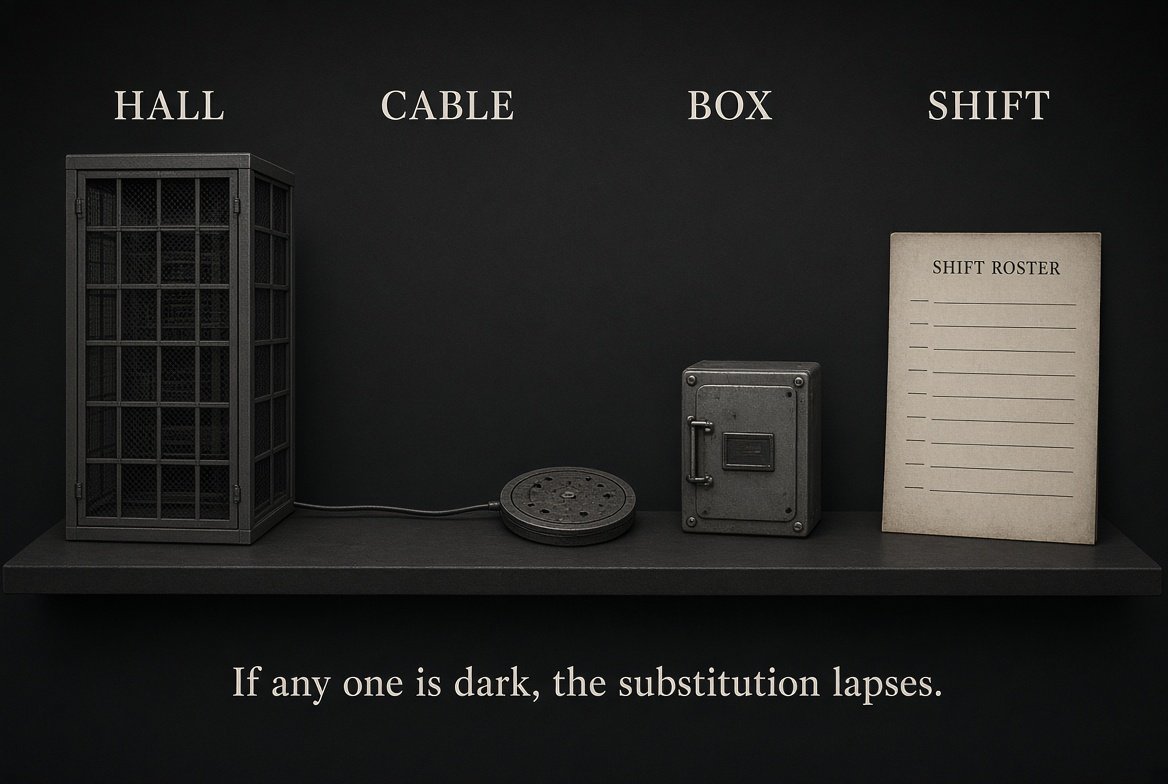
The Plant has asked the same question about the physical shape. Under the same stress, what must be standing for the legal shape to hold? The answer has come in four parts, and each was an essay. A token has a hall, with a landlord, a feed, a fence and a postcode. It has a cable, with a beach, a landing station, an exchange and a ship. It has a box, with a key, a quorum and a clock. And it has a shift, with a roster, a ritual and a technician. Remove any one of these, and the legal shape fails regardless of how well it is drafted. The drafting was September. The standing is October.
Run the terms of Cash Leg against them. The status language does not change. Substitutes, when ordinary conditions hold. Watch, when one field is already the weak channel. Does not substitute under stress, when exit, cash, crowd or basis would not survive the stated shock.
Exit is a promise that a holder can leave. It requires a path, which is the cable, a destination, which is the hall, an authority to release the asset, which is the box, and someone to answer when the holder's instruction does not clear, which is the shift. A capped instant exit is a latency product, an authority product and a staffing product at the same moment. Instant exists only where the cable already is, only while the key can sign, and only while someone is awake to notice that it has not. The September field named the cap. October has named the three things the cap sits on. A cap with no signer, no path and no one on the rota is a sentence in a terms sheet.
Cash is the thing that needs none of them. A note handed across a counter needs no hall, no cable, no box and no shift. Its finality is the hand-over. Each of the four objects in this series is a cost that cash does not carry, and each is a cost that a token carries continuously. That is not an argument against the token. It is the price of what a token can do that cash cannot, which is move at distance, in volume and under rules. But the price is paid in buildings, in glass, in keys and in people, and a token that does not pay it is not a substitute for cash. It is a claim on someone who does. The classification has been stable since the first essay. The token lives with the deposit, not with the note. The shift is one more reason the deposit's continuity was always a purchased continuity.
The operator is the party that holds the plant together, and this series has been, in effect, a description of what the operator must be. The operator is a landlord's tenant, a carrier's customer, a custodian of keys and an employer of a night shift. The legal obligations of the operator in Cash Leg are met, in the end, by those four things. A contract that promises redemption is carried out by a person in a room with a card, on a rota, inside an impact tolerance the supervisor can ask to see. GENIUS and the ROAD to Housing Act decided who may issue. They did not staff the 03:00 line, and they did not put a jointer on a ship.
Basis is the gap between the token and the thing it claims to equal. It is the market's continuous estimate of whether the plant will be there. When the hall is dark, the basis widens by the probability and duration of the dark. When the cable is cut, the basis reflects the lost path. When the box cannot sign, the basis is the price of the missing authority. When the shift is thin, the basis carries the risk that no one will pick up. A token trades at par to the degree that the market believes all four will hold, and it trades at a discount in proportion to the doubt. The doubt is not a sentiment. It is a roster with a gap, a ship in the wrong ocean, a quorum that cannot fly, a landlord whose feed has failed. September priced the doubt in law. October prices it in plant.
Crowd, which September treated as holder concentration, has acquired three more addresses. Landlord concentration was the hall. Path concentration was the cable. Key concentration was the box. Shift concentration is this essay. A tight holder set, in a tight region, on thirteen Atlantic systems, behind one quorum, watched by a team of ten, is one crowd even when the validator count is large. The May 2023 patches were written by a small number of people. That is not a scandal. It is the size of the shift that client diversity, properly done, still requires.
Stated plainly, then: what has to exist in the world before a token can substitute for anything is a hall, a cable, a box and a shift, and all four, at once, for as long as the substitution is meant to last. They can be engineered, contracted, insured and rehearsed. None of them can be assumed. The test that Cash Leg applies to the law and the test that The Plant applies to the world are the same, and they have the same shape. If the thing goes dark, what is left?
| Shock | What still works | What the holder can do | Status |
|---|---|---|---|
| Rota gap at 03:00 | The machines, until they don't | Wait for a name that is not on the line | Watch. A tolerance with no person is a sentence |
| Quorum shown a false screen | The mathematics | Watch a valid signature do the wrong thing | Does not substitute. Dual control held |
| Last mover cannot reach the door | The runbook | Nothing the screen can finish | Does not substitute under stress, for that hour |
| Client bug, chain still producing blocks | The sequence | Hold an unfinalised entry | Watch, then does not substitute for a use that needed finality that night |
| Compliance pause, by policy | The ledger entry | Nothing, at that address | By design. The person is in the object |
| Hall, cable, box or shift dark | The other three | A claim on someone who does | Does not substitute. The series in one line |
| Note across a counter | The hand | The hand | The thing the token does not replace |
Figure 5. The same test, applied to the shift, and to the series.
IX. What the four essays were
The hall established that a token is an entry in a machine in a building with a landlord, a grid connection and a postcode. About 64 per cent of discoverable Ethereum nodes sit in cloud or enterprise facilities. A hall that goes dark takes the entry with it, for as long as it is dark.
The cable established that the building has neighbours, chosen by light. Thirteen Atlantic systems, seventeen crossing segments, a tested 58.95 milliseconds from Slough to Secaucus, and a repair fleet of which fewer than twenty ships do the work as their trade. Instant is a path. A path exists only where the glass already is.
The box established that authority and the hour are not the ledger. A signing box, a quorum of three of seven in the public ceremony and something smaller and less published in a bank, a roof antenna disciplined to a government constellation, a 100-microsecond ceiling under RTS 25. A lost key cannot be recovered by any rule. A false hour can, and only after the damage.
The shift establishes that none of the three runs itself in the sense the vocabulary claims. A roster, a checklist, a technician, a jointer, a compliance officer, a second signer who may still be shown the wrong bytes. Bainbridge's irony is the shape: the better the automation, the rarer and more consequential the person who remains.
Together they are the plant. A token that substitutes does so because all four are standing. A token that is described as having no plant is a token whose plant has been left out of the description. The leaving-out is the error this month was written against.
End of the series.
Notes
1. PRA Supervisory Statement SS1/21, Operational resilience: Impact tolerances for important business services, and the accompanying Operational Resilience Parts, in force 31 March 2022. An impact tolerance is the maximum tolerable disruption to an important business service, measured by time, set at the point where further disruption would threaten safety and soundness or UK financial stability. It is to be set on the assumption that disruption occurs. The FCA framework has the same shape for the firms it supervises.
2. Regulation (EU) 2022/2554, the Digital Operational Resilience Act. Entered into force 16 January 2023. Applies in full from 17 January 2025, with no transitional relief. ICT risk management, major-incident reporting, resilience testing, and oversight of ICT third parties. The two-hour figure in the essay remains the PFMI recovery language used in Essay 01, not a DORA number.
3. World Health Organization Surgical Safety Checklist, first edition 2008, second 2009, developed under Atul Gawande's leadership in the Safe Surgery Saves Lives programme. Nineteen items, three moments. Aviation's earlier adoption of the checklist is the precedent the surgical literature itself cites. The analogy is the mechanism (a written step that a skilled person is not permitted to skip) not a claim that custody and surgery fail in the same way.
4. Bybit, 21 February 2025. 401,347 ETH and other assets, more than $1.4 billion. NCC Group technical analysis and Bybit's forensic account: signers approved what the Safe{Wallet} interface showed as a routine transfer; the signed transaction changed the wallet implementation. FBI attribution to Lazarus, tracked as TraderTraitor. Carried forward from Essay 03. The mathematics held.
5. Meta, "More details about the October 4 outage," Engineering at Meta, 5 October 2021, Santosh Janardhan. Routine maintenance command, audit tool failed to stop it, backbone disconnected, DNS servers withdrew BGP advertisements and became unreachable. Out-of-band access also down. Engineers sent onsite; physical and system security, and the need to activate secure access protocols, added time. Duration widely reported as more than six hours. The door-lock detail is the company's own: access was slowed by the security designed into the facilities, and the tools used to repair the fault depended on the network that had failed.
6. TeleGeography and Infra-Analytics, The Future of Submarine Cable Maintenance, for the SubOptic Association, June 2025. Global lay-and-maintain fleet roughly sixty vessels; fewer than twenty exclusively on repair, in the Scientific American account of the study. About two-thirds of the maintenance fleet at end of working life by 2040. Replacement on the order of $3 billion over fifteen years. The essay drops the unsourced "few thousand people."
7. Ethereum mainnet finality, 11–12 May 2023. Offchain Labs / Prysm post-mortem (Nishant Das, Terence Tsao, Preston Van Loon and others): first incident Thursday 11 May from about 20:19 UTC, finality delayed across about four epochs, participation to the low forties, recovery in about twenty-five minutes; second incident Friday 12 May, longer, about eight or nine epochs, from about 17:20 to 18:24 UTC, with an inactivity penalty. Cause: resource exhaustion on valid-but-old attestations in Prysm, related issue in Teku. Prysm v4.0.4 carried the fix. Patched versions' rollout reported from 19 May. Blocks continued. No reversals. Glassnode: on the order of 253 missed blocks over the two days.
8. AWS us-east-1, 19–20 October 2025. Opening cause a latent defect in DynamoDB DNS automation. Then EC2 instance-launch subsystem impairment, then Network Load Balancer health-check failures. Amazon updates: DynamoDB DNS identified in the small hours of 20 October Pacific, resolved 02:24; NLB health checks recovered 09:38; services normal later that afternoon, with a backlog. Overall event on the order of fourteen and a half hours. Coinbase among the affected, as noted in Essay 01.
9. USDC freeze (blacklist) function, as described by Circle: a contract function that blocks an address from sending or receiving, used for sanctions and law enforcement, with the frozen set published. The example is the regulated, permissioned case. It is not a claim about every token. A token with no pause has made the other choice, and the essay records both.
10. Lisanne Bainbridge, "Ironies of Automation," Automatica, vol. 19, no. 6, 1983, pp. 775–779. The central irony: automation is introduced because the human is judged unreliable, and the result is a deeper dependence on a highly skilled human at the moment of failure, which is the moment they are least practised. The most successful automated systems may need the greatest investment in the operator.
End of The Plant. November is a different object.